


Ukraine-US talks to continue in Berlin as Ukraine willing to drop Nato ambitions – Europe live | Europe
Morning opening: Crunch time
Jakub Krupa
Key Ukraine-US talks are set to continue in Berlin today after five hours of negotiations on Sunday, with a group of European leaders later joining the Ukrainian leader, Volodymyr Zelenskyy, to show their solidarity with Kyiv.
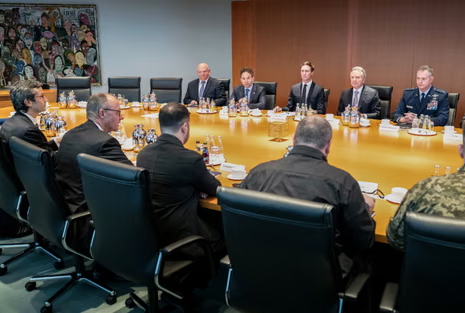
Once the talks with the US are concluded, the mini-summit will bring together Britain’s Keir Starmer, Denmark’s Mette Frederiksen, Finland’s Alexander Stubb, Norway’s Jonas Gahr Støre, the Netherlands’s Dick Schoof, Poland’s Donald Tusk, Sweden’s Ulf Kristersson, as well as top EU and Nato officials.
Europe’s Trump whisperer and his occasional golf partner, Finland’s Stubb, told journalists on Sunday that “we’re probably closer to a peace agreement than we have been at any time during these four years.”
US envoy Steve Witkoff also said that “a lot of progress was made” during the Sunday talks.
But some key questions still remain and are believed to do with Ukrainian territorial concessions in the contested east, and crucial security guarantees to avoid a third aggression from Russia. Moscow has been publicly dismissive of any calls put forward by Ukraine’s European partners so far.
Today’s talks with the US and the mini-summit in Berlin – set to be attended by seven European leaders, and top figures in the EU and Nato – come just days before the key European Council summit in Brussels later this weekend, which will decide on the proposal of using frozen Russian funds to fund Ukraine through a reparations loan.
Over the weekend, new Czech prime minister Andrej Babiš has joined the growing group of countries critical of the proposal, led by Belgium and supported by Italy. “We will not take guarantees for anything nor put any money in,” he said on Saturday.
It looks like a decisive week for the EU and its ability to influence the end of the Ukraine war – first with Germany working together with Ukraine to put the European arguments to the US, and then by a show of European unity in support of Kyiv, and second with the much-anticipated decision on the reparations loan.
Whether they will succeed in making progress on either of the two things remains to be seen.
But US president Donald Trump, who only last week branded EU leaders as weak and indecisive, will be certainly looking at their actions to see if they want to challenge his thinking about them.
I will bring you all the key updates throughout the day.
It’s Monday, 15 December 2025, it’s Jakub Krupa here, and this is Europe Live.
Good morning.
Key events
Moving ahead with EU plan to fund Ukraine using frozen Russian assets ‘won’t be very easy,’ EU foreign policy chief says amid Belgium’s opposition

Jennifer Rankin
in Brussels
The EU’s foreign policy chief has said it would not be easy to move forward with the Russian frozen assets plan to finance Ukraine without the say-so of Belgium, which holds most of the Kremlin’s money.
Kaja Kallas came close to suggesting Belgium had an effective veto over the decision on whether to use €210bn Russian frozen assets to finance Ukraine. The decision, to be taken by EU leaders on Thursday, requires only a weighted majority of EU countries: 55% of EU member states representing 65% of the population.
Days after Donald Trump denounced European leaders as “weak”, the EU faces a make-or-break week, with the decision on funding Kyiv a crucial test of its resolve on Ukraine.
But Kallas suggested EU backers of the frozen assets plan would be reluctant to outvote Belgium, which holds €185bn of the assets at the Euroclear central securities depository in Brussels.
“Of course, we have the QMV decision, but without Belgium, I think it would be increasingly… it wouldn’t be very easy because they have the majority of the assets. And I think it is important that they are on board whatever we do.”
Belgium, backed by Bulgaria, Italy and Malta, has urged the rest of the EU to look seriously at an alternative finance plan for Ukraine: joint EU borrowing secured against unallocated funds in the EU budget.
Unlike the reparations loan idea, common borrowing requires unanimity and Hungary has already indicated it would not agree.
Kallas said other funding options were “not really flying”. She recalled her experience as Estonian’s prime minister when she floated the idea of common borrowing for Ukraine: “It was two years ago when I proposed the Eurobonds, it didn’t fly because you need everybody on board.”
She was speaking ahead of a meeting on Monday of EU foreign ministers in Brussels, who are expected to sign off further tightening of sanctions against Russia. Kallas said 40 vessels and “enablers” would be added to the EU’s shadow fleet sanctions list, which aims to choke off trade in Russian oil traded above an international price cap, carried by ageing tankers with murky ownership structures.
Being listed means vessels cannot obtain insurance or access to ports in the EU. By 23 October the EU had listed 557 vessels, but officials admit the fleet is constantly being renewed.
Meanwhile, EU’s foreign ministers are meeting in Brussels.
Let’s cross to Jennifer Rankin, who is keeping an eye on their discussions.
‘Great deal of work under way,’ Zelenskyy says after morning talk with Finland’s Stubb
And in the last few minutes, Zelenskyy has published a short summary of his talks with Finland’s influential Alexander Stubb this morning.
He said the pair had a “good meeting” as “there is a great deal of work under way on the diplomatic track.”
“We also coordinated our joint positions ahead of today’s meetings with partners in Berlin and agreed on the next steps,” he said.
He also thanked Finland for its support and contribution to military purchases through Nato’s Prioritised Ukraine Requirements List, or Purl.
During this year Stubb emerged as one of the very few European leaders that seem to have access to – and the ear of – Trump and his team, playing a critical role in Europe’s efforts to influence the negotiations.
Ukraine still wants ‘Article 5-like’ security guarantees, Zelenskyy says
In his remarks to reporters after Sunday’s talks, Zelenskyy said that while Ukraine was prepared to drop its Nato aspirations, it would still require “Article 5-like” security guarantees from the US and European partners.
Article 5 is Nato’s collective defence clause which essentially says “that an armed attack against one or more of them in Europe or North America shall be considered an attack against them all”.
It remains to be seen if that’d be accepted by the US, and if so, how they would go about convincing Moscow to accept it as part of the settlement.
Ukraine not joining Nato fundamental issue for Russia, Kremlin says
The Kremlin said on Monday that Ukraine not joining Nato was a fundamental question in talks on a possible peace settlement.
Kremlin’s spokesperson Dmitry Peskov said that Russia expects an update from the US after its talks with European countries and Ukraine in Berlin.
Reuters noted that Russian president Vladimir Putin has repeatedly demanded Ukraine officially renounce its Nato ambitions and withdraw troops from the about 10% of Donbas which Kyiv still controls. Moscow has also said Ukraine must be a neutral country and no Nato troops can be stationed in Ukraine.
Over the weekend, Ukraine’s Volodymyr Zelenskyy has offered to drop Ukraine’s aspirations to join Nato, as he held first talks with US envoys in Berlin on Sunday.
The move marks a big shift for Ukraine, which has fought to join Nato as a safeguard against Russian attacks and has such an aspiration included in its constitution. It also meets one of Russia’s war aims, although Kyiv has so far held firm against ceding territory to Moscow.
Morning opening: Crunch time

Jakub Krupa
Key Ukraine-US talks are set to continue in Berlin today after five hours of negotiations on Sunday, with a group of European leaders later joining the Ukrainian leader, Volodymyr Zelenskyy, to show their solidarity with Kyiv.
Once the talks with the US are concluded, the mini-summit will bring together Britain’s Keir Starmer, Denmark’s Mette Frederiksen, Finland’s Alexander Stubb, Norway’s Jonas Gahr Støre, the Netherlands’s Dick Schoof, Poland’s Donald Tusk, Sweden’s Ulf Kristersson, as well as top EU and Nato officials.
Europe’s Trump whisperer and his occasional golf partner, Finland’s Stubb, told journalists on Sunday that “we’re probably closer to a peace agreement than we have been at any time during these four years.”
US envoy Steve Witkoff also said that “a lot of progress was made” during the Sunday talks.
But some key questions still remain and are believed to do with Ukrainian territorial concessions in the contested east, and crucial security guarantees to avoid a third aggression from Russia. Moscow has been publicly dismissive of any calls put forward by Ukraine’s European partners so far.
Today’s talks with the US and the mini-summit in Berlin – set to be attended by seven European leaders, and top figures in the EU and Nato – come just days before the key European Council summit in Brussels later this weekend, which will decide on the proposal of using frozen Russian funds to fund Ukraine through a reparations loan.
Over the weekend, new Czech prime minister Andrej Babiš has joined the growing group of countries critical of the proposal, led by Belgium and supported by Italy. “We will not take guarantees for anything nor put any money in,” he said on Saturday.
It looks like a decisive week for the EU and its ability to influence the end of the Ukraine war – first with Germany working together with Ukraine to put the European arguments to the US, and then by a show of European unity in support of Kyiv, and second with the much-anticipated decision on the reparations loan.
Whether they will succeed in making progress on either of the two things remains to be seen.
But US president Donald Trump, who only last week branded EU leaders as weak and indecisive, will be certainly looking at their actions to see if they want to challenge his thinking about them.
I will bring you all the key updates throughout the day.
It’s Monday, 15 December 2025, it’s Jakub Krupa here, and this is Europe Live.
Good morning.
Source: www.theguardian.com
Published: 2025-12-15 16:22:00
Tags:
This article was automatically curated from public sources. For full details, visit the original source link above.