


Tech Explained: Here’s a simplified explanation of the latest technology update around Tech Explained: The Problem in Legal Tech No One is Talking About – Artificial Lawyer in Simple Termsand what it means for users..
By Aatish Nayak, VP Product, Harvey.
Across firms and in-house teams, generative AI has rapidly become part of everyday legal work. Our recent global survey found that 80% of lawyers now use AI at least weekly, and 40% use it several times per day — for both personal and professional use.
But as we looked more closely at how lawyers actually work day-to-day, we realized something was missing from the legal industry conversation. AI use may be increasing, but its availability is not aligned with where legal work is performed. Lawyers are highly mobile. Their AI tools, for the most part, are not.
To understand the implications of this mismatch, we commissioned an independent study of 200 legal professionals across North America, EMEA, and APAC. The responses revealed a structural gap that has gone largely unexamined — one that now represents a clear opportunity to improve productivity, responsiveness, and workflow continuity across the profession.
Legal Work Has Become Almost Completely Mobile
While the legal industry has invested heavily in desktop-centric technology over the past two decades, the actual patterns of legal work have shifted dramatically. The data confirms what many have sensed: Lawyers now operate across a constant flow of environments, devices, and contexts.
- 86% of respondents rely on a smartphone or tablet as their primary device away from the desk.
- 89% check work messages multiple times outside standard hours.
- 90% use smartphones for work in some capacity.
This is not merely a reflection of hybrid work. It reflects the reality of modern legal practice: client communication spans time zones, negotiations unfold in hallways and conference rooms, and in-house teams support business partners who expect near-continuous access.
Legal work has become an always-on, multi-device discipline. Yet much of the technology ecosystem still assumes a static, desk-based workflow.
AI Adoption is Growing, but Hasn’t Followed Lawyers Into Mobile Contexts
One of the most striking findings from the study is the extent to which AI has embedded itself in daily legal routines. In-house teams, junior lawyers, and practitioners working across corporate and litigation matters reported high levels of comfort using AI for research, drafting, synthesis, and issue-spotting.
But when we examined where this AI usage occurs, a gap emerged.
- 75% of AI users primarily access AI on a laptop or desktop.
- Only 20% primarily use AI on a smartphone.
- Just 5% rely primarily on a tablet.
The contrast with mobile patterns is stark. Lawyers primarily use mobile devices away from their desks, but they rely on AI only when a laptop is available. In effect, the toolset that could meaningfully support judgment, preparation, and responsiveness is often inaccessible when those capabilities are most valuable.
This is not a matter of convenience. It is a matter of workflow design.
What the Data Signals About the Next Phase of Legal Work
Because legal work now moves fluidly across devices, the separation between mobile environments and AI introduces friction at key moments in legal practice. Lawyers routinely transition between meetings, travel, client interactions, and focused work — yet the tools that support reasoning, synthesis, and analysis remain largely confined to desktop settings.
This separation creates a fragmented workflow. Mobile devices support communication and coordination, while AI supports deeper analytical tasks, but according to the research, the two rarely intersect. As a result, AI’s benefits — faster early-stage reasoning, reduced cognitive load, and improved synthesis — tend to appear in isolated moments rather than as part of a continuous, end-to-end workflow.
Importantly, the study indicates that this gap is not driven by hesitation or lack of confidence. Seventy-seven percent of respondents report feeling somewhat or very confident using AI responsibly, and junior lawyers, in particular, anticipate significant change in how AI will shape their work over the next year. The limiting factor is not appetite, but access.
Together, these signals point to a broader transition in the legal sector’s digital maturity. The next phase will not be defined solely by smarter tools, but by systems that preserve context across environments — enabling lawyers to move seamlessly between devices without losing continuity, rigor, or governance.
Addressing the Mobile–AI Gap
If mobile work defines the rhythm of modern legal work, and AI defines its emerging analytical infrastructure, then bridging the two is essential. Closing the mobile–AI gap is ultimately about enabling continuity, and ensuring that insight, context, and reasoning are available wherever work occurs.
With mobile access to legal-grade AI, a range of everyday workflows that previously required a return to the desk become possible in real time. For example:
- A lawyer preparing for a meeting or negotiation can review summaries, surface relevant precedents, or revisit historical matter context while in transit or just before entering the room.
- A litigator moving between hearings can synthesize depositions or filings on the go, rather than deferring analysis until later.
- An in-house lawyer supporting fast-moving business decisions can review documents, generate summaries, or clarify issues as questions arise, without delaying guidance until they are back at a computer.
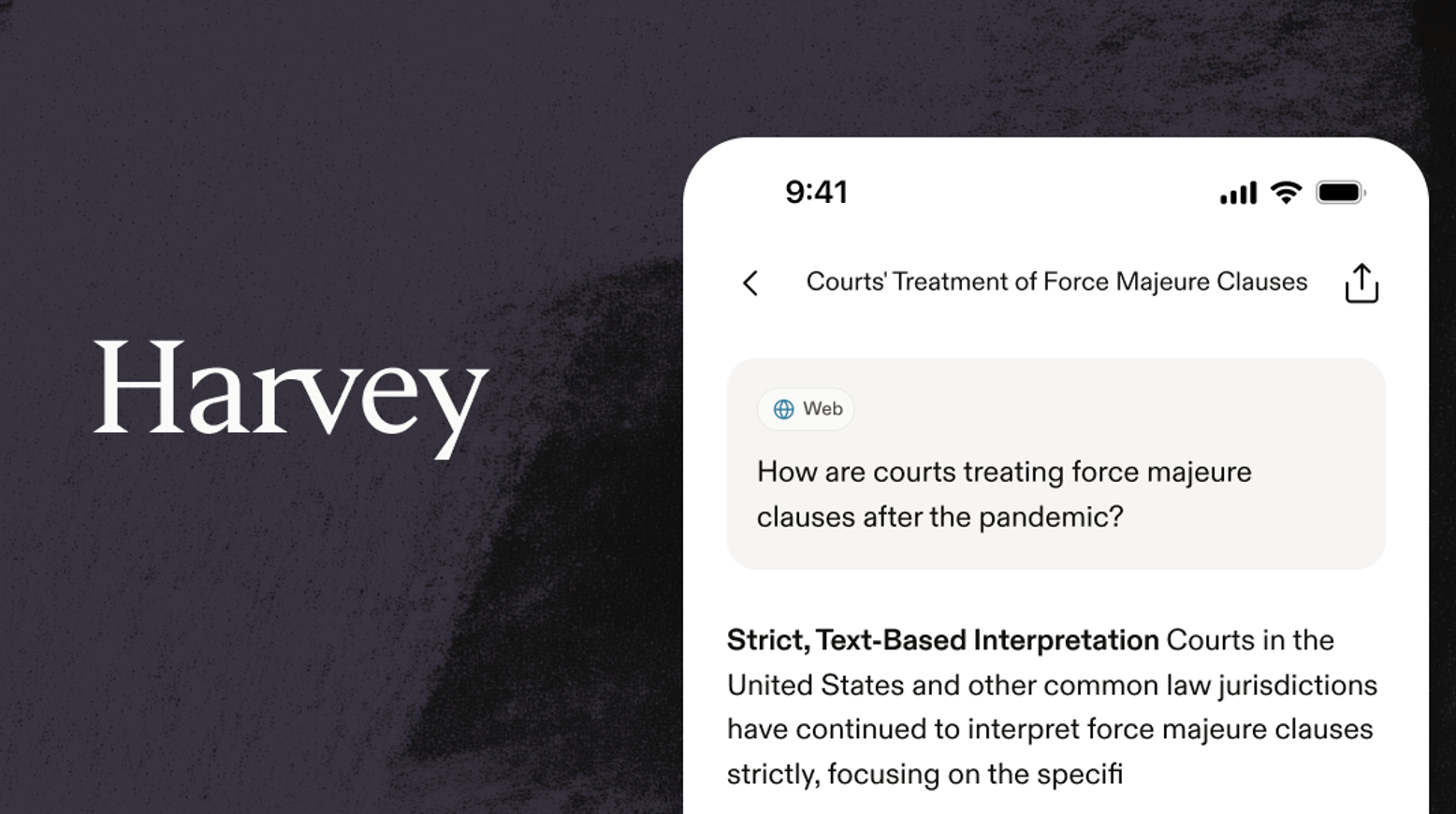
Harvey’s mobile application for iOS and Android is designed to support these types of workflows. It provides secure access to core Harvey capabilities — including dictation, scan-to-upload, Vault search, audio transcription, and synced matter history — on the devices lawyers already rely on throughout the day. The goal is not to replicate desktop work on a smaller screen, but to extend AI thoughtfully into the mobile contexts where legal work naturally occurs.
The findings of the mobile outlook report suggest an inflection point for the profession. Mobility is now foundational to legal practice. AI is mainstream. Ensuring that the two operate together — seamlessly and responsibly — represents the next step in the evolution of legal technology.
Learn more about Harvey Mobile here.
—
[ This is a sponsored thought leadership article by Harvey for Artificial Lawyer. ]
Discover more from Artificial Lawyer
Subscribe to get the latest posts sent to your email.