


Tech Explained: Here’s a simplified explanation of the latest technology update around Tech Explained: The great AI disconnect: Law firms & legal departments are not communicating about AI usage in Simple Termsand what it means for users..
As use of AI continues to surge, a recent TRI report finds law firms and corporate clients are seeing significant gaps in their visibility and measurement of AI usage
Key insights:
-
-
-
There’s an AI awareness gap — Most corporate legal professionals do not know whether their outside legal counsel are using AI in handling their client matters, leaving both law departments and their firms in a state of AI uncertainty.
-
A potential upcoming billing model shift — Efficiencies from AI usage could have a major impact on how many law firms bill matters; value-based billing may need to replace or supplement hourly billing for matters in which AI is used.
-
Transparency builds trust — Lack of visibility and ROI measurement could erode trust between law departments and their outside counsel. Dialogue and measurements can strengthen the firm/client relationship and create scenarios in which both sides can reap the benefits of AI usage.
-
-
While the use of AI is increasingly widespread for both corporate legal departments and their outside law firms, there is a considerable lack of dialogue and data-sharing between the two sides on usage, guidelines, and expectations regarding AI. This complicates efforts to maximize the benefits of using AI, and it also may be eroding trust between the two sides.
Significant gaps in visibility and measurement
The Thomson Reuters Institute’s (TRI’s) 2026 AI in Professional Services Report found major gaps in visibility and measurement between law firms and legal departments. The survey found that more than half of law firm respondents said their organizations are currently using or considering using GenAI. And more than half of corporate legal professionals surveyed said they feel that their outside legal firms should use AI on their matters.
However, more than two-thirds (68%) of corporate legal professionals admitted that they currently have no idea if their outside law firms are using AI or not.
In addition, neither side is effectively measuring whether or to what degree their use of AI is improving the delivery of legal services. Indeed, 85% of law firm respondents and 75% of corporate legal department respondents said their organizations are either not collecting ROI data on AI usage or are unsure if they are doing so.
Is your organization measuring the ROI of AI tools?
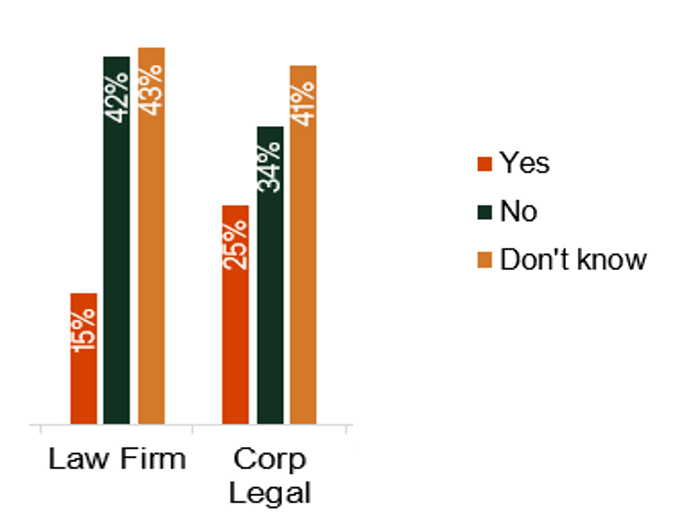
These visibility and measurement gaps make it difficult for both sides to plan how AI can and should be used in handling client matters. It also raises questions about how potential efficiencies from AI use will affect related factors such as how much firms charge for their services and how much clients are willing to pay. Half of legal professionals surveyed said they feel that AI is either a major threat or somewhat of a threat to billings and law firm revenues. Not surprisingly, the industry continues to wrestle with how to balance efficiency gains from AI against the limitations of the hourly billing model.
Concerns of corporate law departments
For corporate law departments, the lack of AI usage visibility and ROI measurement is producing a wide variety of responses, ranging from mild but growing concern all the way to outright suspicion about how law firms are using AI on their clients’ behalf. Law department respondents said that while they generally trust their outside counsel to make the right decisions regarding AI use and maintaining quality, most departments have not yet had conversations on those issues with their law firms, including how AI use will affect billing.
“Billing has remained the same as it did before,” noted one corporate legal department attorney. “So, either they are not using AI tools efficiently, or they are just doing double work.”
One corporate CLO was far more blunt in their assessment, especially given the lack of detailed discussions or data from firms: “I fear that firms will use AI to cut time, but continue to bill for the hypothetical amount of time a task would have taken without it. It’s dishonest, but so are many firms.”
One encouraging note is that, according to TRI’s 2025 Future of Professionals Report, 56% of law firm respondents said they are highly or moderately confident in their ability to articulate the value of AI to their clients. Despite law firms’ confidence in explaining the value of AI, however, the visibility gap illustrated in the 2026 AI in Professional Services Report indicates that law firms are not actually having those conversations with clients. Indeed, some corporate law department respondents suggested their outside counsel may be reluctant to discuss AI with them because of concerns about quality and accuracy. One even suggested that firms may feel threatened by AI.
More & better communication is needed
As difficult and complicated as discussions involving AI usage may be, they are also essential. Absent those discussions, trust between firms and clients may be eroding, potentially jeopardizing long-standing relationships.
Here are a few steps that both sides can take to build confidence around the use of AI:
For law firms —
-
- Communicate with clients — Hold discussions with clients that allow firms to detail how AI is being or will be used in client matters. Solicit feedback from clients about in which instances they would accept (or even demand) AI usage on different parts of a matter.
- Develop an AI billing strategy — Determine not only how AI usage is impacting billable hours, but also how that will interact with the firm’s billing and pricing strategy.
- Demonstrate and articulate value — Be prepared to explain billings in detail and answer client questions in terms of not only time and rates, but of value to the client. This includes both the value that AI brings to client engagement, but also the value that the firm brings above and beyond what technology provides, such as more freed-up time for lawyers to pursue value-added work.
For corporate law departments —
-
- Lead the conversation, if need be — About three-quarters of both law firm and legal department respondents said it is the firm’s responsibility to initiate discussions around AI usage. However, corporate law departments should not wait for their outside firms to start the conversation. Take the initiative and make sure firms’ delivery models and fee structures are clear regarding AI usage.
- Set expectations — Provide guidelines, expectations, or mandates on how and when AI will be used in handling client matters. This includes outlining specific use cases, data security protocols, and the human-in-the-loop oversight mechanisms that are used to ensure accuracy.
- Build an external-facing metrics program — Law departments need to accurately measure the efficiency gains their outside firms are achieving to ensure that they, as the client, are receiving a fair price for value received. Baselines can be established for how long various legal matters took historically and how much they cost. The baselines then can be compared against AI-enabled engagements to evaluate ROI and business impact. This also allows legal departments to more thoroughly explain those gains to their own stakeholders.
For both corporate law departments and their outside counsel, it is imperative to engage in thorough discussions and develop data that can inform better decision-making. Such dialogue and measurements can strengthen the firm/client relationship and create scenarios in which both sides can reap the benefits of AI use.