


Tech Explained: Here’s a simplified explanation of the latest technology update around Tech Explained: Korea Bets Big on Physical AI as BOS and UVify Close Record ₩147B Infrastructure Rounds – KoreaTechDesk in Simple Termsand what it means for users..
The focus of South Korea’s venture capital is shifting from generative software to the hardware that powers the physical world. While early 2026 began with a cautious return to deep tech fundamentals, the final week of February signaled a massive escalation in capital commitment. By channeling KRW 147 billion (USD 110 million) into just two infrastructure-heavy startups, investors are placing a high-stakes bet on Korea’s ability to dominate the global “Physical AI” supply chain.
Strategic Capital Floods Autonomous Chips and Swarm Drone Infrastructure
During the final week of February 2026, sixteen Korean startups successfully closed funding rounds across semiconductors, drones, and education. Two deals defined the period by their sheer scale and technical ambition. BOS Semiconductors and UVify collectively secured KRW 147 billion, marking a significant departure from the smaller, specialized rounds observed earlier in the quarter.
BOS Semiconductors, a mobility-focused AI System-on-Chip (SoC) designer, closed a KRW 87 billion (USD 65 million) Series A round. This represents one of the largest early-stage investments in the history of the Korean semiconductor ecosystem. The round attracted a massive syndicate of nineteen investors, including the Korea Development Bank (KDB), KB Investment, and STIC Ventures, signaling broad institutional consensus on the company’s roadmap.
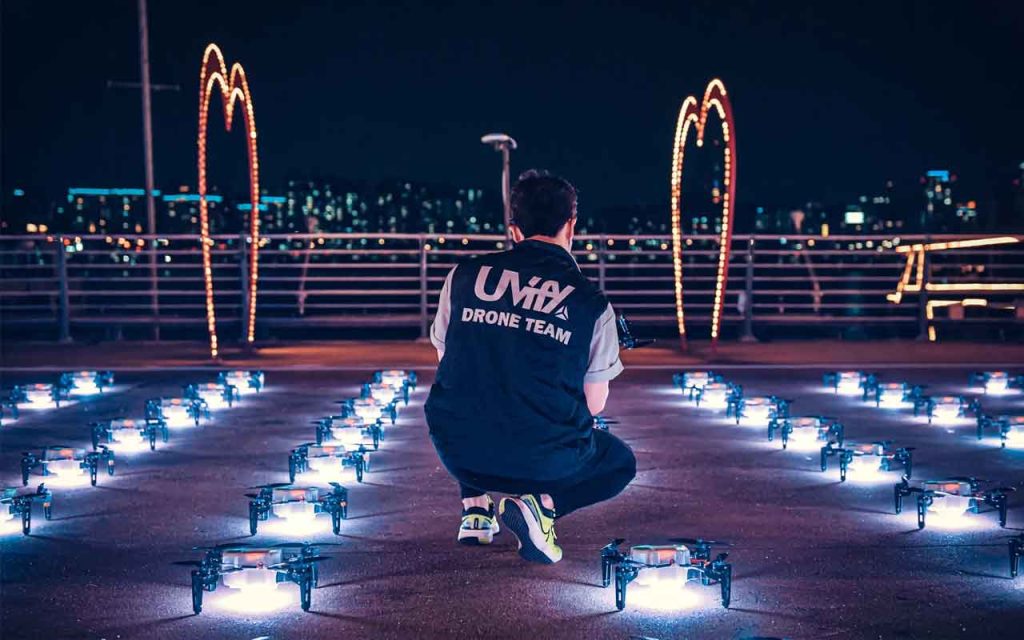
Simultaneously, UVify, a specialist in drone swarm flight and autonomous platforms, raised KRW 60 billion (USD 45 million). Led by Crit Ventures and NXC (the holding company of Nexon), this transaction stands as the largest single investment ever recorded for a drone firm in South Korea. The company has already gained international recognition, recently receiving the ‘Ten Million Dollar Export Tower’ for its global sales performance.
Beyond Software: The Infrastructure Powering the Physical AI Era
The rapid advancement of these two companies highlights a critical evolution in the Korean startup scene. BOS Semiconductors is currently developing “Eagle-N,” the world’s first chiplet-based AI accelerator designed specifically for automotive use. The chip can process 250 trillion operations per second (250 TOPS), providing the “brain” required for Level 4 and Level 5 autonomous driving.
UVify’s value proposition lies in its proprietary swarm technology and its unique position within the Dronecode Foundation. As the only Korean firm on the foundation’s board, UVify influences ‘PX4,’ the global open-source operating system for drones. Their ability to coordinate hundreds of drones in complex environments—demonstrated in shows for artists like G-Dragon and BLACKPINK—is now being translated into industrial and defense applications.
Industry Leaders Pivot Toward Commercialization and Global Scale
Park Jae-hong, CEO of BOS Semiconductors stated,
“The successful collaboration with global clients and this capital injection provide a clear green light for the commercialization of our autonomous driving semiconductors
We intend to lead the mobility AI chip market through aggressive global expansion.”
At the same time, Crit Ventures’ director Lee Dong-woo emphasized the rarity of such a firm:
“UVify is a rare example of a company that has proven world-class technical skills and commercialization capabilities in the global drone market. We will actively support their leap into a central player in the global industry.”
Ecosystem Significance: Korea as the Global Lab for Specialized Hardware
This surge in funding reflects a maturing ecosystem that is moving past the “platform winter” of 2025. While previous rounds reported identified a shift back to materials and AI caretech, these latest rounds suggest that the market is now ready to fund high-CapEx infrastructure.
For global investors and founders, this move confirms that Korea is positioning itself as the “Specialized Hardware Hub” of Asia. The involvement of corporate giants through SIs (Strategic Investors) and the Korea Development Bank suggests a synchronized effort to bridge the gap between R&D and global supply chain integration.
The focus on “Physical AI”—AI that interacts with and moves through the real world—is a calculated move. Korea is leveraging its existing strengths in semiconductor manufacturing and high-end engineering to create defensible moats against purely software-driven competitors.
Future Outlook: From Experimental R&D to Industrial Dominance
The success of BOS and UVify will likely serve as a litmus test for the “Venture Big 4 Nation Strategy.” If these firms can successfully integrate their hardware into global automotive and defense supply chains by 2028, it will validate the current government-led push into deep tech.
We are moving away from the era of “startup volume” and into an era of “structural durability.” Investors are no longer just looking for the next app; they are looking for the next standard in autonomous infrastructure.
Key Takeaway: The Physical AI Pivot in Korea
- Infrastructure Dominance: Capital is concentrating in AI hardware (SoC) and autonomous platforms (Drones) over software.
- BOS Semiconductors Milestone: The KRW 87B Series A for chiplet-based AI signals a major shift in how the automotive “brain” will be designed.
- UVify Global Footprint: The KRW 60B round for swarm technology proves that Korean drone tech is ready for industrial-scale export.
- Institutional Support: The heavy involvement of KDB and major VCs like STIC indicates a “National Team” approach to deep tech.
- Investment Climate: These rounds confirm that the early 2026 recovery has reached a phase of high-conviction, large-scale deployment.
Looking to connect with verified Korean companies building globally?
Explore curated company profiles and request direct introductions through beSUCCESS Connect.
– Stay Ahead in Korea’s Startup Scene –
Get real-time insights, funding updates, and policy shifts shaping Korea’s innovation ecosystem.
Follow KoreaTechDesk on LinkedIn, X (Twitter), Threads, Bluesky, Telegram, Facebook, and WhatsApp Channel.