Tech Explained: Here’s a simplified explanation of the latest technology update around Tech Explained: AI, Productivity, and Jobs – Sponsor Content in Simple Termsand what it means for users..
No new technology has ever been poised to transform the global economy as AI appears to be. Though studies suggest that AI could bring about many positive, widespread benefits, predicting its exact impacts is challenging. As adoption increases, we are faced with new questions: How will AI impact the workforce? How productive can an AI-enabled workforce be? What impact will increased productivity have on the economy?
Martin Baily, a senior fellow emeritus at the Brookings Institution and a former chairman of the Council of Economic Advisers, is a noted economist, thought leader, and adviser to industry. He has written extensively on productivity and AI. In a recent conver- sation about AI’s effects on the economy, he weighed in on some of these questions and helped us to envision AI’s potential impact on the global economy.
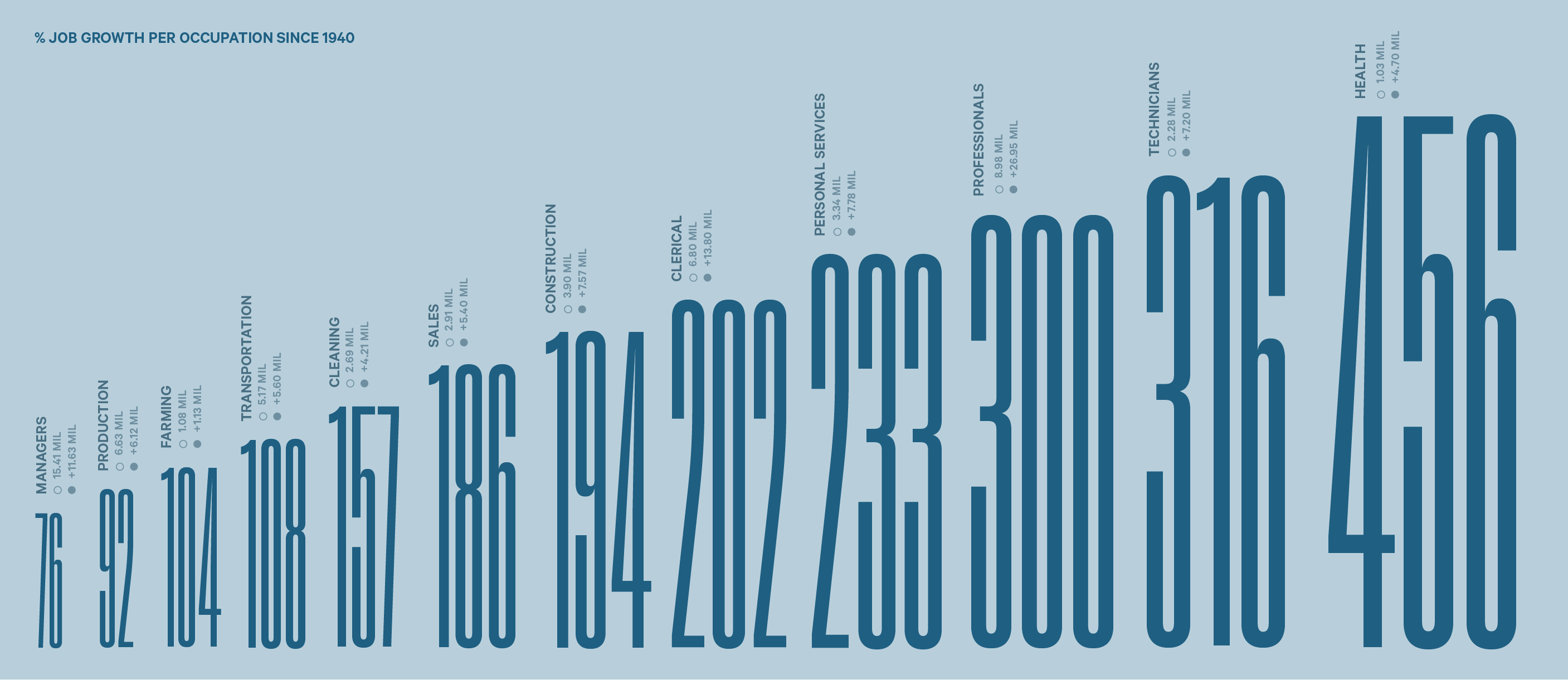
Technology reshapes jobs over time. Computers and the internet have reduced blue-collar roles while increasing jobs in professional fields—just as farm work dropped as production became more mechanized, creating new factory jobs.
Source: Deming, D.J., Ong, C., & Summers, L.H. (2025). “Technological Disruption in the Labor Market” (NBER Working Paper No. 33323). National Bureau of Economic Research.
Nathaniel Penn You’ve posited that generative AI is a general-purpose technology (GPT). History shows that GPTs (such as the steam engine and electricity) eventually create more jobs than they eliminate after being widely adopted. What do you see as the likeliest timeline to widespread adoption of AI in the public and private sectors?
Martin Baily Gen AI is being developed at a dazzling pace, with rapid improvements in algorithms and massive investment in computing infrastructure. However, the pace of AI diffusion and productive use will be slower than the media often suggests.
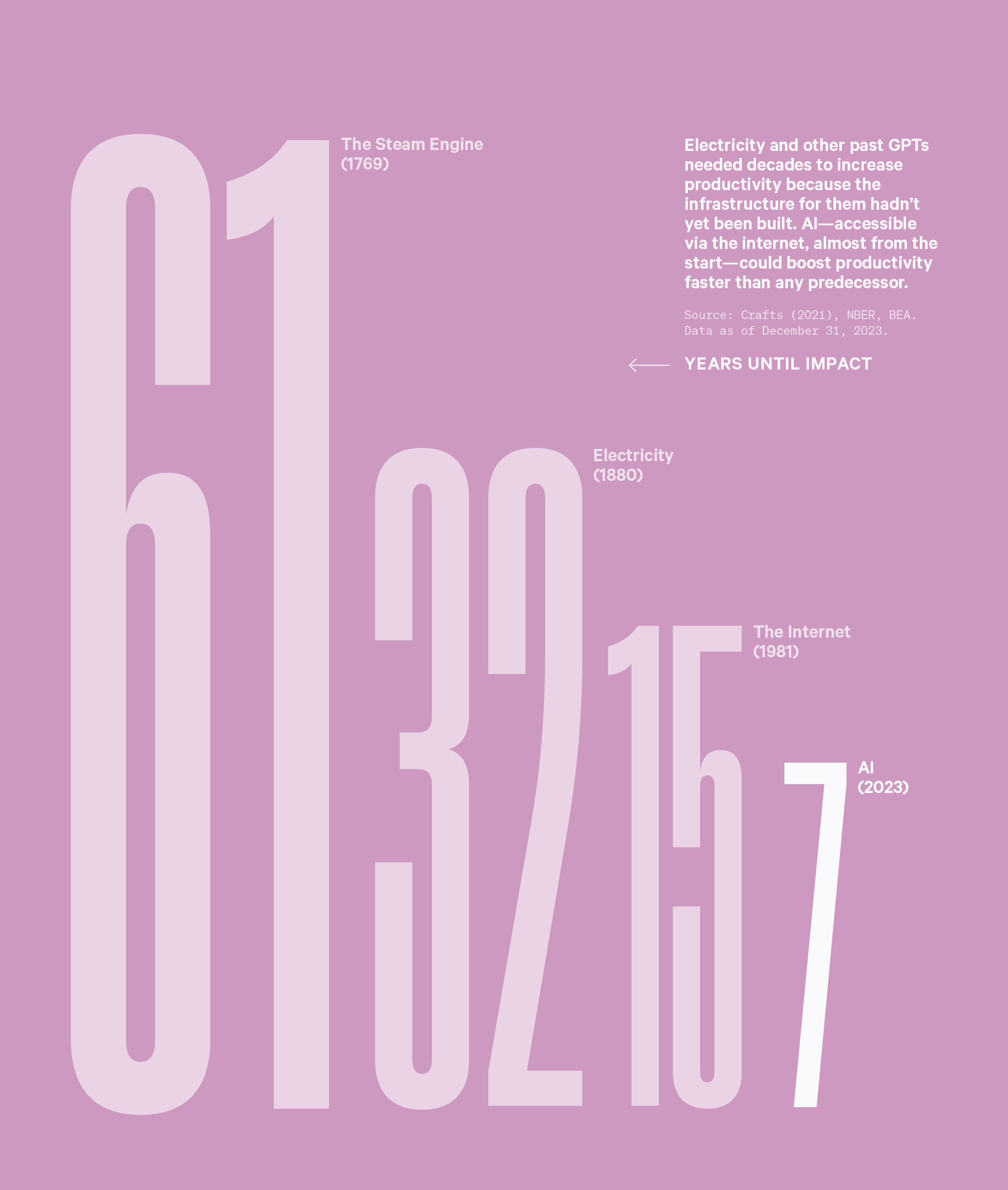
History tells us that previous technological changes took many years before there was a signifi- cant impact on productivity. The development of the electric motor and the dynamo (electricity generator), for example, took decades for widespread adoption and required businesses to redesign their business processes. With AI, we can expect an initial period of experimentation followed by organizational change and complementary innovation and investment.
Penn What effects do you believe AI adoption will have on the unemployment rate, and over what time frames would you expect these effects to peak and dissipate, respectively?
Baily For the past 50 years or so, the biggest labor market problem has been the relative decline in the demand for workers without college degrees or special skills. The decline in production-worker jobs in manufacturing is one aspect of this. There is conflicting evidence about whether AI will worsen this problem or whether its impact will be on more skilled workers, like computer coders or paralegals. An optimistic view is provided by Deming, Ong, and Summers (2025), who point out that historically there have been huge structural changes in the U.S. labor market, but that employment has remained strong as new jobs have replaced
the ones that have been lost.
My judgment is that the impact of AI on productivity will take 20 years or more. I do not see much impact on the unemployment rate, but the labor market could be impacted in other ways.
Penn A recent paper from the University of Pennsylvania’s Wharton School has very tentatively projected an AI-driven bump in produc- tivity and GDP of 1.5 percent by 2035, nearly 3 percent by 2055, and 3.7 percent by 2075. What are your thoughts on these projections? To put these numbers in perspective, is there a precedent for this kind of growth in U.S. economic history, and if so, when did
we last see it?
Baily Productivity growth is the key to overall economic growth and broad improvements in living standards. It has been growing at 1.5 percent a year lately, much slower than in some past periods. Faster productivity growth, if its benefits are applied well, would be a big help, generating greater resources to deal with poverty, the budget deficit, and the environment. There is a huge range of estimates of the likely impact of AI on productivity.
Is AI comparable to the light bulb, an important innovation that raised productivity but had essentially a onetime effect, or is it like the dynamo, which led to a series of knock-on innovations, such as electric motors and more efficient factory organizations, that had a bigger and longer-lasting impact on productivity? Then again, AI could be like the microscope, an innova- tion that greatly enhanced the technology of research itself and eventually paid off in stronger productivity.
To me, AI looks like both the dynamo (a GPT) and the microscope (called “an invention in the method of invention”). That suggests its long-term impact on productivity could be substantial.
Penn Different countries and regions are taking vastly different approaches to AI workforce policy. What early evidence do we have about which interventions (e.g., retraining programs) actually work? What role should businesses play in managing this transition?
Baily The northern European economies and Germany have apprenticeship programs to provide workplace skills, and they have retraining programs for workers that lose jobs. Those programs worked well for a long time, but the downtrend in the share of jobs in manufacturing that all advanced economies face, together with a lack of tax revenue, has stressed this economic model. If AI really causes a major disruption to existing employment patterns, Europe will have difficulty responding. Facing discontent among their workforces, governments would probably decide to slow down the adoption of AI and pay a productivity penalty.
Penn Would the potential emergence of artificial general intelligence substantially alter the way you’re envisioning AI’s impact on productivity?
Baily Keep in mind that a constant flow of innovation is required just to keep our current productivity growth trend of 1.5 percent a year going. AI could just
get folded into the current trend.
The U.S. labor force is now growing slowly and may start to decline because of the low birth rate and the decline in immigration. We do not need a lot of new jobs, but we do need jobs that fit the skills of our workforce. Gen AI may help if it can enhance the skills of not only the highly educated but also the workers who left school early. An important national priority is to direct government research dollars toward innovations in AI that help the workforce.
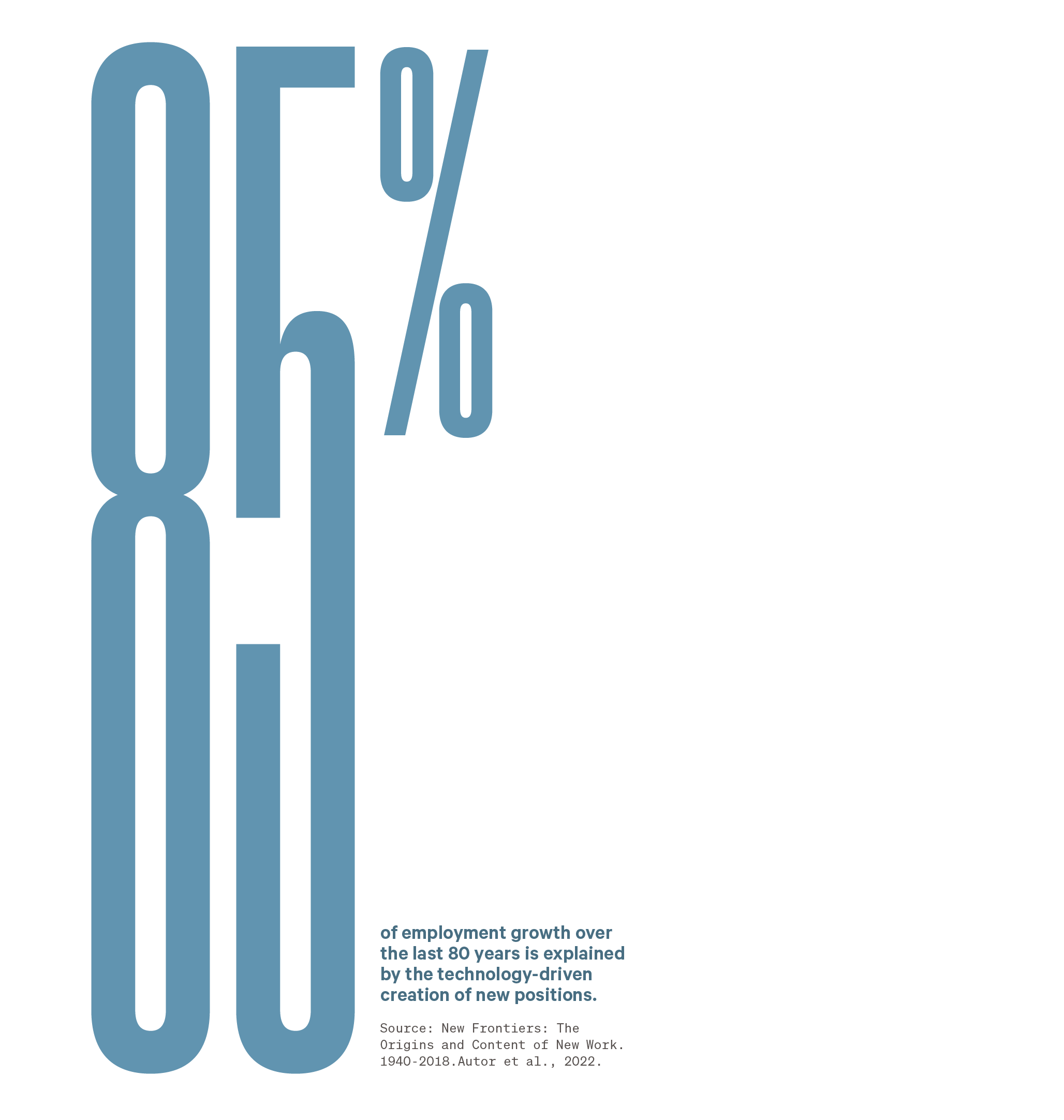
The majority of current employment is in job specialties introduced after 1940.
Historically, technology has created more roles than it has replaced.
Source: David Autor et al., “New Frontiers: The Origins and Content of New Work, 1940– 2018,” The Quarterly Journal of Economics 139, no. 3 (August 2024): 1,399–1,465.