


Tech Explained: Here’s a simplified explanation of the latest technology update around Tech Explained: A Chinese AI Startup Said It Tracked U.S. Stealth Bombers Over Iran. It Wasn’t What It Seemed. in Simple Termsand what it means for users..
The day after the operation, a little-known Chinese company said it had been watching anyway.
Jingan Technology, a Hangzhou-based defense AI startup, claimed on social media that its “Jingqi” system had “intercepted voice communications” and tracked the trajectories of four B-2A Spirits. Jingan called it a “real-time livestream of war, powered by AI.”
The post circulated widely in Chinese media, with state outlets touting how “a Hangzhou AI startup had tracked American forces.” Then the post disappeared. Last week, Jingan put up an edited version, without the B-2 intercept details, calling it an effort “to lower attention.”
In a March 2 social media post, Jingan claimed to have “fully reconstructed” the return flight path of a U.S. B-2 bomber and “successfully intercepted” related communications audio.
“This is a sign of growing private sector interest in China in combat support operations,” said David Lin, a former China technology policy official at the State Department and now senior director at the Virginia-based Special Competitive Studies Project. “The Chinese government is normally very sensitive about publicizing anything military. The fact that this company deemed it a safe space to brandish its wares tells you that military-civil fusion is becoming openly accepted inside China, which hasn’t always been the case.”
Jingan did not respond to multiple email requests for comment. But the Iran conflict has surfaced more examples.
Another Hangzhou AI startup, MizarVision, has released dozens of high-resolution satellite images over the past month showing American bases, fighter jets, warships and missile defense systems across the region. In a statement, the company credited the releases to “industry deregulation.” “Open-source intelligence needs an Eastern narrative,” it boasted.
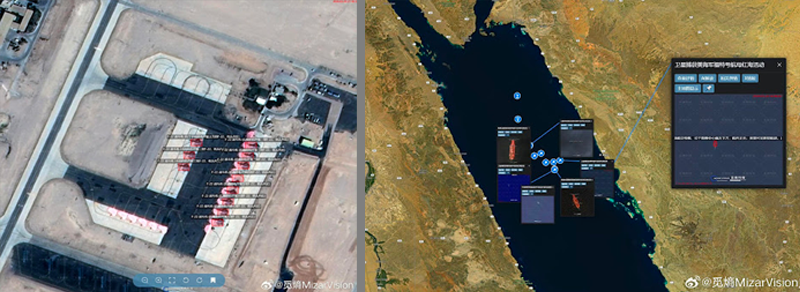
The left image, which MizarVision posted to Weibo on Feb. 26, shows 11 Lockheed Martin F-22 stealth fighters on the ramp at Israel’s Ovda air base. The right image, posted March 19, shows the USS Gerald R. Ford carrier strike group operating in the Red Sea, with a caption pledging to “continue tracking.”
That ambition has a Hangzhou address. The city that incubated Alibaba, DeepSeek and Unitree is ground zero for China’s bet that technology is the next arena of great power competition.
How Jingan Built the Machine
Jingan Technology is one more manifestation of that bet. Shi Qiaomu, who Chinese media say was an Alibaba-trained engineer, founded Jingan in 2021. Its initial pitch to investors was more modest: a company focused on “urban security intelligent technology,” its software enabling the remote control of drones and robot dogs for city surveillance and patrol.
By May 2025, however, Jingan’s goals appeared to have grown considerably.
“Our positioning is to be a provider of China’s new generation of defense technology,” Shi said then, at a government-hosted aerospace and emerging technology forum in Guiyang. The company was now focused, he said, “on defense artificial intelligence, benchmarking against America’s top new defense tech companies, building the next generation of intelligence systems and command-and-control systems.”
- Jingan’s leadership reflects that identity, too. Vice President Zhang Zhenkun is a former People’s Liberation Army (PLA) Rocket Force officer who was named Zhejiang Province’s “Model Veteran” in 2025, an honor that the company celebrated online. Before joining Jingan, Zhang worked at Alibaba as an AI-focused security expert, a press release for that award stated.
— David Lin, senior director at the Special Competitive Studies Project
- its Jingqi platform, an “open-source intelligence situational awareness system” that tracks aircraft, ships, satellites and military installations in real time.
- an “unmanned equipment command and control system” that integrates software across different companies.
- an unmanned “sentry” system that integrates radar, infrared and edge computing to guard bases and critical infrastructure.
Behind the shift: Government support and relationships.
Within its first three years, Jingan secured 6 million RMB in government R&D subsidies and 1.5 million RMB in rental support, certified under both Hangzhou’s AI Town and 5G Innovation Park programs, according to a company press release. A state-owned investment vehicle became a minority shareholder.
In 2022, it landed a security contract for the Asian Games, the highest-profile international event China had hosted since the covid-19 pandemic. In 2024, Jingan said it had raised more than 200 million RMB (roughly $29 million) and been named a Zhejiang Province seed unicorn, a designation that unlocks preferential investment and policy support.
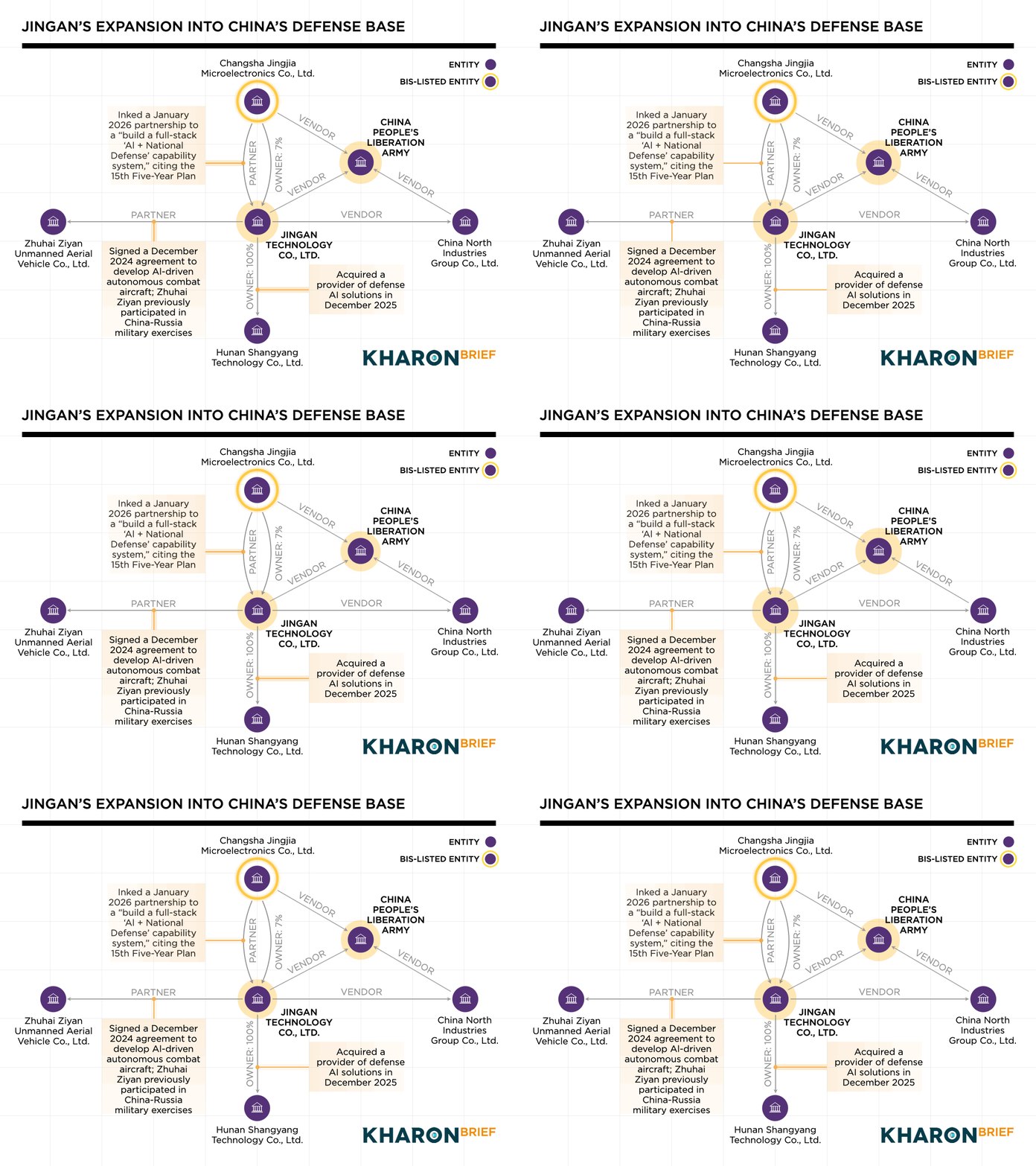
Now, it lists among its clients the PLA and the state-owned China North Industries Group, known as Norinco, which describes itself as “the main platform responsible for developing mechanized, digitized and intellectualized equipment for PLA.”
In practice: The subsidies on paper are only part of the picture. Local governments across China have long propped up homegrown firms with operating funds, free land and office space, noted Drew Thompson, a former U.S. Defense Department official on China policy and now a senior fellow at Singapore’s S. Rajaratnam School of International Studies.
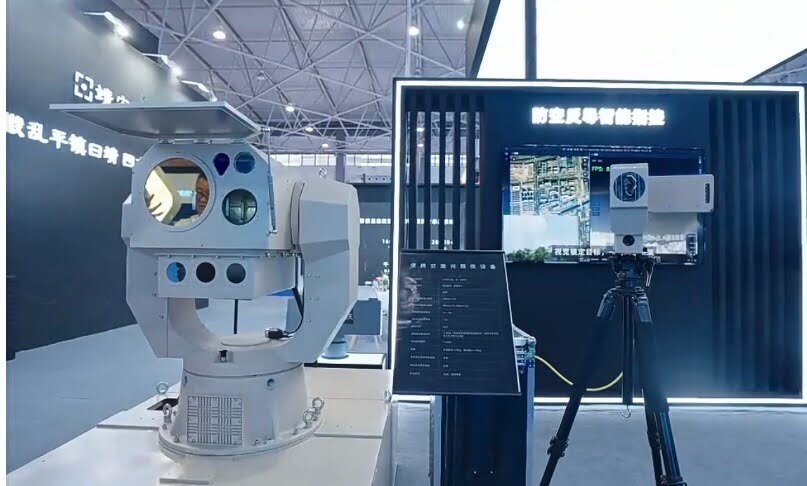
Jingan attended the China International Big Data Industry Expo, hosted by China’s National Data Administration, in August 2025, where it displayed a weapon system capable of using lasers to target drones. “At first, we only served the military,” a company representative said in a video while demonstrating the weapon. (Jingan)
- “That doesn’t necessarily make [Jingan] tech-savvy,” he said. “That makes them government-savvy.”
National stakes: China’s 15th Five-Year Plan, adopted this month, explicitly calls for accelerating the flow of commercial technology into military use, what Beijing calls a “fast-track channel” for civilian firms to feed into the defense industrial base. The approach breeds pressure and competition by design, Lin said, especially for startups like Jingan.
“By talking about [tracking U.S. military operations] publicly, this company activates the competitiveness of this space,” he said. “It has this effect that could be beneficial to China’s military civil fusion effort, to really pit these startups against each other.”
Over the past two years, Jingan has marched steadily deeper into China’s defense industrial base through partnerships, acquisitions and weapons development, a Kharon review found.
Loud B-2 Claims but a Real AI Race
It may be China’s national defense and AI competition that are behind Jingan’s B-2 bomber claims, experts said.
“What we’re seeing may say less about what these companies can actually do than about how urgently they want to be seen as relevant,” said Graham Webster, a Stanford University lecturer and research scholar focused on emerging technology in China and the U.S.
Reality check: B-2 bombers minimize their radar, infrared, acoustic and electromagnetic signatures. But they communicate via radio during takeoff and landing, and their callsigns flow through channels that are, by design, not secret: The day before Jingan posted the audio it claimed to have intercepted, aviation enthusiasts had already posted the same clip on X.
The B-2 audio that Jingan claimed to have “intercepted,” versus an aviation account’s post from the day before.
“Estimating the B-2’s route involves subjective judgment,” he said, “often based on past operations, likely from 2025’s Operation Midnight Hammer.”
Bigger picture: Past the interception claim, something more substantive comes into view.
Jingan says its real-time, globe-tracking Jingqi system draws on “hundreds of billions” of data points, signals intelligence, satellite imagery, and live weather and atmospheric feeds. The claims are impossible to verify independently, but “using AI to process large amounts of open-source data into intelligence tools is the future,” Wen said, “and we’re seeing Chinese startups eager to jump into this field.”
Two of the bottlenecks are capital and computing power, he added, because “geospatial analysis requires massive datasets.”
But “AI is a force multiplier,” said Lin. “If you combine that with the scale that China has—the population, the number of companies, the data available—the vector of potential impact becomes much wider.”
The most telling test, Lin said, is not whether defense-AI companies like Jingan can demonstrate some level of capability.
It’s whether the PLA will actually fold them into its operations—and start watching the U.S. through their lenses, too.
Read more from The Brief: