


The Smithsonian Environmental Research Center turned 60 this year. We’re celebrating with six of our favorite stories since 1965.
Smithsonian Libraries & Archives and Stephen Voss / Smithsonian
It’s been a wild six decades. The Smithsonian Environmental Research Center celebrated its 60th anniversary this past year. Since 1965, the site has gone from a remote field station on the western shore of Chesapeake Bay, without any full-time resident scientists of its own, to a cutting-edge research community with over 100 scientists and educators working around the world. As we bid farewell to our anniversary year, we dug into our archives to unearth some of our favorite discoveries and experiments from the past 60 years.
1. Fighting Pollution with Nature
In 1984, SERC ecologists made a game-changing discovery: If streamside forests stood between farms and rivers, they could filter out harmful chemicals before they reached Chesapeake Bay. Today, streamside forests and wetlands are key parts of plans to restore the entire Bay. In the decades that followed, SERC’s researchers made additional discoveries on mercury pollution, harmful algal blooms, low oxygen “dead zones” and urban streams. And in 2013, SERC planted its own 20,000-tree forest restoration, called BiodiversiTREE. The forest is still filtering pollution and yielding new discoveries today.
Blue crab (Callinectes sapidus) with a SERC tag for tracking. SERC Fisheries Conservation Lab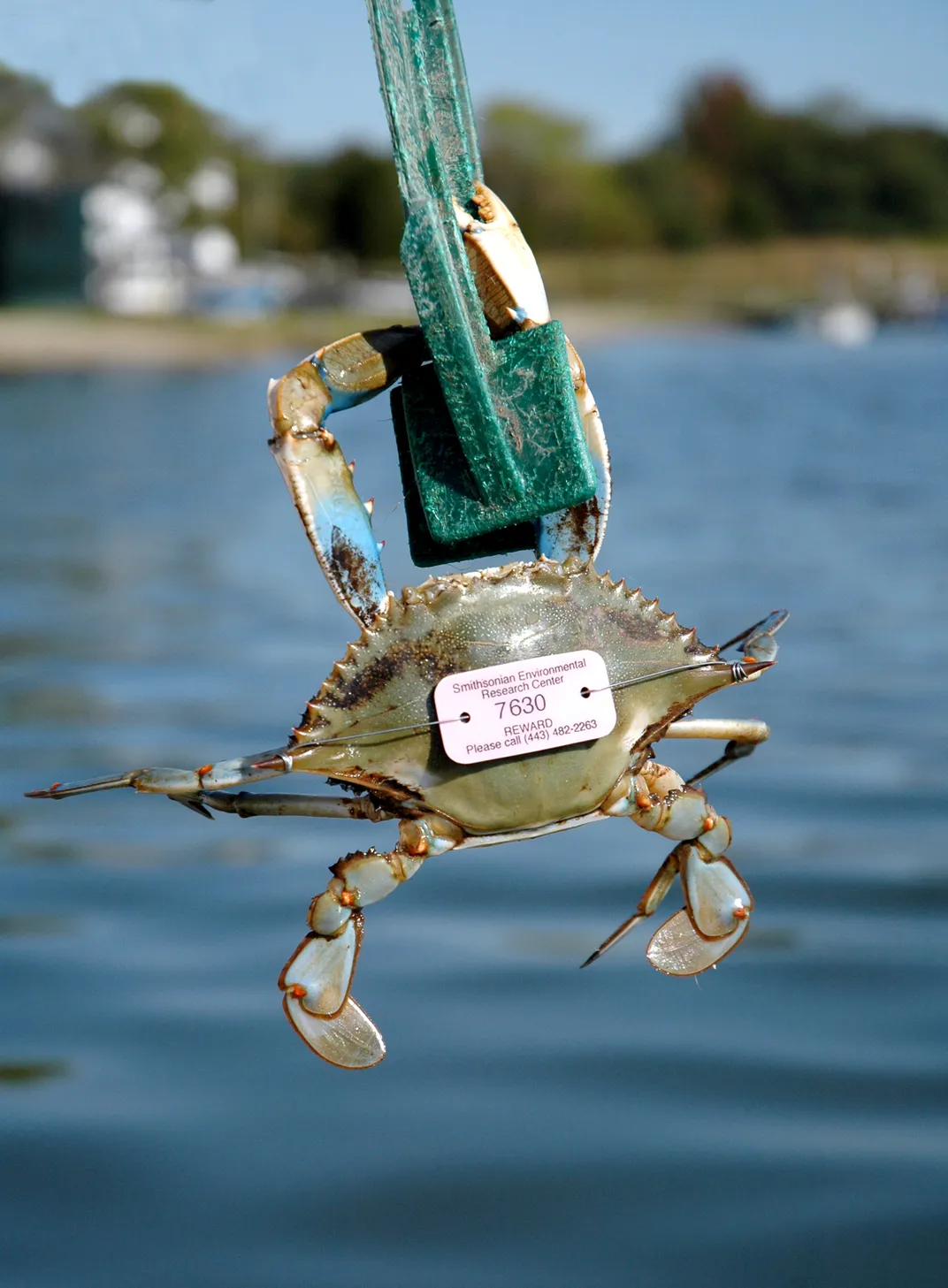
2. Rescuing Fisheries
No creature captures the heart of the Chesapeake like the blue crab. But in the early 1990s and 2000s, its future came dangerously close to ruin as numbers plummeted. Fortunately, SERC scientists had been tracking the crabs since 1981, before the annual Winter Dredge Survey that began in 1988. They realized the fishery depended on female crabs to spawn the next generation. In 2008, both Maryland and Virginia enacted new policies designed to protect female crabs. SERC biologists are still keeping tabs on the crabs’ health today.
SERC fisheries scientists are also tracking oyster sanctuaries. In 2021, they developed a new, low-cost way to check on the oysters: lowering a GoPro camera in the water. It’s a quicker, less destructive method than dredging or diving. They’ve even recruited local riverkeepers and volunteers to help, in a project called “Oyster Cam.” They’ve discovered that pairing sanctuaries with active restoration improves the oyster reefs’ health and attracts more fish and wildlife.
3. Climates of the Future
SERC created its Global Change Research Wetland in 1987. At the time, global warming was increasingly gaining acceptance among scientists. But the idea was just emerging for the wider public. The setup was simple: Double the carbon dioxide in experimental chambers and see how plants respond. Nearly four decades later, that project is the world’s longest continually running field experiment on plants and higher carbon dioxide.
The wetland houses even more futuristic experiments now, looking at rising temperatures, methane emissions, nutrient pollution and invasive plants. Nearby, a forest project known as TEMPEST runs futuristic flooding experiments, to simulate sea level rise and more extreme rainfall predicted for the East Coast.
Left: Bert Drake, creator of the Global Change Research Wetland, examines a wetland chamber in 1987. Right: SERC scientists Alia Al-Haj (left) and Genevieve Noyce on the Global Change Research Wetland in 2024. Eric Long / Smithsonian and Hampton Bridwell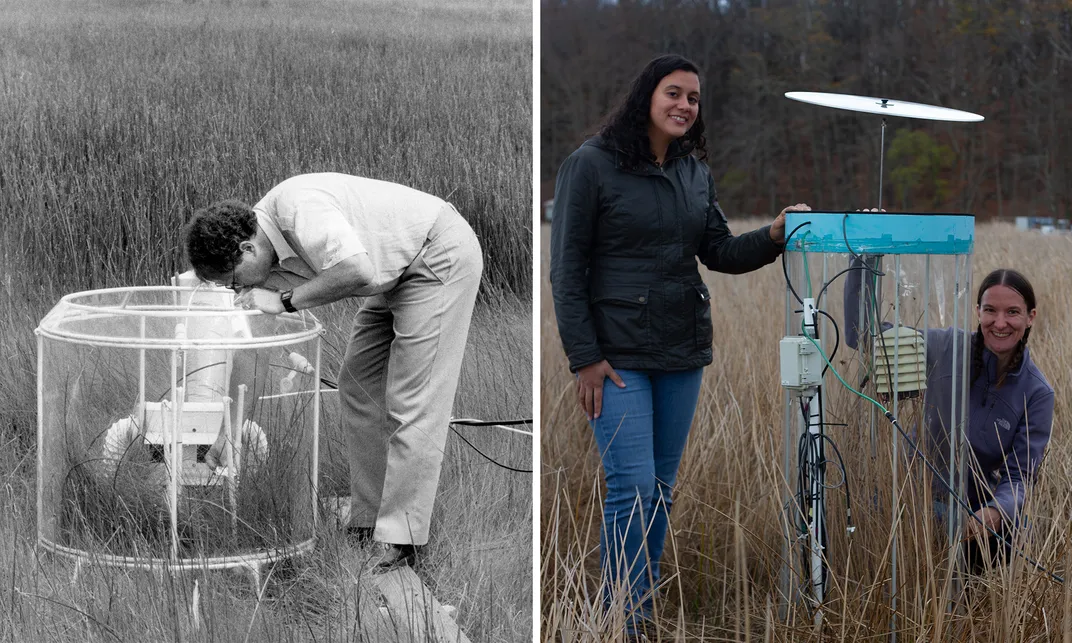
4. The Missing Connections in Conservation
Habitat loss is one of the biggest threats to species survival today. That’s one reason SERC takes a holistic approach to conservation. Its ecologists look not only at individual species, but also at the hidden connections they depend on to flourish. In 2012, SERC launched the North American Orchid Conservation Center, a coalition of over 60 organizations working to preserve the continent’s native orchids. Besides studying orchids and their pollinators, the center also identifies the essential fungi they need to grow and looks for potential restoration sites where those fungi already exist. SERC ecologists are also zeroing in on the benefits of protected areas both on land and at sea, and exploring non-traditional, community-based methods of conserving biodiversity.
5. Stopping Invasives Underwater
When Congress passed the National invasive Species Act in 1996, it called on SERC and the U.S. Coast Guard to track one of the most common ways they spread: in the ballast water massive ships carry for stability. Since then, the two agencies have monitored how every commercial ship entering the U.S. manages its ballast water to reduce the risk of carrying invaders, through the National Ballast Information Clearinghouse. The last decade has witnessed astounding progress: 97% of overseas vessels and 80% of coast-voyaging vessels now treat their ballast water. Most use on-board technologies like ultraviolet light or electrolysis.
6. Global Science on the Ground
Left to right: Ninon Martinez, Galento Galvez and Lisa Beers take a soil core as part of a collaborative blue carbon project with SERC in Belize. Jonathan Lefcheck / SERC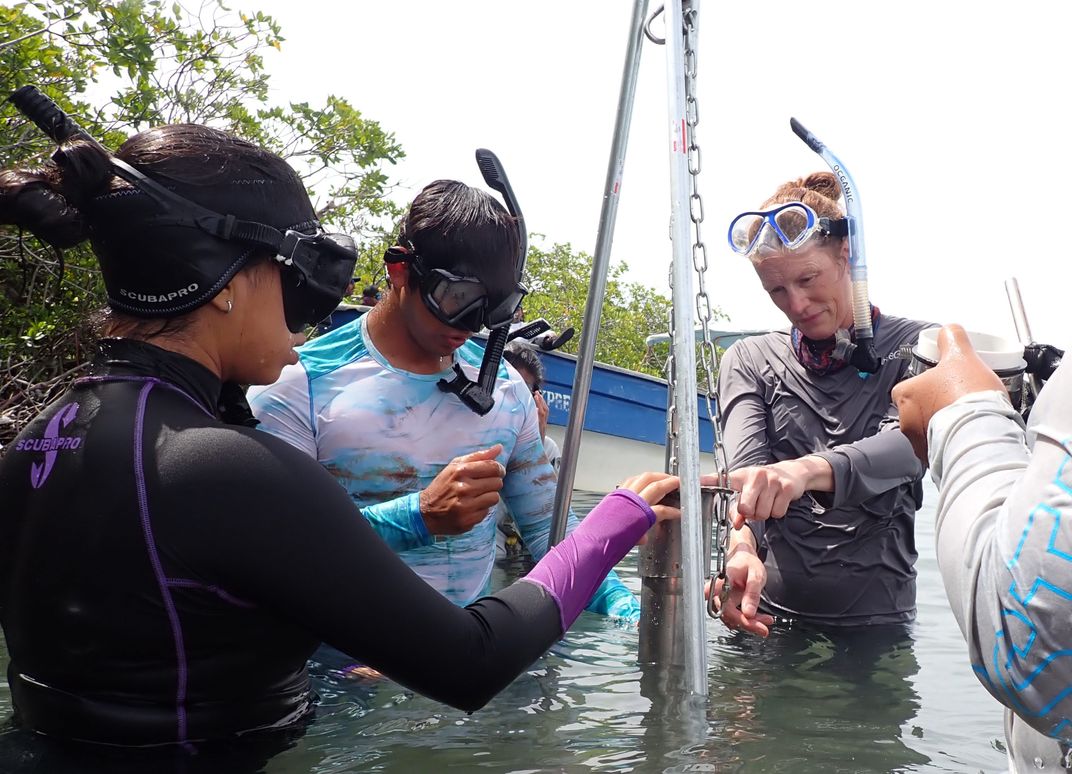
Blue carbon—the carbon stored in ecosystems like wetlands, mangroves and seagrasses—is a gold mine for nations looking to fight climate change. But getting real data on how much carbon they store is difficult. SERC scientists work alongside local communities in nations like Belize, Panama and Honduras, to get in-country estimates governments can use for climate adaptation plans. In 2023, SERC also launched the Coastal Carbon Library and Atlas, an open-access repository with blue carbon data from 70 countries.
SERC’s global reach includes coastal oceans and forests as well. Through networks like the Marine Global Earth Observatory (headquartered at SERC) and the Forest Global Earth Observatory (headquartered at the Smithsonian Tropical Research Institute in Panama), countries worldwide are joining the Smithsonian to track biodiversity. Together, these organizations are creating a more complete picture of how life on Earth is evolving and what these changes mean for people and communities.
Categories
Archive