

Explained: This article explains the political background, key decisions, and possible outcomes related to Explained : The War on Iran Comes to the Indian Ocean and Its Impact and why it matters right now.
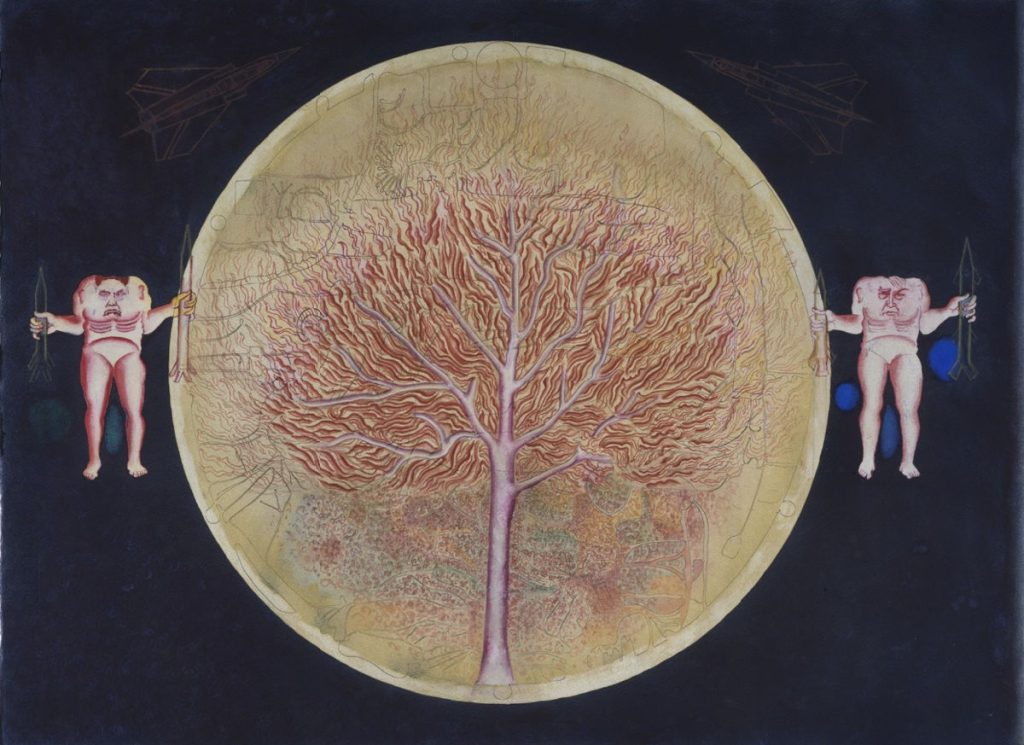
Gulam Mohammed Sheikh (India), Whose World, Mappamundi, 2017.
Dear friends,
Greetings from the desk of Tricontinental Asia.
On 4 March, two days after the United States and Israel attacked Iran, killing Ayatollah Ali Khamenei and hundreds of others, including over 170 children in a strike on a girls’ school, US nuclear submarine USS Charlotte torpedoed and sank an unarmed Iranian frigate, IRIS Dena, in the Indian Ocean.
The attack on IRIS Dena took place in Sri Lanka’s Exclusive Economic Zone – roughly twenty nautical miles from the port of Galle. Sri Lanka’s navy responded according to international law and rescued 32 sailors, many of whom were admitted to the Karapitiya Hospital in Galle for treatment. The Sri Lankan navy also recovered the bodies of 84 sailors killed in the attack. Leaked cables from the US State Department have revealed that the US is pressuring Sri Lanka not to repatriate the sailors to Iran.
The IRIS Dena and its crew had only days earlier been welcomed as guests of the Indian Navy. The Iranian frigate was struck as it was returning from participating in MILAN – India’s flagship multilateral naval exercise. Days earlier, the vessel had been docked in Visakhapatnam, in the Indian state of Andhra Pradesh, as an invited participant, and took part in ceremonial events, including a parade attended by President of India Droupadi Murmu.
The destruction of an invited naval guest within India’s maritime neighbourhood (by the US military, with whom Prime Minister Narendra Modi has sought closer alignment) raises uncomfortable questions for India. The Indian government’s subsequent silence is striking; by withholding both public condemnation of the attack and condolences for the killed sailors, New Delhi risks self-inflicted humiliation. For a ship welcomed by India to be sunk without a formal response suggests a concerning subordination of regional prestige to diplomatic convenience.
Meanwhile, in Washington, the US Secretary of War Pete Hegseth publicly boasted about the sinking of the Iranian frigate in the Indian Ocean. President Donald Trump joked that a US Navy general said it was ‘more fun’ to sink the ship than capture it. The contrast could not be starker. Despite the US violating Iranian sovereignty and expanding its acts of aggression to the Indian Ocean, India has remained silent.
Saleh Kazemi (Iran), Eram Garden, 2025.
Modi’s Acquiescence to Israel
The attack on Iran and the killing of Ayatollah Ali Khamenei began soon after Prime Minister Modi’s visit to Israel and his address to the Knesset (25–26 February). The nature of the visit was humiliating in itself. Modi was reportedly not invited as an official guest of state but rather as a personal guest of Benjamin ‘Bibi’ Netanyahu, a war criminal for whom an arrest warrant has been issued by the International Criminal Court.
Modi addressed a Knesset session that was boycotted by the opposition, while non-members filled vacant seats. He was also awarded a hitherto non-existent ‘Speaker of the Knesset Medal’ which was concocted specifically for him. He smiled and simpered and proclaimed solidarity with Israel against terrorism, all while Israel and the US were mobilising for a war against Iran. This humiliating behaviour damaged India’s dignity and made it appear complicit in the US-Israeli aggression against Iran.
Iran was attacked within two days of Modi’s visit to Israel. No one can say that India did not anticipate an attack on Iran, which was obvious to the rest of the world. This is a continuation of India turning its back on Gaza in the international arena – always careful not to condemn Israel for its ongoing genocide of Palestinians while expressing support for Israel against alleged ‘terrorism’.
India has come a long way under Modi, from being one of the first countries to recognise Palestine to shamefully abandoning the Palestinian cause and sliding into the embrace of a genocidal Israel. Under the Indian government’s benevolent gaze, India’s top industrialists have taken part in the production of Israeli drones that are used against Palestinians and Iran.
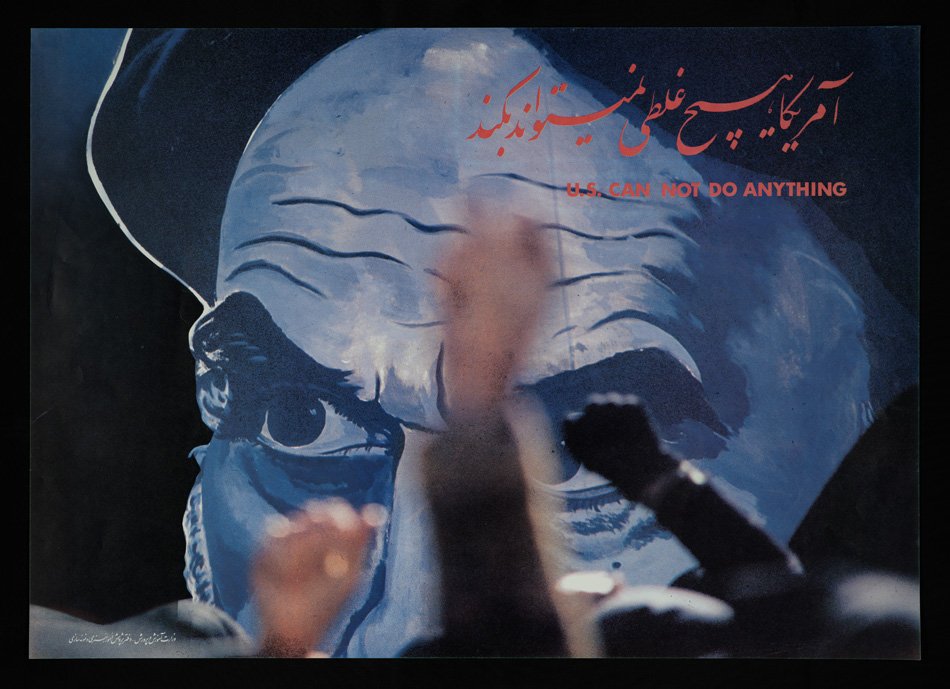
Middle Eastern Posters Collection, The U.S. Can Do Nothing, ca.1980.
India’s Strategic Losses in Iran
Iran has long been a strong friend and civilisational neighbour to India, even as claimed by the current Indian government. However, since the late 2000s, India has downgraded economic relations with Iran in a bid to get closer to Washington.
In 2008, India signed a nuclear deal with the US in return for abandoning Iran’s gas pipelines, a project that would have been vital for India’s energy security. However, the US nuclear deal has yielded little benefit in the field of nuclear energy.
Iran used to be India’s second-largest supplier of oil, but under US sanctions since 2019, Iranian oil exports to India have dwindled to zero. The Indian government has not had the initiative to seek ways to import heavily discounted Iranian oil, as China has done.
Nonetheless, Iran has been a time-tested friend of India. With long-run hostilities involving Pakistan, India’s only viable route to Central Asia has been through Iran’s Chabahar port. Iran has allowed India to develop this port, enabling continued trade with Afghanistan and the wider Central Asian region. Even so, under pressure from US sanctions, India dragged its feet on the port’s development.
The strategic importance of the Chabahar Port project for India cannot be overstated. It offers a route into Eurasia that bypasses Western-dominated maritime chokepoints and traditional trade corridors, potentially giving India greater economic and geopolitical autonomy in its access to Central Asia, Russia, and Europe.
The US recently ended the waiver that had allowed India to fund and construct the port without a word of protest from the Indian government. Chabahar was reportedly bombed on the first day of the US-Israeli campaign. Despite the implications for India’s own long-term strategic and economic interests, New Delhi has chosen to remain silent in the face of attacks on Iran.
Despite occasional statements critical of India’s stance on Kashmir, Iran has often supported Indian interests in various international forums, including by helping to block resolutions pushed by the Organisation of Islamic Cooperation that could have led to sanctions against India. Under Ayatollah Ali Khamenei, whose views guided Iran’s foreign policy, Iran had been a trusted friend. Yet, the Indian government did not have the spine to condemn his killing by the US.
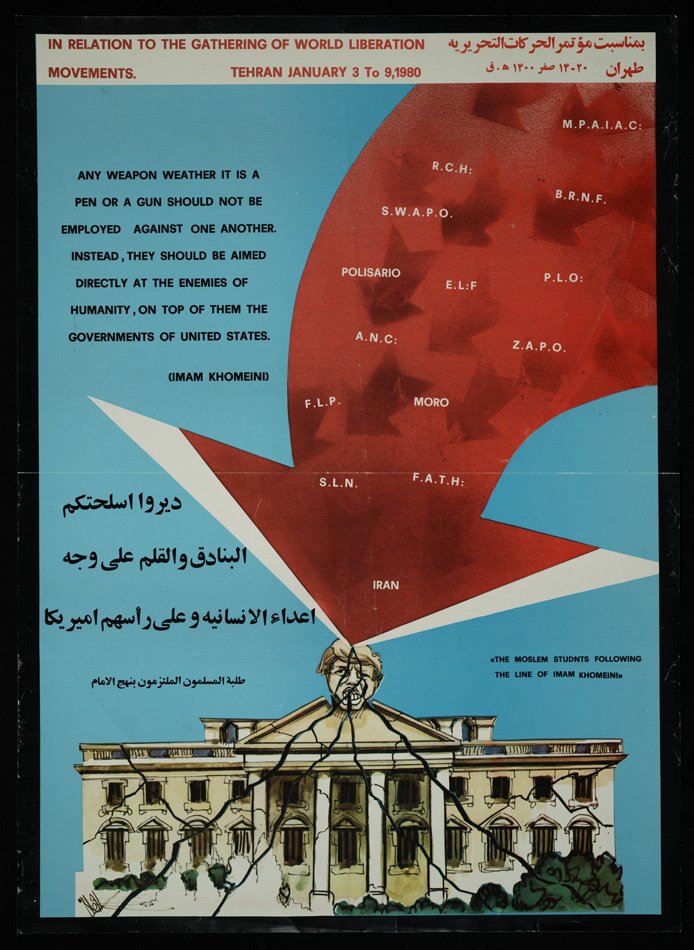
Middle Eastern Posters Collection, Advertisement for Gathering of World Liberation Movements, Tehran, 1980.
Shallow and Opportunistic Calculations
India’s complete abandonment of non-alignment, autonomy, and political spine in the face of US hegemony stems from the shallow, opportunistic calculations of the Modi government. More precisely, these are the economic interests of India’s large corporations, which Modi has championed throughout his political career and whose priorities have been the cornerstone of both domestic and foreign policy since he took office.
India’s top corporate monopolies have keenly pursued partnerships with both US and Israeli corporations. With little concern for investing in the development of sovereign capabilities in technology, research, and innovation, these Indian corporations have entered subordinate technological partnerships with US firms as a strategy for their next phase of growth. These corporations seek access to the US market while leaving India’s domestic economy and technological base underdeveloped and impoverished.
The Indian government’s foreign policy and domestic economic strategy have been structured around these corporate interests. The government has been assiduously pursuing a subordinated partnership with the US solely to this end. This relationship of subordination that India has cultivated with the US is certainly not aligned with the interests of its own people.
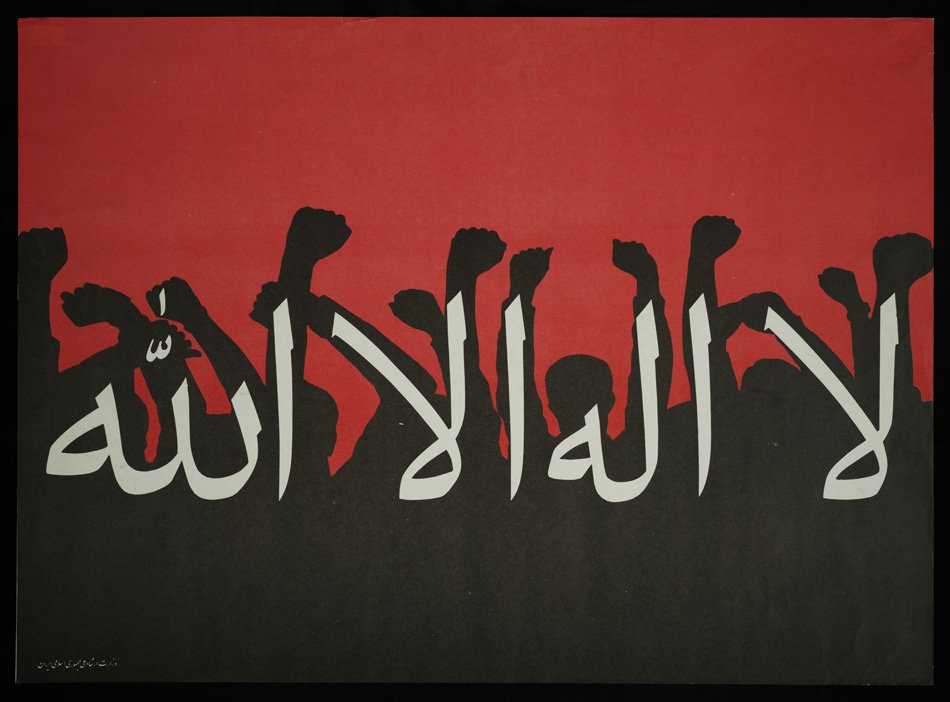
Middle Eastern Posters Collection, Silhouette of Crowd with Shahada, ca. 1970s–1980s.
A Flawed Strategy
The US acts of aggression against India’s guests, within a maritime zone where India has positioned itself as a net security provider, only underscore that the subordinate partnership is unlikely to yield any benefits for India’s economy, its people, and the broader South Asian region.
Recently, US Deputy Secretary of State Christopher Landau, speaking in India, did not mince his words when he said that the US has no intention of letting India develop the way China did by leveraging US markets. Trump’s imposition of 50% tariffs, later reduced to 18%, and the push for India to adopt zero tariffs on US goods and stop purchasing discounted Russian oil further illustrates this point. While the US is determined to make India complicit in its international misadventures, it is equally resolved that India should never grow into its own technological and industrial power.
The effective closure of the Strait of Hormuz, through which a major portion of India’s oil supplies passes, leaves India with only about 25 days of reserves, a serious blow to the Indian economy. On 6 March 2026, US Secretary of the Treasury Scott Bessent generously suggested that India could be temporarily ‘allowed’ to purchase Russian oil; after that, India would have to buy US oil at much higher prices. The Modi government appears blindly acquiescent to this economic extortion.
The intellectual hollowness of the Modi government’s economics and politics is increasingly apparent. India’s pandering to US misadventures is not only morally and ethically wrong, but also against the material interests of India and its people. The responsibility falls upon India’s working people and social movements to help India rediscover its spine and stand up for the rest of the Global South.
Warmly,
Bodapati Srujana
Bodapati Srujana is an Indian economist. Her research focuses on agrarian relations, banking, and inequality. She has participated in several studies around India.
Disclaimer: The views expressed by the author do not necessarily reflect the views of Tricontinental: Institute for Social Research.