

Explained: This article explains the political background, key decisions, and possible outcomes related to Explained : Rajya Sabha Polls Expose India’s Open Secret: Cross-Voting and Poaching and Its Impact and why it matters right now.
The recently concluded election to 37 Rajya Sabha seats across 10 States in March was no exception. While the Congress barely managed to scrape through in Haryana, cross-voting and absenteeism decided results in favour of the National Democratic Alliance (NDA) candidates in Odisha and Bihar.
In Odisha, Dr Datteswar Hota, an eminent urologist, was pitched by the Biju Janata Dal (BJD) as a “common candidate” with the support of the Congress and the CPI(M). The BJD had 18 surplus votes after electing one MP, and Hota could have won comfortably—but the BJP had the last laugh.
Independent candidate Dilip Ray, an industrialist and former Union Coal Minister backed by the ruling party, had a smooth run amid large-scale cross-voting. Eight BJD and three Congress MLAs defied the party line and supported Ray’s candidature. In 2002, too, Ray, after being expelled from the BJD, had pulled off a sensational victory in the Rajya Sabha election, with BJD and BJP MLAs defying the party line to support his candidature.
In Bihar, Shivesh Kumar won the fifth Rajya Sabha seat for the BJP-led NDA, defeating the Rashtriya Janata Dal’s (RJD) Amarendra Dhari Singh as four MLAs of the Mahagathbandhan—three of the Congress and one of the RJD—skipped voting. Their absence handed the NDA candidate a walkover, even as all five MLAs of the AIMIM and the lone BSP legislator voted for the RJD candidate.
In Haryana, the Congress won one seat by a whisker after five of its MLAs cross-voted for the BJP-backed Independent candidate. The party survived only because four of those votes were later declared invalid. One BJP vote was also declared invalid. Had one more Congress MLA defected, party candidate Karamvir Singh Boudh would have lost to BJP-backed Satish Nandal, as the ruling party already had 11 surplus votes after electing one candidate.
The result was decided after nine hours of counting and claims and counter-claims, during which both the Congress and the BJP approached the Election Commission. The BJP filed a complaint about a breach of secrecy in the votes of two Congress MLAs, Bharat Singh Beniwal and Parmvir Singh. The Congress complained about a similar breach in the vote of Cabinet Minister Anil Vij. Congress president Mallikarjun Kharge petitioned Chief Election Commissioner (CEC) Gyanesh Kumar, saying: “There is a clear attempt to interfere with the integrity of the election and it must be stopped—redressed by the EC immediately.”
Not an exception
In Haryana, such incidents have a history. In 2022, Congress’ Ajay Maken lost to BJP-backed Independent candidate Kartikeya Sharma, son of former Congress leader Vinod Sharma. In the keenly contested election, Maken lost by a single vote after one of his votes was cancelled. The party, which had in the meanwhile celebrated Maken’s victory on social media, had to withdraw its celebratory posts.
In 2016, when media baron Subhash Chandra, chairman of the Essel Group, won an election from Haryana with BJP support, allegations of manipulation of pen ink dominated the headlines. Independent candidate R.K. Anand, a senior Supreme Court advocate who lost the election, later filed a police complaint against Chandra, alleging that a conspiracy was hatched to ensure his defeat as an unauthorised pen was given to his supporting Congress legislators, leading to their votes being rejected.
In February 2024, the election to 15 Rajya Sabha seats across Uttar Pradesh, Karnataka, and Himachal Pradesh was marked by cross-voting in all three States, despite parties having issued three-line whips.
The most dramatic instance was in Himachal Pradesh, where six Congress MLAs voted in favour of the BJP candidate, despite a three-line whip for the party’s nominee, Abhishek Manu Singhvi. This led to a tie, with both the BJP and the Congress nominee getting 34 votes each in the 68-Member Assembly. A draw of lots decided the result in favour of the BJP candidate.
In Karnataka, a BJP MLA, S.T. Somashekar, cross-voted in favour of the Congress candidate Ajay Maken, while another BJP MLA, Shivaram Hebbar, abstained from voting.
The Ahmed Patel precedent
But the incident that dominated headlines was the election of Ahmed Patel to the Rajya Sabha from Gujarat in 2017 and the high-voltage drama surrounding it. Patel won, but the matter went up to the Supreme Court.
Before the voting, the Congress flew 44 of its MLAs to a resort in Bengaluru to prevent poaching. During voting, two Congress MLAs showed their marked ballots to a BJP election agent before casting them in favour of the BJP candidate. After a fierce late-night battle, the Election Commission invalidated the two rebel votes, and Patel won the seat. Patel died in November 2020 before the court case could be settled. The BJP later won the seat in a byelection in 2021.
The law and its limits
Since a whip cannot be issued for the Rajya Sabha election, asking Members to vote for any party candidate, parties are often keen to field extra candidates to engineer an upset whenever it is possible.
In recent years, parties have begun issuing whips for the Rajya Sabha election, but there is no legal provision that backs this, just as a party whip has no legal validity in the presidential election or an election to the post of Vice President.
The reason is that these elections are not a part of House proceedings, where the whip has legal sanctity under the anti-defection law, and are conducted by the Election Commission.
“If an MLA has exercised his or her vote against the party’s candidate or a candidate backed by their party, the party can take disciplinary action against the legislator. It will not amount to defection, but the party can take action according to its constitution and rules,” said O.P. Rawat, former CEC.
There is another ground on which the Tenth Schedule can be applied: if the party to which the Members belong seeks their disqualification from the Speaker, arguing that the Member has voluntarily given up the membership of the party.
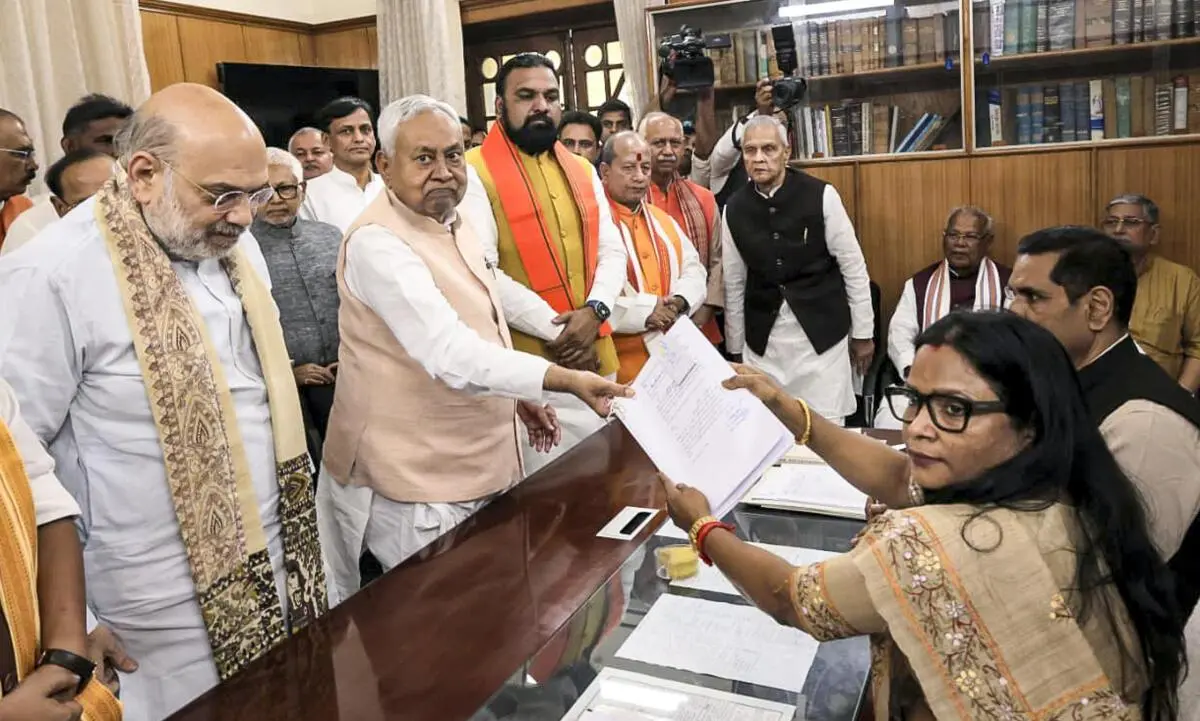
Bihar Chief Minister Nitish Kumar, in the presence of Union Home Minister Amit Shah, files nomination papers for the Rajya Sabha election in Patna with State Deputy Chief Ministers Samrat Choudhary and Vijay Kumar Sinha on March 5, 2026. The latest Rajya Sabha polls revived debates on party discipline, whip enforcement, and the limited applicability of the Anti-Defection Law in the Upper House election.
| Photo Credit:
PTI
The case of Rajya Sabha MP Sharad Yadav, against whom the then Janata Dal (United) (JD(U)) president Nitish Kumar sought action for anti-party activities in 2017, is a case in point. The JD(U) argued that Yadav had “voluntarily given up the membership” of the party by attending a rally of the opposition RJD, going against the party’s direction. The then Rajya Sabha Chairman, M. Venkaiah Naidu, expelled Yadav and another JD(U) MP, Ali Anwar Ansari, on the charge of defection.
“The Tenth Schedule does not apply to voting in Rajya Sabha elections, but if a party thinks its Members went against the party’s directive, it can seek their disqualification, arguing that they have voluntarily given up their membership by acting against the party’s directives. In the case of MLAs, it is the Speaker who has to decide. He can interpret such an act as voluntarily giving up membership, and the MLAs can lose membership of the House,” Rawat said.
The purpose behind the Rajya Sabha election being conducted through an open ballot is to ensure that parties can verify the support of their legislators. MLAs are required to show their vote to their respective party’s authorised agent before casting it. If a legislator goes against the party line, the agent can report it to the party leadership, which can then decide on disciplinary action.
“It was to prevent cross-voting that the open ballot system was introduced in Rajya Sabha elections in 2003,” said P.D.T. Achary, former Secretary General of the Lok Sabha.
How the open ballot came about
It was the Rajya Sabha election in Maharashtra in June 1998 that prompted political parties to push for an open ballot system. Before that, elections to the Upper House largely saw party MLAs voting for the nominee supported by their respective parties.
In the 1998 election in Maharashtra, one of the Congress nominees, Ram Pradhan, who was known to be close to Sonia Gandhi, suffered a shock defeat, although the party had adequate numbers to ensure his victory. The MLAs’ votes were cast in a secret ballot, and it was clear that party legislators had cross-voted.
The ethics committee of the Rajya Sabha, under former Maharashtra Chief Minister S.B. Chavan, recommended in its report in December 1998 that, in order to ensure money power and other considerations did not influence the elections to the Upper House, the elections should be conducted by open ballot. The Atal Bihari Vajpayee government acted on the recommendation, and the law related to Rajya Sabha elections was amended in 2003.
Veteran journalist Kuldeep Nayar, a nominated Member of the Rajya Sabha, challenged the constitutional validity of the open ballot system in the Supreme Court, arguing that secrecy of ballot was an essential requirement for free and fair elections. The court, however, upheld the legal provision, stating that while secrecy of the ballot is a vital principle for ensuring free and fair elections, the higher principle is free and fair elections accompanied by purity of elections.
“If secrecy becomes a source of corruption, then sunlight and transparency have the capacity to remove it,” the court said.
MLAs have, however, continued to act against the party’s interests in Rajya Sabha elections regardless of the change in law. They have kept their parties in the dark about their plans until the last minute, often springing a last-minute surprise, and have also found ways of circumventing the rules.
Rawat recalled the Rajya Sabha election in Haryana in 2016 to illustrate how MLAs have found ways to beat the system.
“In that election, all the votes cast by the Congress before three o’clock were valid. However, a group of 12 MLAs turned up to vote after three pm, and they used a pen that was different from the one provided by the Election Commission (EC). As per the rules, the MLAs have to use the instrument provided by the EC. The result was that all these 12 votes were invalidated and the Congress candidate lost,” said Rawat, who was Election Commissioner at the time.
The episode, which became known as the “inkgate” scandal, resulted in an FIR against the Assembly’s then secretary, R.K. Nandal, who had served as the Returning Officer.
According to Achary, while a legislator’s defiance of the party line is not directly covered under the anti-defection law, it could be looked at within the purview of the clause that deals with the MLA voluntarily giving up the membership of the party and hence qualifying for disqualification from the House.
“When an MLA votes in the Rajya Sabha election in a manner that hurts the party’s interests, a case can be made that the action is anti-party and hence he or she has effectively given up the membership of the party. But then, that is a question of interpretation,” Achary said.
According to experts, it comes down to intra-party dynamics, and the behaviour of legislators in these elections is an indication of the future plans of those leaders.
“What we are witnessing in Rajya Sabha elections is a reflection of the churn within the parties. More than focusing on the legal provisions and whether the law should be further amended, parties should ensure inner-party democracy is strengthened. If you are able to convince your MLAs, you would not require any law,” said Rawat.
The bigger picture
Ever since coming to power in 2014 with a massive mandate in the Lok Sabha, the BJP has felt constricted in passing Bills in the Rajya Sabha, where it was in a minority. The party has been focused on winning every Rajya Sabha election. It now has at least a simple majority (for the NDA) in the House in the third term of Prime Minister Narendra Modi, and plans to get closer to a two-thirds majority.
The Congress has been the weak link as the BJP pursued its aggressive approach to winning the Rajya Sabha election. Even in Bihar this time, when the All India Majlis-e-Ittehadul Muslimeen (AIMIM) and BSP MLAs voted for the Mahagathbandhan, the Congress could not keep its flock together. The first time it truly jolted the Congress was when its stalwart Ahmed Patel almost lost the election in Gujarat in 2017. The party has received similar jolts in the elections that followed—in Haryana in 2022 and Himachal Pradesh in 2024.
The repercussions of the Rajya Sabha election have often been felt beyond the immediate contest. The Rajya Sabha election was the immediate trigger for the political developments that resulted in the toppling of the Kamal Nath government in 2020, within two years of the Congress having ended its 15-year exile from power in Madhya Pradesh in 2018.
Also Read | Two veterans, two Rajya Sabha seats, and a long fall from influence
Also Read | Beyond the historic first