


Explained: This article explains the political background, key decisions, and possible outcomes related to Explained : India Can’t Count Its Cities. It Just Allocated ₹3.56 Lakh Crore for Them. and Its Impact and why it matters right now.
Note: This article is Part 1 of the 3-part series on the findings of the XVI Finance Commission Report.
The last time India counted its people was 2011. Barack Obama was in the White House. Virat Kohli hadn’t captained a single international match. And India, according to that census, was 31 per cent urban.
That number, frozen and increasingly out of step with reality, has been a key input governing the distribution of lakhs of crores ever since. Finance Commission allocations and state-level fiscal transfers have leaned on a fourteen-year-old snapshot of a country that has been urbanising at one of the fastest rates on the planet, even as successive commissions have tried to partially correct for this.
The XVI Finance Commission just placed ₹3.56 lakh crore on the table for urban India, 2.3 times the previous cycle, equivalent to thirteen years of centrally sponsored scheme funding combined. The number is historic. And the work behind it is telling: Janaagraha, a Bengaluru-based civic organisation, spent the better part of a decade assembling evidence on the true scale of India’s urbanisation, demonstrating that the country was considerably more urban than available data suggested.
Janaagraha’s engagement with Finance Commissions goes back to the thirteenth, when its founder met Dr Vijay Kelkar and argued for more grants for local bodies. By the time the XVI Commission was constituted, the organisation had spent two decades learning where the real bottleneck lay: not in the willingness to allocate, but in the data that justified allocation.
The problem was circular. India’s urban share of Finance Commission grants was pegged to census data. The census was frozen. So urban India’s fiscal entitlement had limited room to grow with it.
Apula Singh, a senior manager at Janaagraha, and her team set out to build a clearer picture of India’s urbanisation. They found 24,000 villages with populations above 5,000 that looked, functioned, and congested like towns but remained classified as rural because no state government had reclassified them. If these settlements were added to the existing urban population, India could be 47 per cent urban. They ran geospatial analysis and pulled international nightlights data, the satellite imagery that measures economic activity by how brightly a settlement glows at night, which suggested a figure as high as 63 per cent.
Then there was CityFinance.in, the digital platform of the Ministry of Housing and Urban Affairs that Janaagraha manages. Nearly 1,000 new urban local governments had been quietly constituted since 2011, pushing the recognised urban population to at least 33 per cent. The Ministry of Health and Family Welfare’s own projections put India at 41 per cent urban by 2031.
“There has been a growing recognition over the last decade that India has been rapidly urbanizing and that urbanization is the catalyst for economic development,” Singh explains. “About 70% of the country’s GDP is coming from cities.”
The Commission looked at this evidence, the unreclassified settlements, the satellite data, the Health Ministry’s own numbers, and moved. The urban share of local government grants jumped from 36 per cent to 45 per cent. That nine-point shift represents hundreds of crores redirected from where the census said people lived to where they actually live.
But here is what the allocation exposed: the previous system was not just outdated. It was structurally inequitable.
Urbanisation rates of states
Under the XV Finance Commission, every state got the same 65–35 rural-urban split, regardless of whether the state was 11 per cent urban or 48 per cent. The consequence was skewed. In states like Bihar, which was only 11 per cent urban, cities were receiving 36 per cent of the state’s total local government grants, well above their population share. Meanwhile, states with dense concentrations of urban population, but where cities are still not formally governed as urban under state law, were not necessarily benefiting commensurately.
“Bihar had just 11% urban population back in 2011 and it got 36% of the total grants that overall local governments get in Bihar,” notes Prabhat Kumar, who directs public finance management at Janaagraha. “So already it was getting 25% more than the population. This is more like a correction.”
The XVI Commission fixed this by distributing grants based on each state’s projected urban population for 2026. When the state-wise numbers came out, the headlines screamed disparity: Kerala up 415 per cent, Bihar down 8 per cent, Arunachal Pradesh down 49 per cent. It looked like favouritism. It was mathematics: the mathematics of acknowledging that a uniform national formula was producing unequal outcomes for states at very different stages of formal urbanisation.
The allocation also carried a quieter revolution. Buried in the recommendations, the untied grant component grew 5.5 times, from ₹33,143 crore to ₹1,84,094 crore. This matters more than it sounds.
Tied grants tell a city: spend this on water and sanitation, regardless of what you actually need. A city that has already invested heavily through Swachh Bharat Mission and desperately needs street lights or parks is stuck. “When you have tied grants, you’re basically telling local governments that they should use that money for a certain purpose only,” Singh explains.
Janaagraha collected data from Karnataka, Telangana, and Maharashtra during the XV Commission period. The finding was instructive: utilisation of untied grants ran at least 20 per cent higher than tied grants. Cities could spend money they controlled. They struggled with money that came with mandates, especially when the mandated functions were not even controlled by the city government but by state parastatals.
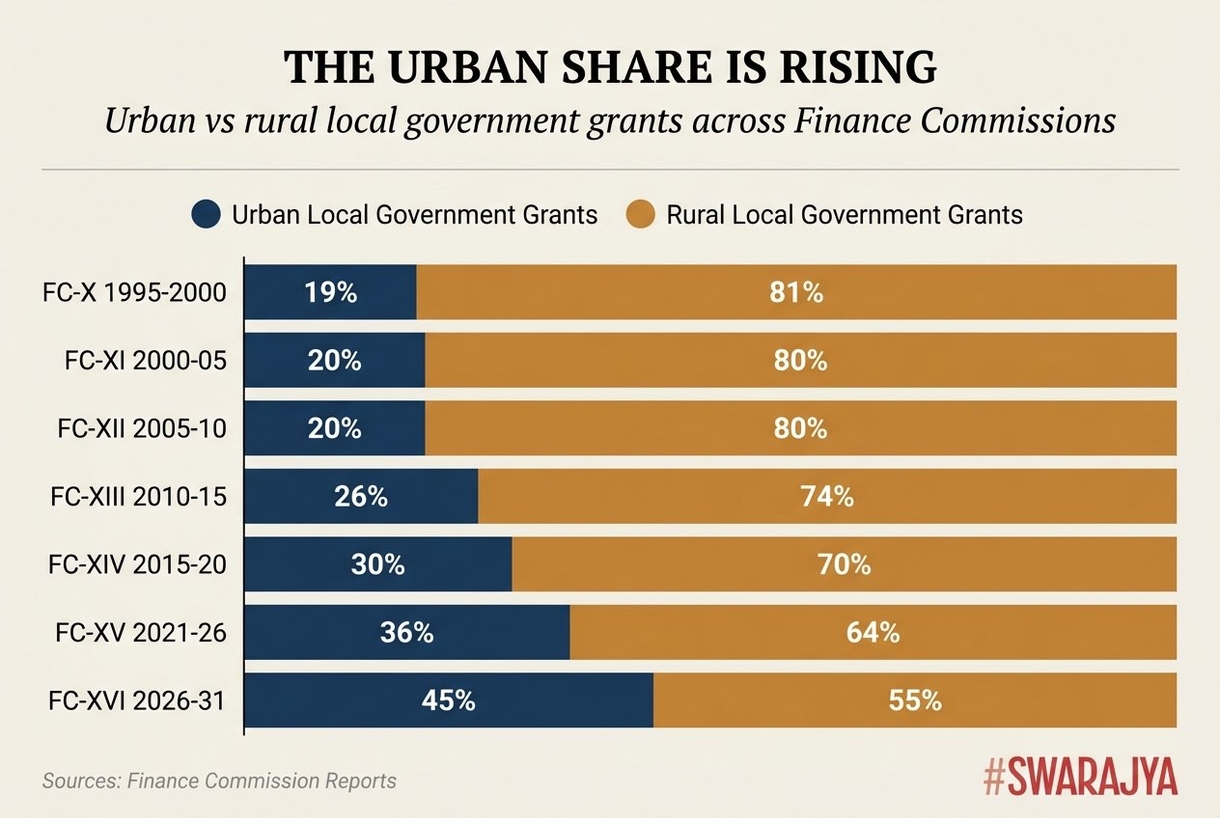
Urban vs Rural – grants across finance commissions
“Where water supply or other functions are with other parastatals or the city does not have adequate capacity to plan for those projects, then in those heavy capital-intensive sectors, the cities were not able to plan for and utilize funding,” Singh observes. The 5.5x increase in untied grants is, in principle, the largest expansion of urban fiscal autonomy since the 74th Amendment. In principle.
Because the ₹3.56 lakh crore comes with a catch that Janaagraha is careful to name: local governments are a state subject. The Union Government can allocate. The Finance Commission can design. But states decide whether cities actually get the money, have the staff to spend it, and operate under rules that allow them to function.
“We worked for around one and a half years with the Commission and many of our recommendations found place in the report,” Kumar says of their engagement with the XV Commission. “We also worked with the Ministry of Housing and Urban Affairs and many states to implement those recommendations. And those recommendations have had far-reaching effects on our day-to-day life.”
With the XVI Commission, Janaagraha spent two years completing two major studies. They know the architecture intimately. And they know that architecture ends at the state capital’s door.
The Commission has done what a Commission can do. It rewrote the formula. It followed the evidence. It put the money on the table. What happens next, whether ₹3.56 lakh crore transforms Indian cities or sits underutilised, will depend on how state governments choose to devolve funds, functions, and functionaries: the three pillars the 74th Amendment envisaged, and which remain unevenly realised across the country.
Adithi Gurkar is a staff writer at Swarajya. She is a lawyer with an interest in the intersection of law, politics, and public policy.