


Explained: This article explains the political background, key decisions, and possible outcomes related to Explained : How the city’s archive of fraternity challenges the politics of majoritarianism and Its Impact and why it matters right now.
In our era of fragmented identities and manufactured cultural tension, we are often told that deep, religious, and ethnic harmony is a naive dream, perpetually undermined by the “real” forces of history – conflict, empire and political manipulation.
To live in the Kerala coastal city of Kozhikode, however, is to inhabit a quiet, persistent rebuttal. This is not a city frozen in a utopian past, but a vibrant, living archive where a millennia-old politics of fraternity continues to shape its streets, its flavours, and its very soul.
Long before the term “globalisation” was coined, Kozhikode was its thriving epicentre. For nearly years, ships from the Mediterranean, Arabia, Persia, Africa, and China docked here, drawn by pepper and cardamom, but sustained by a uniquely cultivated trust.
The Hindu Zamorin rulers established a radical precedent: granting land and protection to early Christian traders, offering royal patronage to Muslim merchants for their mosques, and welcoming Jewish, Jain, Buddhist and Parsi communities. The visit of the Chinese admiral Zheng He’s treasure fleet in the 15th century was a spectacle of this conscious openness. Fraternity here was not a philosophical abstract; it was the practical engine of commerce and civic life, built on face-to-face familiarity.
The arrival of Vasco da Gama at Kappad Beach in 1498 introduced a different politics – one of crusading ideology and monopolistic conquest. Yet, even subsequent colonial encounters left traces of complex cultural and intellectual exchange. In the 17th century, the Dutch commissioned the monumental Hortus Malabaricus, a botanical compendium that systematically documented the region’s plant wisdom.
A century later, in 1774, the French staged a brief political intervention, signing a treaty with the local Zamorin ruler and raising their flag in a fleeting attempt to gain a foothold, only to be swiftly displaced by the advancing forces of Hyder Ali of Mysore. Later, the British colonial administration imposed foreign systems – from land revenue laws to English education – leaving behind both bureaucratic frameworks and physical landmarks like the serene St Mary’s English Church.
Throughout this period, the city’s innate character persisted. This was exemplified in the 19th century by the German missionary-scholar Hermann Gundert, who immersed himself in Malayalam to create its first dictionary, and by the Basel Mission, which contributed through education and landmark industries like the famous weaving mills and tile works. Each, in their own way, became a thread in the city’s plural mosaic.
The architecture of coexistence
Nowhere is Kozhikode’s living legacy more palpable than at its beach, where the city’s mercantile soul is written in architecture and community life. Extending into the sea are two historic piers – the older an iron screw-pile structure from 1871 stretching 400 feet. Once a hive of activity where cranes loaded spices, timber, and textiles onto global vessels, they stand as skeletal reminders of that exchange.
Lining the shore, the sturdy facades of old warehouses, known locally as pandika saala, silently guard the past. These storerooms of Arab, Gujarati, and European trading agencies, with thick laterite walls and steep, narrow wooden stairs, built for bales of goods, have been adaptively reused in a seamless transition from colonial trade depot to contemporary social hub.
They now house boutiques, art galleries, and beloved restaurants serving Malabar cuisine. This is Kozhikode’s philosophy in action: the past is not abandoned but woven into the daily fabric of community life – a truth felt as crowds gather for sunsets and literary festivals, sharing the same breeze.
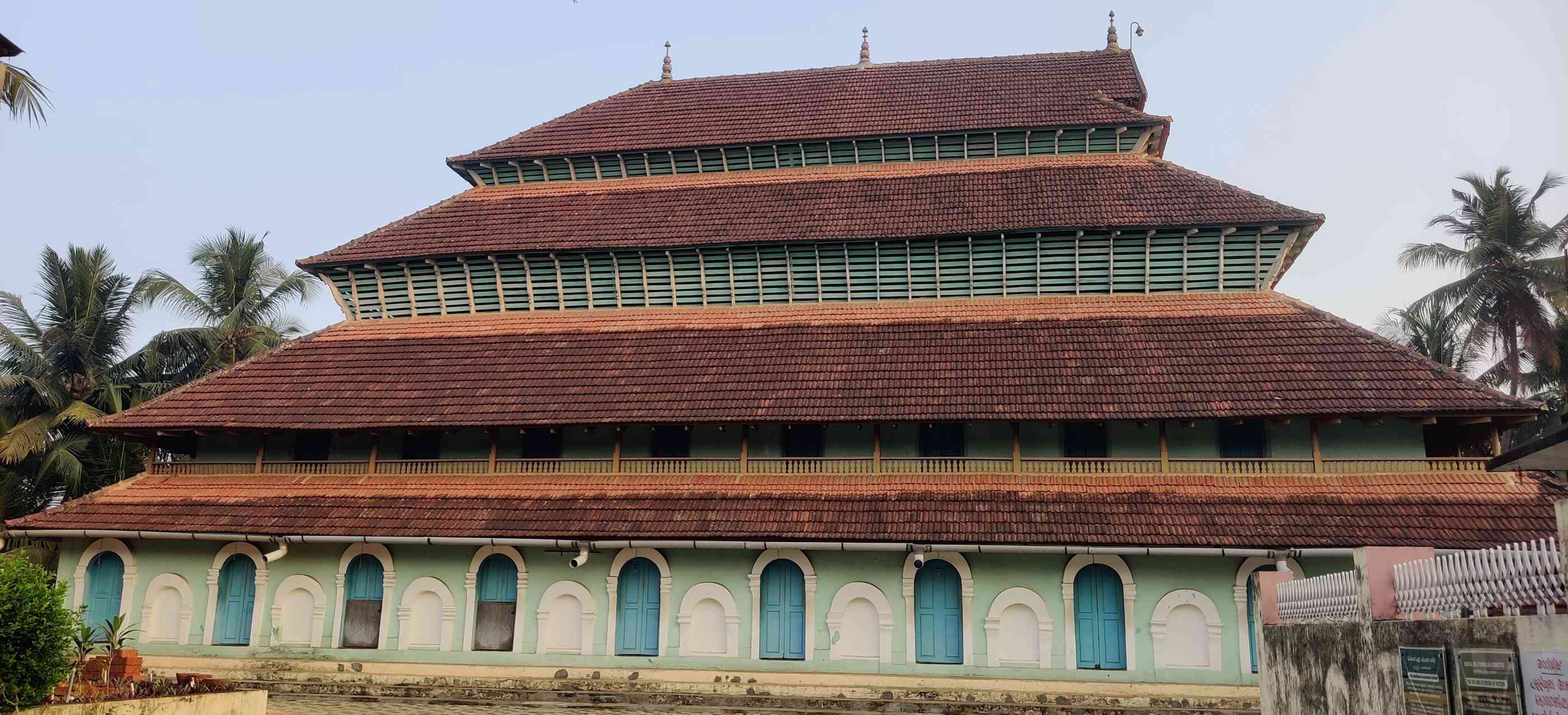
This same spirit of shared space finds its most profound architectural expression a short distance inland, in the ancient Kuttichira neighborhood. Within a stunning radius of a few hundred meters, one encounters a silent, powerful dialogue of spires and roof-lines. Here stands the 14th-century Mishkal Mosque, a multi-storied wooden structure with a distinctive Kerala-style tiered roof, built by an Arab trader. A short walk away is the Mother of God Cathedral, a site of worship dating back to Portuguese contact.
They are neighbored by centuries-old Hindu temples and a historic Jain temple. This remarkable cluster is not a curated museum exhibit but a lived, everyday reality. For generations, the call to prayer, temple bells, and church chimes have woven together into a singular soundscape of belonging, a physical manifestation of a community where sacred spaces were built side-by-side, not in opposition.
The city’s famed culinary palette is its most delicious testament to this heritage. At the iconic Paragon Restaurant, founded in 1939, you do not just eat Malabar biryani; you taste the layered history of Arab spice routes and local genius. In the now-pedestrianised Sweet Meat Street, the halwa and crispy banana chips are the direct inheritance of a mercantile culture that blended techniques and tastes across communities.
From historic curry houses to modern multi-cuisine cafés, eating here remains a daily act of communion and shared heritage, continuing the ancient tradition of trade as a social bond.
Legacy in idea and action
This enduring spirit of exchange and shared space fuels the city’s intellectual life. Kozhikode’s identity as a Unesco City of Literature – with its over 500 libraries and thriving publishing houses – is a natural outgrowth of this deep-rooted culture, a tradition reflected in its sons and daughters who have shaped contemporary Malayalam literature, film, and music.
It culminates in events like the Kerala Literature Festival, where thousands gather on the very beach that saw historic arrivals to debate ideas in a cacophony of languages. Here, the legacy of literary and artistic giants finds its living, democratic echo in the public square. This vibrant, civil culture of debate in tea shops and public squares is the democratic echo of the old trading port’s negotiation tables, now channeled through prose, poetry, and public discourse.
This is where Kozhikode’s story challenges our contemporary majoritarian political despair. It demonstrates that the constitutional ideal of fraternity enshrined in India’s Preamble as the assurance of dignity and unity is not a top-down legal construct but a bottom-up, lived reality built on shared space, mutual interest, and daily encounter. Unity here was forged not through assimilation, but through the dignity of working, trading, worshipping, and creating alongside one another.
In a polarised world quick to weaponise difference, Kozhikode offers a different manifesto. It proves that pluralism can be robust, not fragile; that diversity, when woven into the urban fabric, the culinary palette, and the literary imagination, becomes a source of immense resilience and joy. The city does not ask us to merely tolerate one another. It invites us to build together – be it a new business in an old warehouse, a new understanding in a shared neighborhood or a new story in a common language.
Kozhikode’s mandate is clear: fraternity is a habit cultivated in the mundane architecture of everyday life. It is the politics of the shared street, the common meal, the neighboring house of worship and the collective story. In preserving this, the city is not just gazing at its past; it is actively writing, page by page, stone by stone, a vital chapter for our fractured future.
John Kurien, a reflective development practitioner, who has found in Kozhikode the perfect harbour for his sunset years.