


Explained: This article explains the political background, key decisions, and possible outcomes related to Explained : Bharatiya Bhasha Parivar Debate: The Politics of Language History and Its Impact and why it matters right now.
Indian languages—called Bharatiya Bhashas in the ideological framework of the Central government—are generally understood to belong to four (or six, if the Andaman languages are included) distinct language families spread across the subcontinent. In recent years, the government of India has sought to alter this near-universal understanding. According to the proposed alternative framework, these languages belong to a single linguistic family christened Bharatiya Bhasha Parivar for “Indian language family”. The two books under review are an attempt to prop up the alternative theory with “academic” arguments.
The Central government established the Bharatiya Bhasha Samiti (Committee on Indian Languages) under the Ministry of Education in November 2021. Its Chairperson is the Sanskrit promoter Chamu Krishna Shastri, a long-time head of Samskrita Bharati, which is based in Delhi at the Rashtriya Swayamsevak Sangh’s premises on Deen Dayal Marg. The Samiti published two books in October 2025 through the National Book Trust of India, aiming to present an alternative framework for Indian languages in academic terms. The contributors to the books include professors from the disciplines of linguistics, cultural anthropology, archaeology, genetics, and history.
The titles of the two books are Bharatiya Bhasha Parivar: A New Framework in Linguistics (373 pages) and Collected Studies on Bharatiya Bhasha Parivar: Perspectives and Horizons (343 pages). The first book presents arguments from the above disciplines in support of the idea of a single Indian language family. Although the authors of the five disciplinary sections of the book are not individually named, 12 scholars are acknowledged for collectively writing and editing them; there are 42 additional contributors who offered feedback. The second book contains 32 research papers authored by individual scholars, who wrote them either specifically for the volume or first presented them at a seminar on the subject. Most papers in this book describe similarities in the grammars of Indian languages; the remaining explore how these similarities facilitate preparation of artificial intelligence tools to work with Indian languages, translation from and into them and teaching them.
Many linguists cited in the two books, including this reviewer, have indeed written about grammatical similarities among Indian languages. However, the book reverses the reasons these linguists offer for the similarities. It presents convergence—which linguists understand as the outcome of historical interaction between languages—as a set of traits inherent in them from their very origin.
This review critiques this view promoted as a new framework for “new linguistics”. The critical observations in this essay are limited to what is called the framework and the theory on which it stands. One could—and should—produce detailed critiques, discipline by discipline, of the evidence the two books present in support of the theory. One finds the same evidence of similarity being interpreted differently across the chapters of the second book, which deserves a separate review.
The two volumes on Bharatiya Bhasha Parivar, published by the National Book Trust, present a framework that interprets India’s many languages as part of a single linguistic family.
| Photo Credit:
By Special Arrangement
It is a common saying that history is written by the victors. The victors are not only those who win wars, but also those who win elections, who construct alternative histories to legitimise their power. The purpose of the two books is to write an alternative history of Indian languages. The next stage of this project, probably, is to incorporate this alternative history into school textbooks.
Historian Romila Thapar1 has observed that when Indian history research moved in the modern period from Indology to the social sciences, the discipline underwent a decisive turn towards scientific methods. These books, in contrast, attempt to return language history to the earlier position of using beliefs and mythologies; they also seek to take this revisionist history to coming generations of students in India and abroad. Bharatiya Bhasha Samiti provides financial support for seminars in universities to legitimise the alternative linguistic history. The aim of the present critique is to demonstrate how this alternative history departs from scientific reasoning, and in doing so, how the two books draw education into political trajectory.
The alternative history accepts many widely accepted facts: India’s multilingualism, the existence of distinct languages, the presence of four language families, and the similarities between them. But it proposes a different explanatory framework for these facts and weaves these explanations—calling them “civilisational memory”—into political beliefs. The foundational claims of it are these: diversification of Indian languages is superficial; they cannot be isolated from the Sanskrit from the Vedic period onward; all languages of India possess an inherent Indian “spirit”. From this perspective, differentiating Indian languages from one another is manifestation of ignorance about India, which Westerners have. Linguistic relationship between Indian languages, therefore, is not structural but organic arising from within languages, as an embryo grows.
Sanskrit as ‘god mother’
Sanskrit is posited as the source of this organic unity. While avoiding the linguistically discredited claim that Sanskrit is the genetic mother of Indian languages, this framework instead advances the notion of Sanskrit as a “god mother.” Concepts such as Indian spirit and mental essence—concepts that cannot be mapped on to linguistic features— go into constructing the new linguistics.
To sustain the arguments for the new framework, historical events, and facts universally verified and accepted in linguistics and in the related disciplines must be rejected. Among these rejections is the classification of languages into well-founded families: IndoAryan, Dravidian, AustroAsiatic (including Munda and Khmer languages), and SinoTibetan (including the Thai/Tai branch)2. Linguistics determines genetic relationships between languages by identifying systematic sound correspondences governed by general rules. These rules, like mathematical formulas, admit no exceptions; exceptions, if any, must have an explanation. To reject this scientific method and to choose instead to define a language family based on cultural traits expressed in the language code is to move beyond linguistics, and beyond science. While linguistic features can be identified and described systematically, identifying shared cultural traits is often subjective; disagreement among scholars is common.
In identifying shared cultural elements in Indian languages, Sanskritic culture is taken to be the reference point. One frequently cited example in the first book is the concept of puruṣārtha—dharma (righteousness), artha (power), kāma (pleasure), and moksha (liberation from bonds)—which is said to appear in all Indian languages and their literatures. Cultural ideas found in epics such as the Mahabharata and the Ramayana are also treated as evidence of cultural unity among Indian languages. Such examples may demonstrate cultural connections, but they do not establish linguistic relationships. At most, they can be used to argue that Indian languages belong to a shared cultural universe, but not that they constitute a single language family. It would be hard to imagine that scholars proposing this new linguistics in the two books are unaware of this fundamental distinction.
The sole linguistic feature cited in the first book to support the claim of a single Indian language family is the traditional grammatical classification of vocabulary into tatsama, tadbhava, and grāmya words. In Telugu grammar, grāmya words are those that show no formal connection to Sanskrit. Tatsama words closely resemble Sanskrit forms of words. When such words are of Dravidian origin historically, it must be noted that the similarity with Sanskrit is accidental. Tadbhava words are Sanskrit or Prakrit forms that have been modified to conform to Dravidian phonological pattern. Linguistics demonstrates that Sanskrit words entered Dravidian languages, just as it demonstrates that Dravidian and Munda words entered Sanskrit.
Linguistics also provides a method to prove these facts. It will need to show that tatsama words in Dravidian language did not exist in ProtoDravidian and that the source of tadbhava forms did not exist in ProtoIndoEuropean for Sanskrit to inherit them. Cultural contact explains lexical borrowing; genetic relationship explains lexical cognates. The new theory does not keep this distinction.
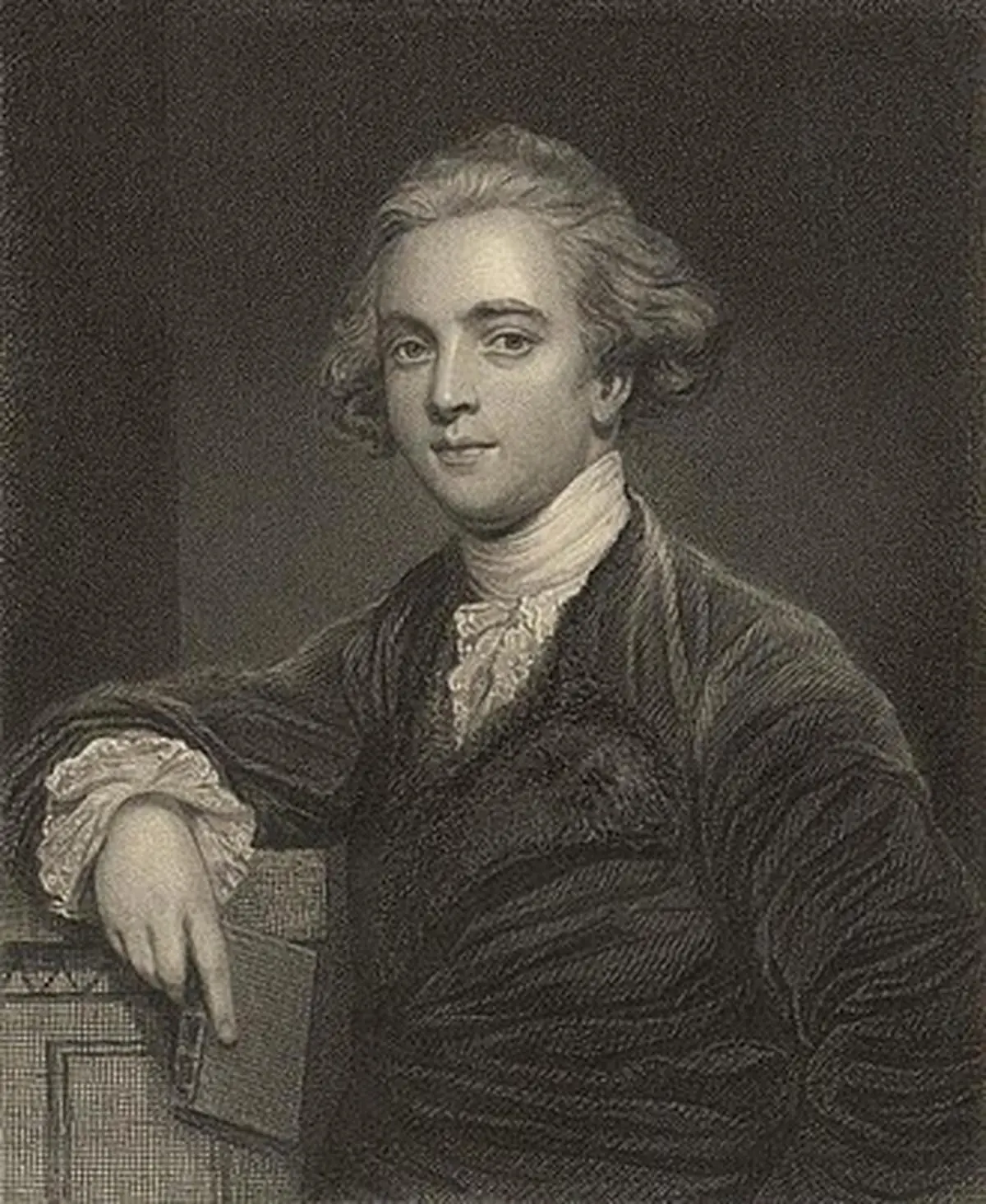
Sir William Jones, who founded the Asiatic Society in Calcutta in 1784, identified the relationship between Sanskrit, Latin, and Greek in 1786.
| Photo Credit:
By Special Arrangement
Beyond these linguistic arguments, the first book also advances a political reason to reject the established historical language families. Sir William Jones discovered in 1786 the relationship between Sanskrit, Latin, and Greek, which made him place Sanskrit in the IndoEuropean family. Francis Ellis in 1816 identified the relationship between Tamil and other South Indian languages and argued that they were distinct from Sanskrit.
Robert Caldwell, in 1856, found similar relationship with some languages beyond South India and established the Dravidian language family through systematic linguistic correspondences. In subsequent periods, other European and American scholars along with Indian scholars identified the remaining language families. The new linguistic framework argues that these scholars divided the unified one Indian language family into four families either to serve colonial political interests or because they failed to perceive the deeper spiritual unity of India. This political argument characterises colonial linguistics as a “divide and rule” strategy; the new linguistic theory is even claimed to be a form of postcolonial studies.
Languages and geography
A related accusation made by the proponents of the new theory is that colonial scholars linked language families to ethnic or racial categories, such as Aryan and Dravidian. The new theory asserts the existence of a single Indian ethnicity or race, a claim disputed in anthropological science. Geneticists do note that ethnic divisions among Indian populations cannot be sharply demonstrated through genomic variation, owing to long histories of intermixing. At the same time, they do not claim that there was one genetic pool of Indians historically or pre-historically. The above observation of geneticists parallels linguistic accounts of language contact and mixing and this fact does not warrant the claim of a single linguistic origin for all languages of India3.
The new framework acknowledges that Indian languages belong to four separate families, but it denies that this separation is based on linguistic differences. Instead, it argues they are merely geographical manifestations of a single, original language. Indo-Aryan Marathi (from Maharashtri Prakrit) in western India, Dravidian Telugu and Tamil in southern India, Dravidian Gondi in Madhya Pradesh, Indo-Aryan Bhili in Rajasthan, Austro-Asiatic Santali in West Bengal, and Tibeto-Burman Bodo in Assam are all said to be local geographical manifestations of the same language.
In the beginning, it is claimed, there existed a single Bharatiya Bhasha, identifiable with Sanskrit, which later diversified according to the regions its speakers inhabited. From a linguistic scientific perspective, language change is predominantly driven by speakers, not by geography unless by contact. As a language is learned anew by each generation and is used in multilingual settings with other languages through bilingualism, incremental changes take place; they accumulate and produce major linguistic changes.
Languages belonging to the four families are spoken not only in India but also in Pakistan, Afghanistan, Myanmar, Vietnam, and a few other places in Asia. If geography alone were to determine linguistic affinity, one would have to extend the boundaries of India across much of Asia and describe all these languages as modified forms of Bharatiya Bhasha. This expansive region is perhaps the Akhand Bharat the proponents of the new linguistic theory believe in, though they do not mention it!
Another theory rejected by the new framework is the Aryan invasion/migration hypothesis. Denying this theory requires rejecting Jones’ historical account of Sanskrit. The new framework prefers to view Sanskrit as the indigenous language of people who have lived in India since antiquity. This grants Sanskrit the status of a language of the soil; when this soil is regarded as sacred, Sanskrit acquires sanctity as well. By the sanctity of the Vedas composed in it, Sanskrit is linked to other languages as they are claimed to be spiritually connected with it; Sanskrit origin is sought to underpin the grammatical systems of all the languages of the Indian soil. The first book repeatedly insists that there was no rupture in the linguistic history of India and that Sanskrit continued to have its presence uninterrupted all the time.
The rejection of Aryan migration is extended even further, to also reject the scientific consensus that Homo sapiens migrated out of Africa 70,000–100,000 years ago. Instead, the first book claims that human evolution occurred not only in Africa but also on Indian soil, grounding the origin of homo sapiens in India also. The evidence cited consists largely of mythical epochs described in the Puranas. Archaeological finding of oval stone tool (Acheulean) from Athirampakkam in Tamil Nadu, attributed to Homo erectus, is generalised to be true of whole of India and thus evolution of Homo sapiens in India is sought to be justified.
Although Darwinian evolution is not explicitly denied by sayings that Aryan were created by god, the assertion that human evolution occurred in India indirectly reinforces the idea of India as the sacred land of Aryans. This claim of human origin in India is one of the pillars of the new framework.
Since Murray Barnson Emeneau’s formulation of India as a linguistic area in 1956, linguists have supported the areal basis of Indian languages through their research. The new linguistics draws on the same data to claim it as evidence for a single Indian language family. It does not make a difference between the vertical change for structural reasons and the horizontal change by contact with another language.
Historical linguistics explains grammatical unity found in languages in a multilingual area as a result of sustained contact in multilingual settings. To give an example, research on Indo-Aryan Saurashtra in Tamil Nadu, for example, shows that, while its vocabulary reflects IndoAryan cultural elements, its grammar closely aligns with Tamil. Such convergence has the practical effect of facilitating switching between language in a single conversation. The new linguistics turns this reasoning upside down and claims that the unity of all grammars is a fact at their origin and the observed differences are secondary developments. This inversion contradicts the established understanding that differences converge into unity over time, not the reverse. The Indian language scene shows the emergence of unity from diversity and not diversity from unity. In other words, linguistic diversity converges into unity and linguistic unity does not turn into diversity.
Research on linguistic convergence reveals the direction of linguistic change, based on the sociolinguistic relationships between language communities. The new linguistics causally relates linguistic diversity with geographical diversity. It does not speak of the political relation between the linguistic communities and so does not make any mention of directionality of linguistic change. For this theory, the change is unidirectional from Sanskrit to others because Sanskrit is the Ur language and has spiritual superiority.
To prioritise cultural concepts over linguistic structure as evidence of linguistic unity falls outside linguistics. Even within cultural studies, one must specify which cultural ideas account for unity; invoking Vedic influence alone is not enough. Excluding a historical change in languages from any linguistic explanation is unscientific. It is removing language history from the domain of science. Languages interact and change in the brain; they do not reside in the soul and remain constant.
A rangoli emerges from connecting dots; dots do not arise from the rangoli. To claim otherwise is to invert the history of Indian languages. The reversal exists in the new linguistic theory because it is constructed by political ideology. Scientific conclusions are rejected on ideological grounds; selective research findings are presented to legitimise ideological rejections as scientific. Political ideology is the methodological core of the framework of new linguistics.
E. Annamalai is former director, Central Institute of Indian Languages and also a former visiting professor of Tamil, University of Chicago.
Footnotes:
- Thapar, Romila (2002): “Introduction”, Early India: From the Origins to AD 1300, Berkeley: University of California Press, pp. xvii.
- Abbi, Anvita (2022): “Uniformity is not Unity: A Probe into Linguistic Diversity of India”, Language and Language Teaching, Issue No 22.
- Arora, Aryaman, Adam Farris, Samopriya Basu, and Suresh Kolichala (2022): “Computational historical linguistics and language diversity in South Asia”, Proceedings of the 60th Annual Meeting of the Association for Computational Linguistics, Volume 1: Long Papers, pp. 1396–1409, Ireland: Dublin, Association for Computational Linguistics.
Also Read | India: A linguistic civilisation
Also Read | The life of a language