


Explained: This article explains the political background, key decisions, and possible outcomes related to Explained : Arendt’s Warnings and the Institutionalisation of Islamophobia in India and Its Impact and why it matters right now.
India’s Constitution offers one of the most ambitious promises of equality and secular citizenship in the modern world. It envisions a nation where individuals are not defined by faith, caste, or community, but by their shared belonging to a democratic republic. Yet, for an overwhelming number of Muslims in contemporary India, this constitutional aspiration remains painfully distant. Their everyday experiences reveal an ever-deepening gap between constitutional guarantees and lived reality. It is an exclusion that is not accidental but the product of political choices, administrative neglect, and an increasingly hostile social climate.
The findings of the Sachar Committee, nearly two decades old now, remain an unhealed wound on the nation’s conscience. The report, one of the most comprehensive assessments of Muslim socio-economic conditions, found that Muslims lag behind in almost every development indicator, sometimes below the Scheduled Castes and the Scheduled Tribes.
Inadequate representation of Muslims
Muslim representation in state institutions, public sector employment, and policymaking bodies remains grossly inadequate. A vast proportion of Muslim workers and entrepreneurs are confined to the informal sector, operating in precarious conditions with limited access to capital or markets. Muslim neighbourhoods across States are chronically under-served, without basic infrastructure, civic amenities, or public investment. These are not simply indicators of underdevelopment but markers of systematic neglect.
Hannah Arendt in 1930.
| Photo Credit:
By Special Arrangement
What exacerbates these material inequalities is the discrimination persistent in almost every sphere of public life. In housing, Muslims routinely face rejection based on unspoken but widely acknowledged prejudices. In employment, both formal and informal, they encounter invisible barriers that shut them out. In education, access to opportunities is narrowed not just by poverty but by social stigma. The cumulative effect is a cycle of marginalisation that becomes extremely difficult to break.
To this structural exclusion is added a violent history of periodic, often organised, attacks on Muslim homes and livelihoods that has scarred generations. And now, the idea of “bulldozer justice” has become a vehicle for injustice across several States.
Yet, institutions have rarely delivered justice. When large-scale violence ends with no accountability, the message goes out that some citizens can be attacked without consequence, and the psychological damage far exceeds the physical.
Worrying change in discourse
Now, the discourse around Muslims has also undergone a worrying transformation. Increasingly, they are being portrayed as outsiders, appeased minorities, or Pakistan sympathisers, the historical absurdity of such claims notwithstanding. It bears repeating: Indian Muslims rejected the idea of Partition; their centuries-old presence is ingrained into the social, cultural, and political fabric of the subcontinent. Yet, political rhetoric and popular narratives attempt to recast them as perpetual suspects whose loyalty must constantly be proven.
Even cultural expressions have not been spared. The renaming of cities, the erasure of themes and chapters from textbooks, and the systematic deletion of Muslim contributions from the national story are not isolated acts. The broader project of rewriting the past to legitimise exclusion in the present builds on such acts cumulatively. Such symbolic violence is subtle, but deeply damaging. It tells a community that its heritage, accomplishments, and identity are unwelcome in the public imagination.

During the Shaheen Bagh protests against the Citizens Ammendment Act, in New Delhi on February 17, 2020.
| Photo Credit:
Shiv Kumar Pushpakar
The political sphere has seen an equally disturbing shift. Rhetoric demonising Muslims through terms such as “love jihad” and “ghar wapsi”, or through accusations of mass infiltration, has become normalised. Policies such as anti-conversion laws, hijab bans, beef bans, and modifications to Waqf regulations may be couched in legalistic language, but their effect and their intent are to target one community.
Rise in hostility
The rise of mob lynchings in the name of cow protection is perhaps the most chilling expression of this hostility. Such crimes occur with alarming frequency, yet what is more alarming is their gradual acceptance, pointing to a growing desensitisation that reduces them to mere law and order issues rather than assaults on the moral core of the Republic.
Muslims seldom receive institutional redress. Instead, they often encounter indifference, delay, or hostility. Over time, such experiences erode faith in the very systems meant to protect citizens. A community begins to feel that the Constitution’s promises apply in theory, but not in practice.
Also Read | Do Muslims need to change their approach?
Meanwhile, overwhelmingly large sections of the media amplify harmful stereotypes by repeatedly associating Muslims with extremism, terrorism, or backwardness. These then find a life of their own on social media and in WhatsApp groups, distorting public perception and legitimising prejudice. For a young Muslim growing up in India today, these portrayals are not abstract. They profoundly shape self-image, aspiration, and psychological well-being.
In public discourse, policy prescriptions such as better education, more jobs, and targeted welfare are often discussed. These are crucial, but insufficient. What is perhaps not acknowledged is an urgent need for societal introspection, an honest evaluation of the prejudices that operate quietly in everyday life. Without this introspection, no policy, however well-crafted, can rebuild trust.
Relevance of Arendt’s ideas
It is in this disquieting context of rising Islamophobia and deliberate polarisation that Hannah Arendt’s political thought becomes especially illuminating. Arendt, who passed away 50 years ago this month, wrote in the shadows of the 20th century’s darkest political experiments. She provides a lens through which we can examine the processes that enable exclusion, silence dissent, and normalise injustice.
Arendt’s understanding of how societies create an “enemy within” resonates sharply in India today. She warned that democratic decline does not begin with dramatic events, but with subtle shifts in the form of small accommodations of prejudice, small silences in the face of injustice, and small bureaucratic decisions that collectively create large structures of discrimination. Over time, these become embedded in public consciousness, shaping what is considered “normal”.
Her concept of the “banality of evil”, articulated in Eichmann in Jerusalem, is particularly relevant. She did not suggest that evil is trivial, but that great harm can be perpetrated by ordinary individuals who fail to think critically about the implications of their actions.
Bureaucrats and law enforcement officers who follow discriminatory orders, journalists and content creators who repeat harmful stereotypes, and civil society and citizens who look away from injustice—they all contribute to an environment in which exclusion becomes mundane.
‘Banality of evil’
What struck Arendt as a particularly difficult aspect of resisting hate was that it was not spectacularly and manifestly evil, but rather anodyne and cliched. The casual use of anti-Muslim language in everyday conversations, television debates, and social media posts is precisely the kind of banalisation Arendt described. Hatred becomes ordinary, violence becomes incidental, and empathy becomes rare.
In The Origins of Totalitarianism, Arendt warned that statelessness deprives individuals of “the right to have rights”—a condition where legal identity dissolves and individuals become vulnerable to systematic discrimination.
The anxieties surrounding the Citizenship Amendment Act (CAA) and the National Register of Citizens (NRC) bring this warning vividly to mind. Although defended as administrative exercises, they have raised credible fears of rendering large populations, especially Muslim, effectively stateless, caught in bureaucratic limbo without legal recourse. The mere prospect of such disenfranchisement creates profound fear.
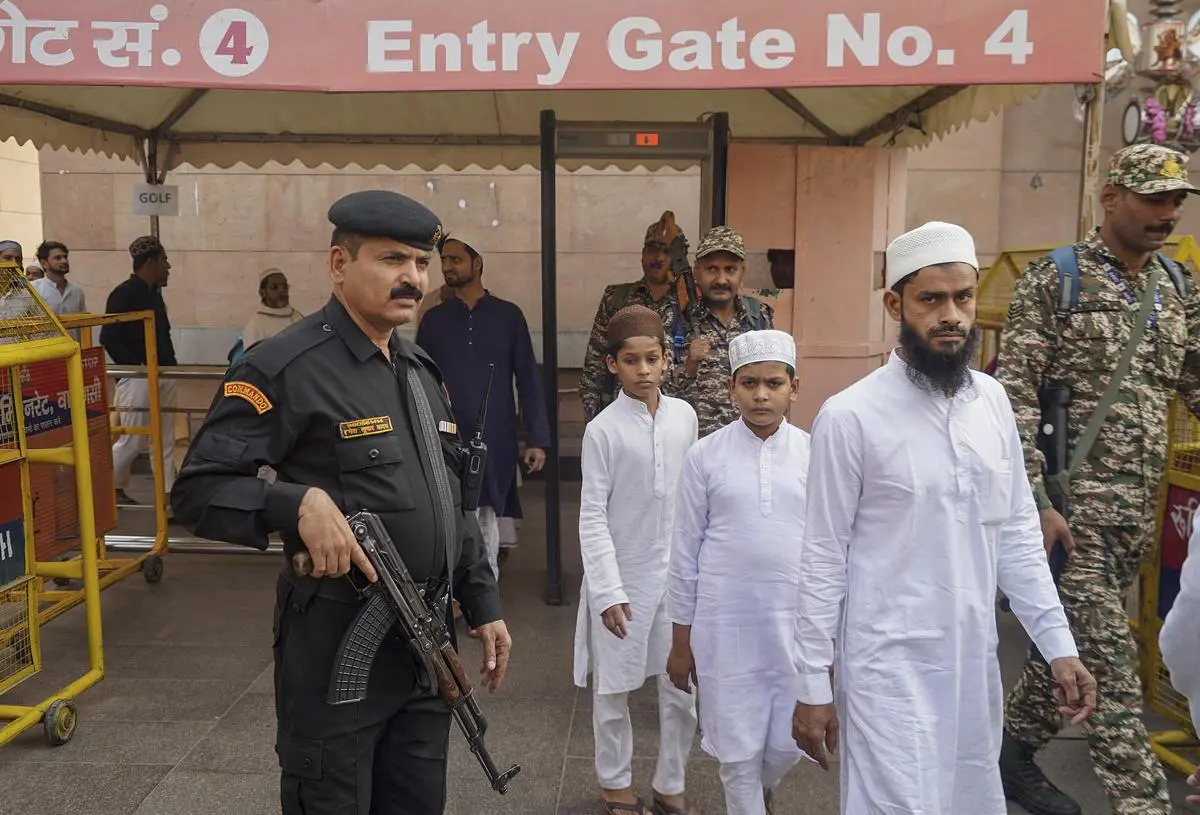
Security personnel keep vigil as Muslims leave after Friday prayers, at Gyanvapi Mosque in Varanasi on November 21.
| Photo Credit:
PTI
The ongoing Special Intensive Revision (SIR) by the Election Commission of India (ECI) is the latest in a series of acts designed to disenfranchise a range of marginalised communities.
Arendt also believed that politics, at its best, is a space of plurality where diverse voices engage, contest, and cooperate. Sectarian polarisation erodes this space. Today, digital ecosystems often serve as instruments of propaganda, trolling, and intimidation, rather than as platforms for democratic deliberation. Dissent is demonised, labelled as anti-national, and met with hostility. Such shrinking of the democratic space is what Arendt warned of.
Her analysis of how totalitarian movements mobilise fear, conspiracy theories, and myth-making to consolidate power also finds echoes in contemporary India.
Identity-based insecurities are exploited also to divert attention from governance failures, economic distress, and growing inequality. In this regard, it is not a uniquely Indian phenomenon but a global pattern emerging out of the right-wing playbook. But its consequences in India are particularly severe because they strike at the heart of the constitutional idea of India.
Faith in civic action
Yet, Arendt also placed immense trust in civic action. She believed that ordinary citizens, through collective resistance, truth-telling, and civil disobedience, could reclaim political space.
The Shaheen Bagh protests, the nationwide anti-CAA demonstrations, and the farmers’ protests exemplify precisely this belief in public action. These movements showed that the public realm, however diminished, can still be reclaimed.
Arendt also worried deeply about the decline of truth in public life. In an era when misinformation spreads rapidly and ideological indoctrination shapes public perception, her concern is more pertinent than ever. When truth erodes, so does the capacity for sound judgment. Without judgment, prejudice thrives.
Threat to Indian democracy
India today stands at a crossroads where the deliberate marginalisation of Muslims is not simply a political strategy; it is a structural transformation that threatens the foundations of democratic life. When a state treats a segment of its own citizens as if they do not belong, it engages in what Arendt called the creation of statelessness within the state. Such internal statelessness is a precursor to deeper forms of authoritarianism.
To reduce Muslims to “the perpetual Other” is to deny them the right to appear in the public realm as equals. This denial violates a fundamental aspect of human dignity. It also impoverishes the nation’s moral and cultural life.
Reading, and understanding, Arendt
Reading Arendt in India today does not mean equating distinct historical contexts. Rather, it means recognising recurring patterns: the normalisation of prejudice, bureaucratic complicity in injustice, and the quiet withdrawal of moral responsibility by ordinary people.
Evil, in Arendt’s sense, persists not because individuals consciously choose it but because they stop thinking critically, because they adapt themselves to the expectations of the powerful, and because violence becomes routine and indifference becomes habitual.
Also Read | Modi’s ‘demographic mission’ is little more than diversionary tactic
The strength of a democracy is not measured by its ability to silence dissent or suppress difference. It is measured by its commitment to justice and equality for every citizen. India’s greatness has always lain in its capacity to embrace diversity, not erase it; to nurture coexistence, not enforce conformity.
As we remember Arendt at a time of profound internal challenge, we must appeal to our collective conscience. We must question rhetoric and policies that divide. We must reaffirm the constitutional promise of equality. Above all, we must remember that real power does not arise from domination; it arises from the shared aspirations of a diverse people determined to live with dignity, freedom, and mutual respect. The future of India depends on our ability to safeguard this vision.
Prof. Manoj Kumar Jha is a Member of Parliament (Rajya Sabha) from the Rashtriya Janata Dal and the author most recently of In Praise of Coalition Politics and other Essays on Indian Democracy.