


Lifestyle Trend:Discover lifestyle trends, travel ideas, and practical tips related to Lifestyle Trend: How use of AI will help travel operators transform behaviour of holidaymakers You Should Know – You Should Know
Artificial intelligence (AI) is rapidly changing the way millions of people experience and connect with the world as computer systems that can copy intelligent human behaviour are growing more accessible, efficient and affordable – and increasingly embedded into our everyday work and leisure activities.
Research tracking and interpreting major AI advances, investment surges, regulatory growth and adoption trends in this field has shown that people across China are embracing the potential of this technology more than those in other countries and regions.
The “Artificial Intelligence Index Report 2025” – which questioned people in 32 countries around the world and was published last April by Stanford University, in the United States – found that 83 per cent of survey respondents in China believe AI offers more benefits than drawbacks.
It also revealed that people in China demonstrate some of the highest levels of knowledge, trust and enthusiasm about AI-powered products and services and how they can have a positive impact on their lives.
When it comes to travelling, another survey from last year by Booking.com showed that 67 per cent of travellers from the Asia-Pacific region already use AI to plan parts of their trips, while 65 per cent expect autonomous travel planning will soon become mainstream – highlighting generative AI’s growing influence on the sector.
Innovative new technologies are helping travel operators create new content, especially text or images, for holidaymakers including offering chatbots for personalised travel recommendations and real-time support to cut the time spent on booking, securing the best deals and overcoming language barriers.
Adopting AI also provides numerous benefits for travel operators, especially those that have to process a lot of data on a regular basis. One example is Dida Holdings, a global company offering smart travel technology solutions to industry partners, which is one of China’s largest business-to-business AI-driven travel distribution platforms.
Daryl Lee, Dida’s group CEO, said he has long been an advocate of the use of AI in the travel industry, which echoes the company’s technology-focused approach across its operations.
“From day one, Dida has always thought about how we can do things intelligently,” he said. “Adopting AI allows us to scale fast without increasing headcount at the same ratio, which is an important advantage in a highly competitive market landscape.
“We have about 5 billion searches a day in our system, which means accuracy becomes hugely important. The matching of supply and demand and being able to sell the right products to the right customers at the right time and at an optimal speed is fundamental.
“AI helps to ensure our suppliers and customers’ experience on our platform is seamless. That reach is very important and is what ultimately converts searches into transactions.”
Lee described Dida’s operational philosophy – known as the “Smart” model, which stands for scale, match, AI, reach and transaction – as a closed-loop flywheel where transactions offered richer data. This information could then be used to strengthen its AI capabilities to enable better matching and a wider reach to drive sustainable growth for the company.
“It’s a layered AI engine that’s been embedded across our platforms, including the supply management and allocation of rooms and flights, to help our hotel and airline partners reduce unused inventory and optimise pricing in real time, while considering factors such as profitability, conversion rate, seasonality and customer behaviours,” he said.
Dida also uses AI-powered tools to provide a performance forecast to better help its partners with inventory and pricing management and identify any abnormalities in booking trends to minimise the risk of fraud. Additionally, the company uses the technology to offer them an overview of customer reviews across multiple websites and platforms.
“We’ve built a tool that can comb through the internet and give our partners a sense of what people like and dislike about them and how they are trending,” Lee said. “These insights and tools allow us to become an extended arm for our partners’ marketing functions and provide the visibility they need to continually improve on their offerings.”
How AI will continue to revolutionise the travel industry was the key theme at last month’s “Limitless: Dida Engage 2026” forum in Shenzhen, China, organised by Dida, which featured SCMP Live as the official media partner.
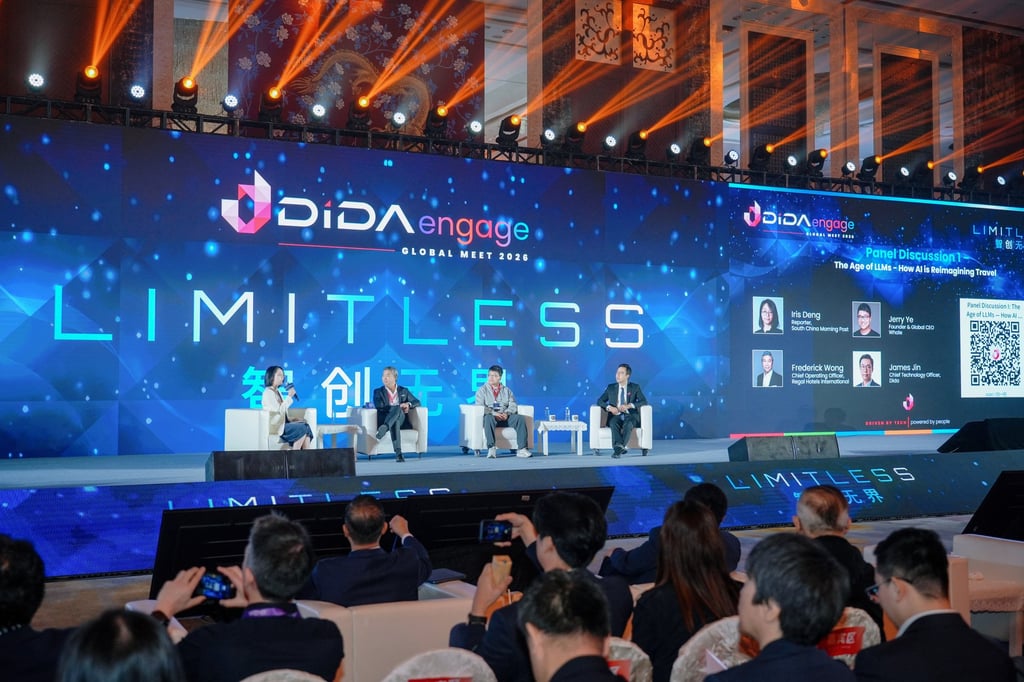
Lee and several technology and hospitality experts gave presentations and took part in panel discussions about how emerging technologies will have an impact on global travel behaviour and inspire a new wave of travel solutions. The talks also explored new opportunities that will help operators capitalise on China’s latest inbound and outbound travel trends.
The panel discussion titled “The Age of LLMs: How AI Is Reimagining Travel”, moderated by South China Morning Post technology reporter Iris Deng, featured Jerry Ye, CEO of retail AI solutions provider Whale, Frederick Wong, chief operating officer of Regal Hotels International, and James Jin, Dida’s chief technology officer. They shared insights into how large language models can help companies working in the travel industry to enhance customer engagement, streamline operations and inspire new smart solutions.
Wong said the partnership between humans and technology was the key to ensuring the use of AI could enhance service levels and benefit guests and consumers.
“AI can be extremely helpful to hotels in many ways, from managing bookings and revenue to automating certain services to provide a smoother experience during the stay,” he said. “But at the same time, our guests still value the human connection when they are at the property. We see AI as a tool that can help our staff anticipate guests’ needs and deliver a more personalised experience.”

The “China Outbound: The Social Media Influence” panel discussion, with Germaine Woon, founder of marketing communications agency The Foundry Asia, as moderator, featured Gareth Matthews, Dida’s chief marketing officer, Daniela Chiani, Switzerland Tourism’s director of Greater China, and Wilson Wu, Disneyland Paris’ director of Greater China and Southeast Asia. They offered insights into how to attract a younger generation of Chinese travellers, who often make decisions based on the content they see on Chinese social media platforms such as WeChat, Xiaohongshu and Douyin.
Matthews was asked how travel operators can ensure their promotional content is adapted across different platforms with a consistency in both the tone and messaging. He said that, while it was important that the marketers themselves remained in control of the narrative and creativity of their social media campaigns, technology could be used to help increase the impact.
“The story that you are telling should always be aligned with the brand’s overall message; what changes across different platforms is the format of telling the stories,” he said. “But what AI can do is to scale the content and adapt it to different formats.”
Wong and Matthews’ observations about AI-human collaboration were among the key takeaways in Dida’s new white paper, titled “Travel Distribution in the Machine-to-machine Era”. The report has called for companies to encourage staff to familiarise themselves with AI, allowing the technology to handle repetitive tasks while enabling people to spend more time carrying out higher-value work involving judgment, systems design, customer relations and ethical oversight.

Collaboration between different players in tourism, including hotels and travel agencies, was also key to continually enhancing the industry’s overall AI capabilities to deliver an even more holistic experience to travellers, Matthews said.
“The future of travel cannot be built in silos,” he said in the closing remarks at the forum. “We need to have open standards and open data and to work together like never before.”