


Trending Now: This entertainment story covers the latest buzz, reactions, and updates surrounding Trending Now: Korea’s entertainment industry struggles as celebrity scandals derail productions – Fans React..
From left, Cho Jin-woong, Park Na-rae and Cho Se-ho / Courtesy of Contents Wavve, Hankook Ilbo file, MBC
A string of personal scandals involving high-profile Korean entertainers is once again leaving broadcasters and production companies to absorb heavy financial and scheduling losses and reigniting concerns about long-standing vulnerabilities in the country’s entertainment ecosystem.
Recent controversies tied to actor Cho Jin-woong, TV personality Park Na-rae and comedian Cho Se-ho have forced networks to cancel programs, halt filming or even scrap completed projects — with few effective tools available to prevent or recover damages.
Completed projects face collapse as re-editing becomes impossible
The fallout escalated on Saturday when Cho Jin-woong announced his retirement from the entertainment industry after reports surfaced about his juvenile criminal record. Broadcasters immediately moved to erase his appearances, replacing his narration in a documentary and making earlier programs featuring him private on YouTube. Park, who is facing allegations related to illegal medical procedures, suspended all activities, resulting in the cancellation of MBC’s upcoming variety show “Nado Shinna,” which was set to air next year.
The most severe blow, however, may be tvN’s “Signal 2,” planned as a flagship drama celebrating the network’s 20th anniversary next year. Cho had reunited with writer Kim Eun-hee and actors Kim Hye-soo and Lee Je-hoon — all members of the original cast — and filming had been completed in full. But the controversy has now put the drama’s broadcast schedule at serious risk.
Editing out problematic actors or recasting roles is possible in some cases. When actor Yoo Ah-in became embroiled in a drug scandal, producers removed him from Netflix’s “Hellbound 2,” and another drama, “Goodbye Earth,” minimized his screen time through re-editing. But “Signal 2” presents a different dilemma: The series reportedly cost more than 10 billion won ($7.5 million) to produce, and Cho plays a central detective whose scenes are integral to the storyline. With postproduction nearly finished, reshoots are considered unfeasible, and tvN said it is “reviewing multiple options.”
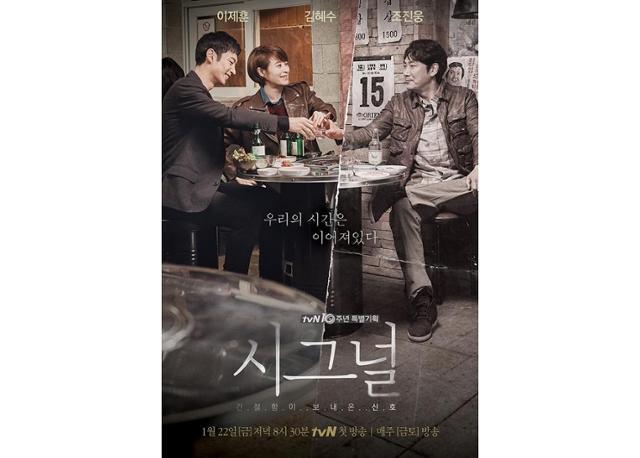
A poster for “Signal” / Courtesy of tvN
Penalty clauses exist, but lawsuits are rare
For now, inserting compensation clauses into casting contracts remains the industry’s only formal safeguard. Broadcasters and production companies cannot investigate an actor’s private life or past conduct as thoroughly as law enforcement agencies, making prescreening nearly impossible. To address this gap, the Ministry of Culture, Sports and Tourism revised its standard broadcasting contract for entertainers in July for the first time in 12 years.
Still, these clauses have limited real-world impact.
“We sometimes include provisions such as ‘In case of public scandal, the actor must return one to three times the appearance fee,’ but cases that actually lead to lawsuits are extremely rare,” a film company CEO with two decades of experience said. Recovering full damages is nearly impossible, the CEO added, and many companies forgo legal action due to potential conflicts with agencies, high legal costs and the ambiguity of what constitutes “public scandal.” Disney+, for instance, indefinitely postponed the release of actor Kim Soo-hyun’s series “Knockoff” last year amid allegations that he dated a minor, but did not pursue penalty fees.
Negotiating penalty clauses with top stars is also nearly impossible. “During contract negotiations, it is very difficult for production companies to make demands that actors find uncomfortable. Unless specialized insurance products become available, producers have no choice but to shoulder the risk,” another film producer said.
A broadcasting official echoed this sentiment. “Korean drama production heavily depends on star writers, directors, and actors. They hold overwhelming power in the system.”
Experts argue that broader institutional solutions are needed to protect the industry when major stars become embroiled in controversy.
“In the United States, there are insurance mechanisms and arbitration companies dedicated to addressing losses when large-scale content projects fall apart,” cultural critic Kim Sung-soo said. “If insurance is difficult to introduce in Korea, the government and private sector should consider creating a governance framework tasked with damage assessment, compensation, and IP management.”
This article from the Hankook Ilbo, the sister publication of The Korea Times, is translated by a generative AI system and edited by The Korea Times.