

Case Explained:This article breaks down the legal background, charges, and implications of Case Explained: Chief Justice Eric Rosen addresses mental health, attorney shortage – Legal Perspective
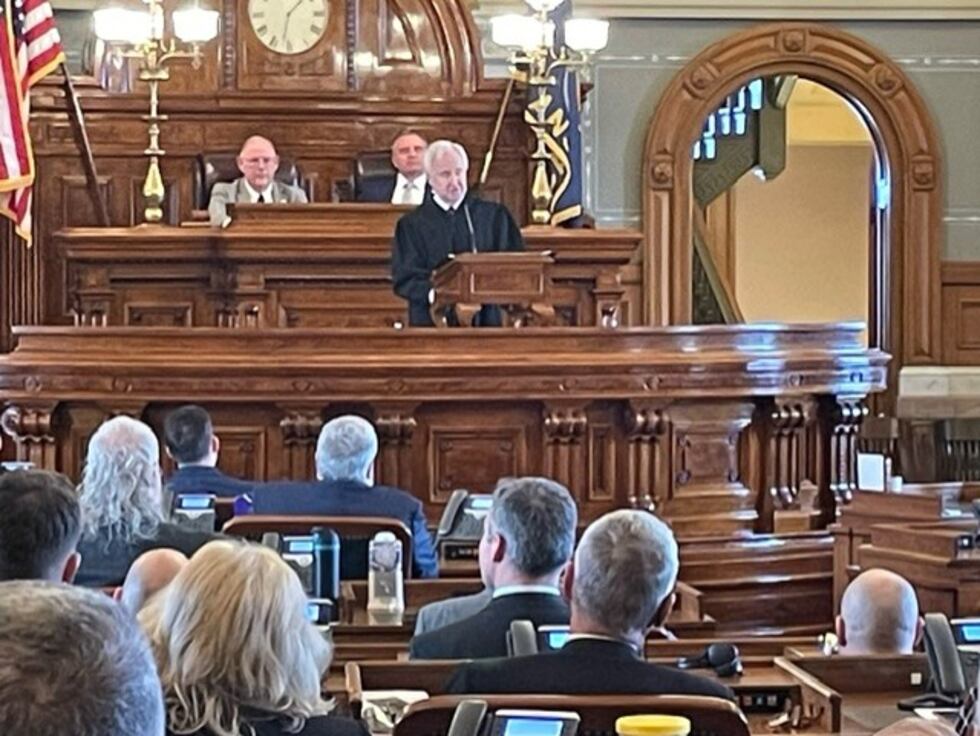
TOPEKA, Kan. (WIBW) – Chief Justice Eric Rosen gave the State of Judiciary Address Tuesday giving insight into the Kansas court system.
Rosen focused on two topics: breaking the cycle of crime related to mental health and substance use and the attorney shortage in Kansas.
Rosen highlighted the need for mental health care as many individuals experiencing mental health challenged and substance abuse are often cycled through the court system. Rosen cited data affirming that young women with mental health issues are more likely to be arrested, while young men who are arrested are more likely to struggle with substance use.
In response, the Kansas courts have implemented specialty courts including drug treatment, veteran and family treatment courts headed by the judicial branch. These specialty courts focus on accountability, along with treatment, supervision and support, to ultimately break the cycle and address the root cause of crimes.
Rosen said that individuals who have graduated from specialty court programs are more likely to live stable, productive lives and less likely to return to court.
The Specialty Court Funding Advisory is recommending the appropriation of $1.5 million in the fiscal year 2027 to continue the support of the program.
During the address, Rosen also spoke on the rising attorney shortage.
In 2022, the Supreme Court convened the Rural Justice Initiative Committee to gather data and make recommendations on how to respond to the shortage. Rosen says that the courts have made some progress with those recommendations.
Recently, Rosen signed an administrative order that establishes a permanent Rural Justice Initiative Committee to monitor the shortage, implement recommendations and evaluate their success.
Since many rural attorneys have solo practices, the committee heard from law students and determined that many felt unprepared to et up and run a small law firm. As a result, Washburn University and the University of Kansas law schools have taken steps to help prepare students practicing in rural areas and manage the businesses aspects of a law firm.
The law schools are also working to create networks to better support those practicing.
The legislative body held hearings in 2025 that would establish a rural attorney training program and a tuition reimbursement program for those attending Kansas law schools and practice within the state. That legislation remains in consideration this year along with budget request to get them going.
Rosen added that the challenges ahead with the attorney shortage is high, stating that some counties in Kansas don’t have any attorneys or the attorneys present aren’t taking on additional casework. This makes it increasingly difficult for businesses and individuals to access the court system and seek remedies on criminal and civil matters.
The shortage also impacts public safety regarding increased caseloads for guardians ad litem, lack of access to legal representation in child on need of care cases, domestic matters, criminal prosecution and defense, being unable to continue the important work with the specialty courts.
The judicial branch has launched the Kansas Online Self-Help Center to address the attorney shortage impact as well. The site allows users to pay fines, court forms and topical information, district court contact information, where to find in-person self-help centers, hearing schedules, and other resources.
The judicial branch convened a diverse group of employees from across Kansas to develop a strategic plan that aligns with its priorities which are to: : enhance access to justice for court users; build public trust, confidence, and understanding; improve court operations and efficiencies; and foster a strong workforce.
Copyright 2026 WIBW. All rights reserved.