

Case Explained:This article breaks down the legal background, charges, and implications of Case Explained: Barrio 18 gang attacks in Guatemala expose government impotence in the face of organized crime | International – Legal Perspective
The day unfolds calmly in Guatemala City, and nothing seems to indicate that just 48 hours earlier, the Barrio 18 gang murdered 10 police officers in different parts of the country, prompting President Bernardo Arévalo to declare a state of emergency. On the main street of the capital’s Alameda neighborhood, a police checkpoint stops two young men riding a motorcycle without helmets. The officers check their documents, inspect the vehicle, and after 10 minutes, detect the infraction: the exhaust noise exceeds the permitted decibel level. There’s a fine. They let them go. “We know the gang members aren’t going to be caught at this checkpoint,” admits the officer in charge of the operation. “But the law doesn’t authorize us to go looking for them at their homes. We’re not allowed to do that.”
Between Saturday and Sunday, Barrio 18 — designated last September as a transnational terrorist organization by the U.S. Department of State — maintained control of three prisons in the country, took 46 guards hostage, and forced the government to suspend classes throughout the national territory on Monday amid fears of further attacks.
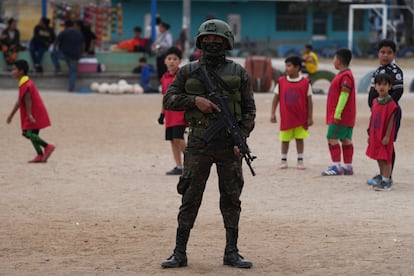
The offensive led Arévalo to authorize the deployment of the army to patrol the streets. However, the response is barely noticeable on the ground. Two days after the attacks, authorities reported the capture of 23 suspected gang members, 17 of whom are allegedly directly linked to the murders. The Attorney General’s Office, however, has only charged one of them with minor offenses: illegal possession of a firearm and drug possession.
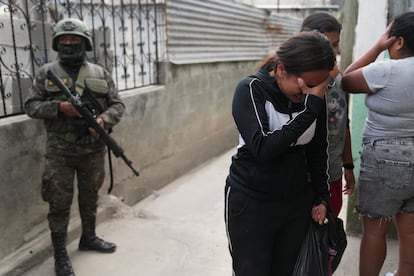
The weekend’s violence has highlighted the enormous challenges the government faces in combating corruption within the country’s prison and justice systems. The clashes began Saturday morning with reports of riots at the Renovación I, Preventivo, and Fraijanes 2 prisons. By late afternoon, authorities confirmed that one of the facilities had been set on fire and that 46 guards were being held hostage after being disarmed. On Sunday morning, during a press conference, Interior Minister Marco Antonio Villeda stated that the attacks were retaliation for the removal of privileges granted to imprisoned gang leaders, who, he said, were demanding king-size beds, air conditioning, and food deliveries from restaurants.
Gangs have permeated the Guatemalan penal system with corruption and obtained privileges within the prisons. One example came to light in June 2024, when the then-minister of the interior, Francisco Jiménez, denounced 102 guards at the maximum-security Canadá prison, known as “El Infiernito” (Little Hell), for allowing the trafficking of weapons, alcohol, and even live animals. Despite the seriousness of the allegations, the government was unable to dismiss the officials due to legal obstacles and only managed to reassign them. Jiménez was finally dismissed in October after the escape of 20 leaders of Barrio 18, a crisis that forced the government to request assistance from the United States. By mid-January, only five had been apprehended. In court, three admitted to paying bribes to guards to escape without resistance. Twenty-five officers were arrested for their alleged involvement.
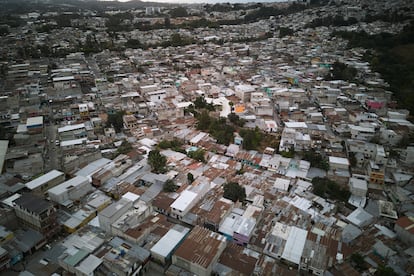
The government appears overwhelmed by the surge in violence. In late December, 12 bodies were found in Santa Lucía Los Ocotes, 15 kilometers north of the capital, in an incident that authorities attributed to a power struggle between the Barrio 18 and Mara Salvatrucha gangs. That same month, the president declared a state of prevention in Indigenous communities in the south of the country after an attack on a military outpost that left at least five dead and 12 wounded. Arévalo and high-ranking security officials have blamed, without providing details, “political-criminal mafias” seeking to destabilize the government. “It is important that we recognize that none of this is a coincidence. We know who is behind it: groups that benefit from the corruption that grows in the shadows,” the president said.
The security crisis coincides with a period of high political tension. In the first quarter of the year, Guatemala must elect a new attorney general and magistrates to the Supreme Electoral Tribunal and the Constitutional Court. Given this scenario, Arévalo requested OAS support at the end of 2025, in a context marked by confrontation with the Public Prosecutor’s Office, headed by Consuelo Porras, whom the president accuses of having tried to prevent him from coming to power and who appears on the U.S. State Department’s list of corrupt officials.
Lissette Lemus, executive director of the Mirna Mack Foundation, asserts that the recent acts of violence in prisons are a political message directed at the Executive branch. “The first half of 2026 marks a decisive moment, in which organized crime is pushing the narrative that the president must be removed from office. They seek to weaken him,” she states.
The state of emergency announced by Arévalo arrived without much explanation and, in practice, without any visible effects. In the capital, it seems as if nothing has happened. The streets maintain their almost unchanged routine. There are no massive military deployments or widespread raids. Police officers stationed in front of the National Palace confirmed that there are no large-scale operations or house-to-house searches underway.
Some people on social media compared the measure to El Salvador’s state of emergency, but the differences are vast. Arévalo emphasized that the decision would not affect daily life or citizens’ rights. Nayib Bukele’s model, on the other hand, involved the suspension of constitutional guarantees and the detention of more than 90,000 people — nearly 2% of the adult population — with documented reports of arbitrary arrests, torture, and deaths in custody. “Here, we can only arrest someone if we catch them with links to a gang,” says a Guatemalan officer. “Until that changes, our hands are tied. All we can do is hope it doesn’t happen again.”
Sign up for our weekly newsletter to get more English-language news coverage from EL PAÍS USA Edition