


Market Update: We break down the business implications, market impact, and expert insights related to Market Update: How a Month of War on Iran Has Remade the World Economy – Full Analysis.
It’s not easy being the world economy right now.
One month into the US and Israeli war on Iran, the shock is upending everything from supply chains to air travel.
As the price of a barrel of oil settles in at north of $100, up from $70 before the war, gas prices in the US are flirting with $4 a gallon, the highest since Russia invaded Ukraine in 2022. And on the other side of the world, consumers in places like the Philippines and India are waiting hours in line for fuel as governments ration dwindling supplies.
“No country will be immune to the effects of this crisis if it continues to go in this direction,” Fatih Birol, the head of the International Energy Agency, told journalists in Australia earlier this week.
This energy supply shock threatens to drive up inflation, which could mean higher interest rates, which can lead to a recession. It’s a delicate balance that is difficult to calibrate in the uncertainty of war. Some economists are warning of a dreaded 1970s -style stagflation, a perfect storm of high prices, a stalled economy, and rising unemployment.
The war is also hammering supply chains for things like helium, a critical component in the semiconductor chips powering the AI revolution, and fertilizer, which could, in time, lead to higher grocery prices.
President Donald Trump says the war on Iran is intended to mitigate what he called the “imminent threat” of its ballistic missiles, alleged nuclear weapons program, and its proxies in the Middle East, like Hezbollah in Lebanon and the Houthis in Yemen.
Iran, however, has shown resilience. How long the war lasts will likely depend on how long the world can withstand its economic impact. Here are some of the major ways that impact is spreading.
The oil shock
Alain JOCARD / AFP
Financial markets begin to crack

Spencer Platt/Getty Images
The spectre of stagflation
Frederic J. BROWN / AFP
Air travel chaos
Marcin Golba/NurPhoto
Supply chain disruptions come for AI and the price of food
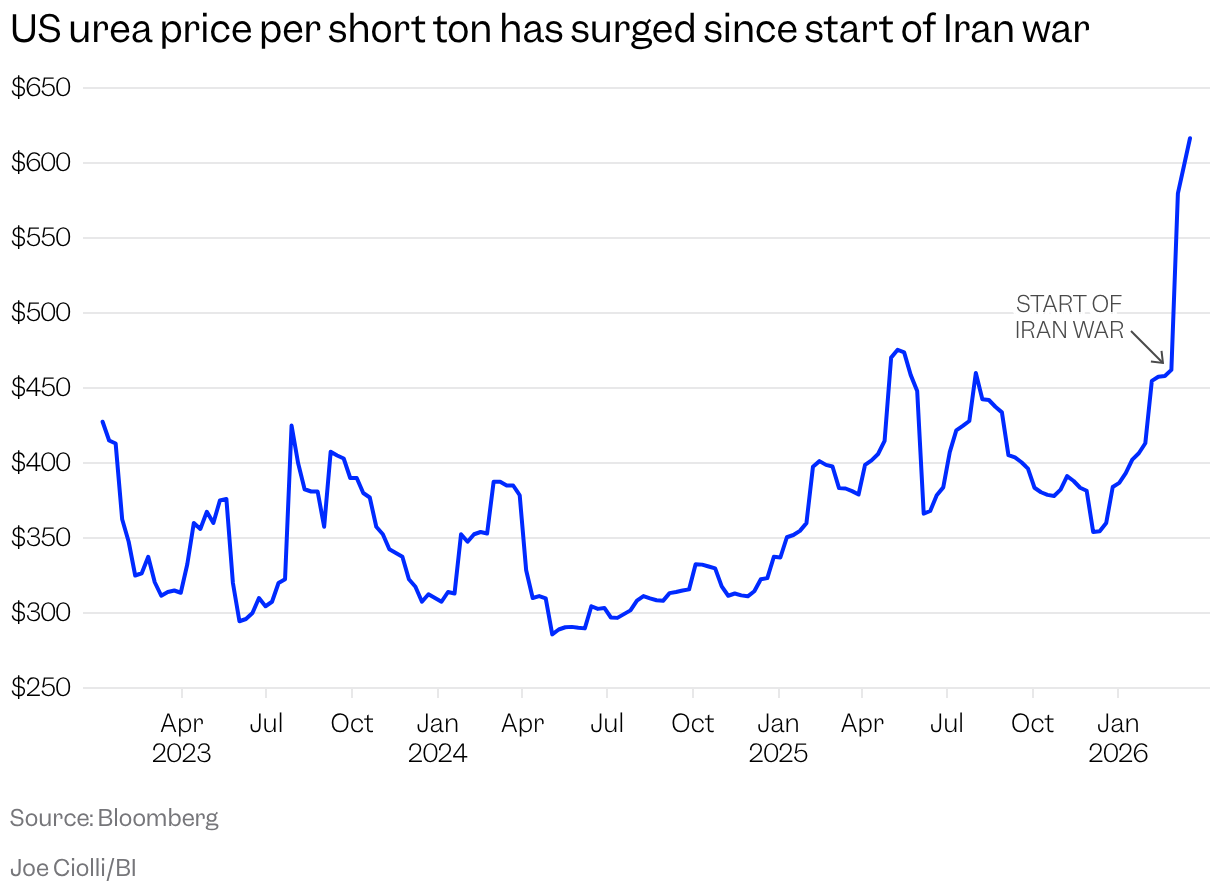
The supply of oil gets most of the headlines. There are other commodities, however, that are also facing supply chain disruptions. And those commodities will affect everything from the AI revolution to food prices.
Sulfur, for instance, is a byproduct of oil and gas processing. It’s wisely recycled to help extract metals like copper and lithium. Those metals are in high demand as AI companies race to build data centers to power their products. They are also used in the production of electric cars.
Sulfur is also key to producing urea, a widely used specialized fertilizer. A third of the global fertilizer supply also passes through the Strait of Hormuz. The prolonged disruption to the fertilizer supply will force farmers to ration its use, resulting in lower crop yields and, ultimately, higher grocery prices, hitting the average consumer where it hurts most.
The war on Iran is also affecting the supply of helium. Qatar supplies nearly one-third of the world’s helium, a byproduct of liquid natural gas production that is critical for semiconductor manufacturing. That’s another blow to AI, one of the key industries propping up the US economy.
It’ll require a peace deal between the US, Israel, and Iran to resolve all these disruptions. For now, a deal remains elusive.