


Breaking Update: Here’s a clear explanation of the latest developments related to Breaking News:Which is the better laptop?– What Just Happened and why it matters right now.

The ASUS Zenbook 14 and Lenovo Yoga Slim 7 are two premium laptops available on the Indian market. The former focuses on design and premium looks, while the latter strives to deliver a balanced experience in multiple aspects, including performance and battery life.
The question is: Which laptop is better overall, the ASUS Zenbook 14 or the Lenovo Yoga Slim 7? That’s what we are looking into in this article.
ASUS Zenbook 14 vs Lenovo Yoga Slim 7: Detailed comparison
Specs comparison
Here are the specs of the ASUS Zenbook 14 and Lenovo Yoga Slim 7:
Design, build quality, and display

Both the ASUS Zenbook 14 and the Lenovo Yoga Slim 7 have chassis built entirely from aluminum, but there are some subtle differences. The Zenbook uses anodized aluminum with a ceramic coating, which ASUS collectively calls Ceraluminum. Basically, it gives the same strength and durability as anodized aluminum, but the surface finish is much nicer to the touch.
In comparison, the Lenovo Yoga Slim 7 uses stamped anodized aluminum, which provides great durability but isn’t as nice to the touch as the Zenbook. Moreover, the ASUS laptop is much lighter. Overall, the ASUS Zenbook 14 wins in both build quality and design.
As for their displays, both the Zenbook 14 and the Lenovo Yoga Slim 7 feature OLED panels capable of accurate color reproduction and deep black levels. However, the ASUS laptop wins again due to its higher resolution and faster refresh rate, which significantly enhances the user experience over that of the Lenovo Yoga Slim 7. Moreover, the Zenbook’s screen is touch-enabled.
Productivity and performance

The ASUS Zenbook 14 is powered by the second-generation Intel Core Ultra 5 225H, while the Lenovo Yoga Slim 7 features the first-generation Intel Core Ultra 9 185H. At first glance, users may think the Core Ultra 9 can easily beat the Ultra 5, but that’s not always how it works. After all, there’s a generational gap between the two.
According to Geekbench, Cinebench, and PassMark benchmarks, the second-gen Intel Core Ultra 5 225H is faster than the Core Ultra 9 185H in single-core performance but slightly slower in multi-core benchmarks. However, the differences are not large enough to be noticeable in real-world apps and programs, where they will both perform extremely close to each other.
In other words, neither processor has any meaningful performance advantage over the other. You will get similar performance from both the ASUS Zenbook 14 and the Lenovo Yoga Slim 7, but the latter has double the memory, which can be useful for content creation and AI workloads.
Read more: 5 best things to improve gaming performance in Windows 11
Battery, speakers, and pricing
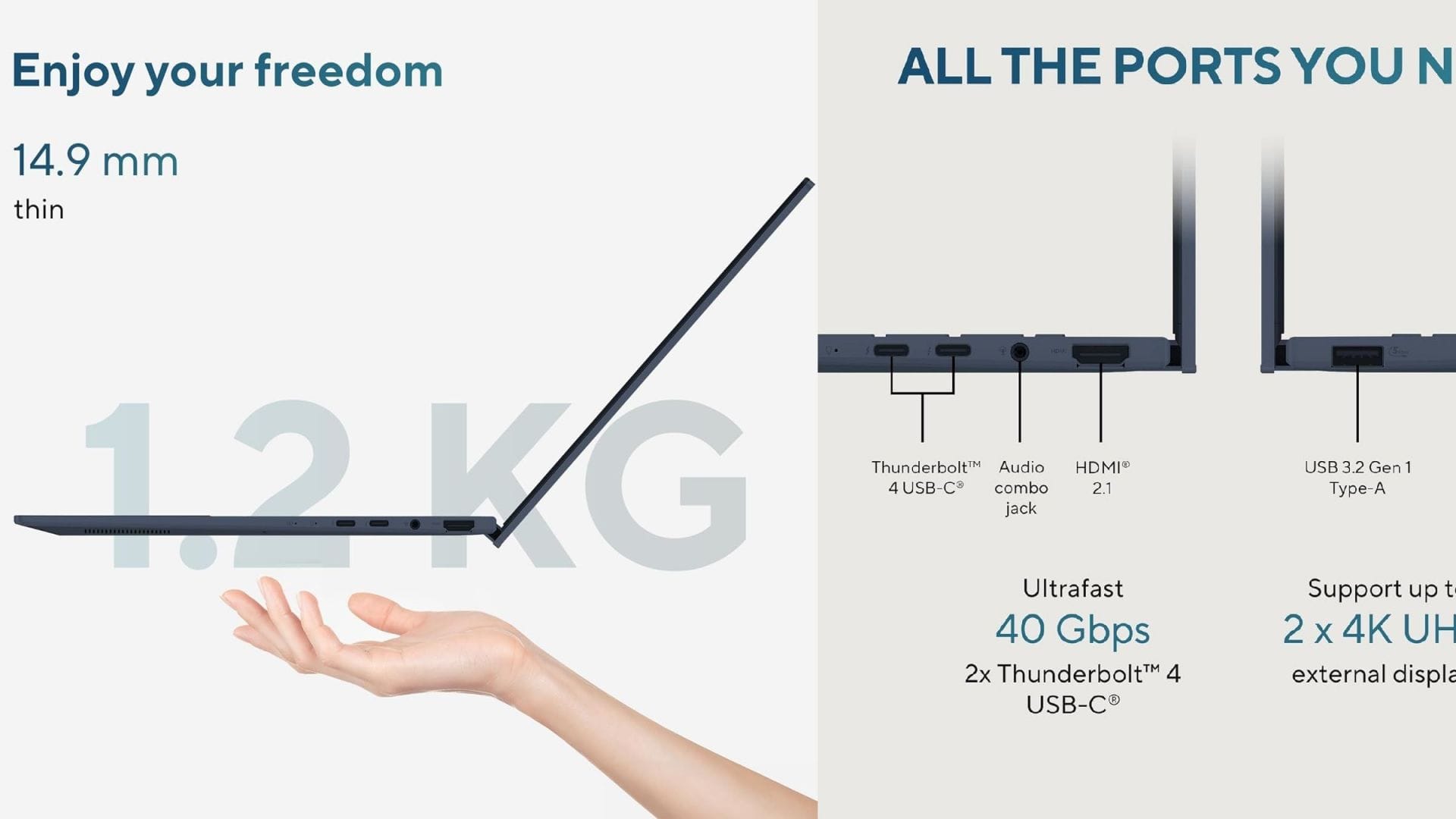
The ASUS Zenbook 14 features a 75Wh battery, while the Lenovo Yoga Slim 7 has a 65Wh unit. However, the latter wins in terms of battery life despite having a smaller battery, thanks to its lower power-consumption CPU and better voltage tuning. The Zenbook laptop can last around 9 -12 hours on lighter mixed usage, while the Lenovo Yoga Slim 7 can last 13 -15 hours on a similar usage.
Moreover, the ASUS Zenbook 14 features two well-tuned 2W bottom-firing speakers, which are decent but nothing out of the ordinary. In comparison, the Lenovo Yoga Slim 7 is equipped with two 2W tweeters and two 2W sub-woofers, which deliver a fuller sound and much richer bass. In other words, the Lenovo laptop has a much better sound system.
As for pricing, the ASUS Zenbook 14 (UX3405CA-PZ162WS) starts at ₹1,05,990 on Amazon, while the Lenovo Yoga Slim 7 (83CV00B3IN) costs ₹1,09,990 on the same. Therefore, their prices are similar for now, although they might change in the future due to the ongoing memory crisis.
Which laptop is better overall?
The ASUS Zenbook 14 features a better build quality, design, and display. In comparison, the Lenovo Yoga Slim 7 offers double the RAM, longer battery life, and better-sounding speakers.
Since both laptops deliver similar performance, the Lenovo Yoga Slim 7 is the overall better option for most users.
Read more: Redesigned MacBook Pro 2026: What Apple’s rumored overhaul could bring next year
Edited by Niladri Roy