


Breaking Update: Here’s a clear explanation of the latest developments related to Breaking News:Water discovery fuels return to Moon– What Just Happened and why it matters right now.
If all systems are go and barring force majeure , four astronauts will in two days lift off towards the Moon on a giant rocket, becoming the first humans to head in that direction in over 50 years, since Nasa’s Apollo programme ended in 1972. After technical delays in Feb and March, Nasa is now preparing for launch on April 1 (April 2 in India).The astronauts will not land. Instead, they will fly a loop around the Moon, breaking at least two spaceflight records. Depending on launch timing and trajectory, the crew of Artemis 2 are expected to reach a peak distance of over 4 lakh km from Earth, the farthest humans have travelled since Apollo 13 in 1970. They are also likely to hit 40,000 kmph on return, faster than Apollo 10’s record of 39,897 kmph, in 1969.
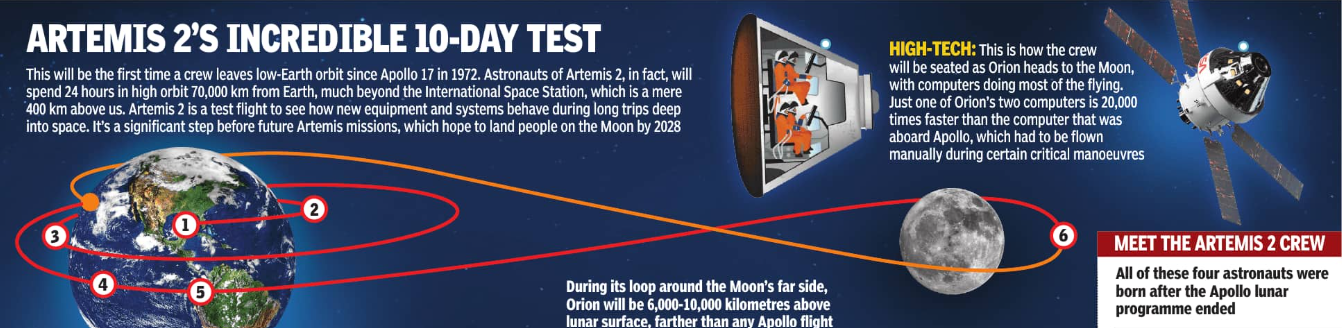
Incredible 10-day test
The launch is historic, a revival of crewed lunar missions. And it’s the discovery of water by Chandrayaan-1 that helped reignite humanity’s interest in the Moon.Nasa’s crewed missions ended after Apollo 17. Analysis of lunar rocks returned by US astronauts led scientists to conclude the Moon lacked water and geological activity. Without water, there could be no sustained human presence. Every kilogram needed for life support or propulsion would have to be launched from Earth, making missions extremely impractical.“After the landings on the were concerned former isro oversaw Moon, people took a view that there was nothing much of interest there, that it was an uninhabitable place,” says G Madhavan Nair, former Indian Space Research Organisation (Isro) chairman, who oversaw Chandrayaan-1.
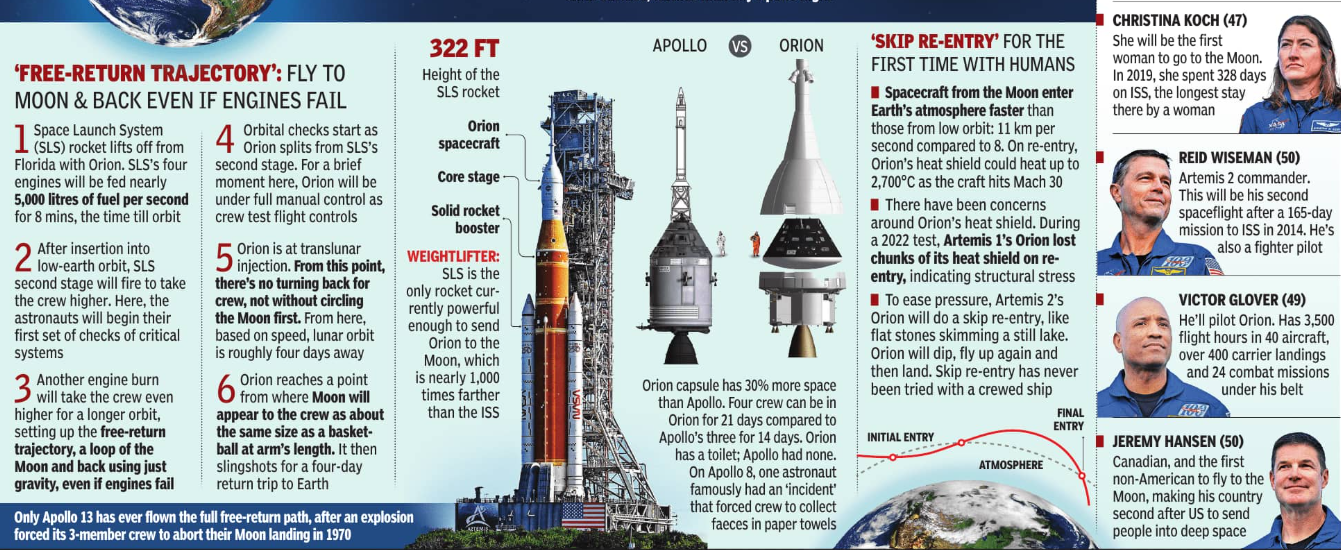
The astronauts will not land. Instead, they will fly a loop around the Moon, breaking at least two spaceflight records.
Designed as a remotesensing mission, it had Indian and international instruments, including Nasa ’ s Moon Mineralogy Mapper and Isro ’ s own spectrometer. The mission was not built around certainty that water would be found.“But the theory existed. That is why a Nasa payload with the ability to detect water lines was flown on Chandrayaan-1, along with our spectrometer,” says S Somanath, former Isro chairman, who oversaw Chandrayaan-3 in 2023.The data that came back was subtle, and the response cautious. Spectral signatures indicated hydroxyl and water molecules embedded in lunar minerals across large regions of the surface, with higher concentrations towards the poles. “Once the American side published the presence of water on the Moon, we published our data which had also found that it was true,” Somanath says.Nair says the discovery was a “combined effort” as both the Nasa and Isro datasets confirmed water. Further analysis suggested water could exist as ice in permanently shadowed areas of the Moon. “In the southern polar region, in deep craters,there are billions of tonnes of ice,” says Nair, adding: “That was a huge finding as far as future missions were concerned, because you need water for everything. If water is there, you can even make hydrogen out of it and use it as fuel for a rocket.”Somanath says when hydroxyl molecules were identified, especially near the poles, the “possibility of finding trapped water or ice became real”. In the absence of an atmosphere, water cannot remain liquid on the surface, but buried in polar regolith, it becomes a viable resource.It wasn’t just water. Chandrayaan-1 also found significant helium deposits, including helium-3, an isotope often cited as future fuel for nuclear fusion.M Annadurai, project director, Chandrayaan-1, says the orbiter ’ s impact is broadly acknowledged. “Things revived because of Chandrayaan-1. There is no doubt about that. The mission is frequently cited in international forums,” he says. The post-Chandrayaan vision now goes beyond brief visits, including longer stays, international cooperation, a possible lunar space station, and missions deeper into space.“The Moon becomes an outpost, a launch pad to Mars,” Annadurai says. In 2023, Isro landed Chandrayaan-3 near the Moon’s south pole. The craft sent data on regolith behaviour, thermal properties and seismic activity.“It gave us direct surfacelevel information that earlier missions could only infer remotely. Together, the missions demonstrated that the Moon was not geologically inert, that it was not a dead body,” Somanath says.The timing mattered too. Chandrayaan had coincided with maturation of low-cost robotic technologies, making lunar missions accessible to more actors. After its findings, missions were commissioned by the US, Russia, Japan, and several European, Arab and African nations.China had its lunar programme plans running parallel. The US adopted a commercial model, funding multiple private landers and orbiters that fed into Artemis planning. Importantly, by the time Nasa formally committed to Artemis — a programme that has so far cost an estimated $90 billion — the scientific justification was in place.So as the four astronauts of Artemis 2 get ready for the much-awaited — and delayed — launch, they carry with them more than the legacy of the Apollo programme.