

Breaking Update: Here’s a clear explanation of the latest developments related to Breaking News:‘Humans are fatter than ever before — GLP-1s can bridge the gap between evolution and modernity’– What Just Happened and why it matters right now.

Susan A. Jebb OBE, Chair of the UK’s Food Standards Agency, is Professor, Diet and Population Health, Oxford University. Speaking to Srijana Mitra Das at Times Evoke, Jebb explains weight — and well-being:Are we humans fatter now than ever before in planetary history?■ On average, we are definitely fatter than we’ve ever been. There has been a steady increase in the average weight of nations around the planet. This is a consequence of enormous changes in the world we live in. Humans evolved in an environment where food was scarce and you had to work very hard to get it — neither of those are true anymore for most people. Many around the world now have access to more food than they need — it’s easily available, palatable and cheaper than it’s been in a historical sense.Alongside, our lives have grown less and less physically active. With gadgets and modern work-lives, most people in highor middle-income countries spend fairly sedentary days. To be physically active, you have to go out and find opportunities. That has fundamentally changed our world — food is now plentiful while energy requirements are low.Hence, obesity is a perfectly normal response to what is quite an abnormal environment. Our evolution cannot keep pace with the rate of change in our environment. We were born with genes which encourage us to eat freely when food is available because it might become scarce later — those genes are not serving us well in a world of plenty.
–
What do you think of the spread of GLP-1 medications, including among people who are overweight but not diabetic?■ These drugs are effective treatments for people who are very overweight. They mimic the effect of our natural ‘I’m full’ hormones. They actually demonstrate how obesity is in part a biological phenomenon as when you boost the ‘I’m full’ signals through these treat-ments, people spontaneously reduce their food intake and lose weight. However, as soon as you stop these drugs, your appetite surges back to its baseline levels. Then, people have to work very hard and exert high levels of conscious control to restrict their eating. For most people, that’s quite tough — and they regain weight. These drugs must therefore be part of a holistic package of care — a healthy diet and physical activity remain absolutely crucial.

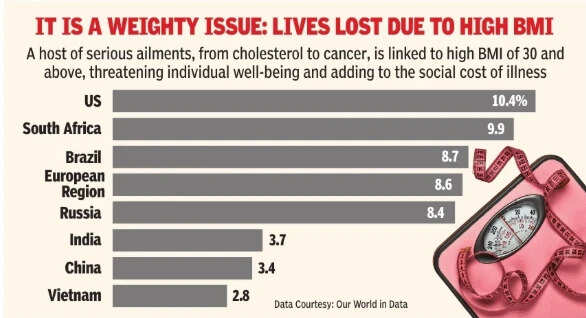
HOW THE TABLES TURNED: Once, humans struggled to obtain food which was often scarce — today, food is plentiful and cheap but our evolutionary track still leads many to overeat while leading sedentary lives, driving serious ailments and treatments like GLP-1s
Should non-diabetic people even use these medicines to lose weight?■ These were developed first for diabetes but they have been extensively tested for treating obesity and they have specific licensing and approval for this. These drugs have been repurposed but that’s not unusual. It’s reassuring they’ve been used for diabetes for some time and we haven’t seen many worrying side effects.Yet, once people stop taking them, don’t they face the same high blood pressure, greater cholesterol, etc., they had before using GLP-1s?■ We conducted a systematic review of the literature on what happens after you stop weight loss medications. We found that with GLP-1s, people would lose about 15 kgs — but, one year later, coming off the drugs, they regained about 10 kgs. It’s also very dramatic since it’s much faster weight regaining than seen after, say, traditional dieting.Hence, there are key lessons here. First, within healthcare systems, we must understand obesity is a chronic, relapsing condition and people need long-term treatment. Those buying these medications must understand it won’t be like, ‘I’ll take this for a year and get cured’. Obesity is a chronic relapsing condition and after stopping these treatments, people regain weight. Of course, any duration when you are less heavy has health benefits because metabolic harms are essentially a function of how overweight you are and how long you’re carrying that excess weight. So, any time your weight is below where you’d have been otherwise has long-term health gains — the longer you stay at a lower weight will always benefit you.As India grows economically, high-fat diets, accessed through ordering in, dining out and ‘aspirational’ packaged foods, are causing illnesses — what are your views?■ I’m extremely concerned and worried for India. In the United Kingdom, poor diets are the leading cause of avoidable ill health — this is mostly from eating too much, consuming too many calories, saturated fat, sugar and salt. Each increases health issues, particularly cardiovascular, with cancer risks.The first thing I’d say to India now is — look at the mistakes we made in the UK and avoid going down the same path. This involves action at several levels. First, we need a healthy food system where people can retain local foods and traditional ways of eating, which have been proven beneficial for health. We need regulations that support the maintenance of local food systems — and resist the worst excesses of big multinationals who sell products high in saturated fat, sugar and salt. In the UK, we’re now trying to put the cat back in the bag — we’ve placed some guardrails around industry. There’s been some tightening on advertising unhealthy foods to children on television and online. We’ve put restrictions on promotions offered in grocery stores. But we need to go much further because we are still seeing obesity rates rise in the UK.What can the obesity crisis learn from how smoking was reduced worldwide?■ Around 50 years ago, in the UK, more than half of adults were regular smokers — today, that’s come down to 12%. Progress was made through three ways. First, we provided support to people who smoked to help them quit. Second, we limited the tobacco industry through restrictions on advertisements. Curbs were also set on places where people could smoke and the price of smoking was raised substantially through tax. Third, there was a shift in culture — it became ‘uncool’ to smoke. People found it socially much tougher to smoke because you just couldn’t do so indoors and in many locations.Now, obesity has several treatments — but we have to offer people support. Losing weight on your own is very hard — losing it with support is far more successful. Second, we must put constraints on the unhelpful practices of the food industry. Unlike tobacco, we’re not trying to put the food trade out of business — food is a source of health and joy but it must be the right kind. We need food that benefits people and the planet. We must stop businesses from making money on the back of unhealthy food. The third challenge is shaping social norms to value healthy diets with fresh, minimally processed foods.We humans are creatures of both mind and body — why can’t we see the irony of a harmful food industry and a dramatic weight loss business growing together?■ Often, there is a disconnect between our rational, objective selves and the much more automatic act of eating. We eat so many times every day, we don’t give it much thought. We just slip into default mode. If something’s convenient, we eat it before we’ve thought about the consequences. Each individual item feels small in relation to the rest of our diet. So, there’s a gap between our best intentions — almost everybody wants to be healthy — and the incredible difficulty to enact that in reality. The environment we live in also makes bridging that gap hard. We are susceptible to making automatic decisions about food — and we live in a modernity where those decisions are often unhealthy ones.

NEW MENU: As diners learn of food value, more restaurants must highlight nutrition
India will now produce lower-cost weight-loss medications, reaching more people — given this, will the global food industry improve its act or just do more of the same?■ I really hope this will be a wake-up call for the food industry. Perhaps GLPs are exactly the treatment the food industry itself needs — if a significant number of people take medications which reduce their appetite and limit food impulses, they will become much more selective about what they eat. The food industry will have to ensure products are carefully positioned for people who have become more weight-conscious. The industry could provide much more nutrient-dense foods, without excessive fat and sugar. Currently, the middle and lower end of market meals feature very large portions as it’s become a value-for-money thing — but people don’t need massive pizza slices that have 1,500 calories. We need to see portion sizes changing. We also need a shift in the global coffee culture which has grown over the last decade, where one cup comes loaded with cream, muffins and several hundred calories. All that should be replaced by much smaller portions of high-quality food.

COFFEE — OR TOFFEE? From a grown-up drink, coffee is now like dessert
I think more people will start saying, ‘I’m controlling my weight but what else is food doing to my body?’ They’ll consider food’s nutritional quality and not just count calories. We must ensure GLPs become a positive disruptive technology that can help people control their weight — and reform our food system.Views expressed are personal