


Breaking Update: Here’s a clear explanation of the latest developments related to Breaking News:All 5 fundamental units of life’s genetic code were just discovered in an asteroid sample– What Just Happened and why it matters right now.
A new study reveals all five fundamental nucleobases – the molecular “letters” of life – have been detected in samples from the asteroid Ryugu.
Asteroid particles offer a glimpse into the chemical ingredients that may have helped kindle life on Earth. The Ryugu samples were returned from space in 2020 by Japan Aerospace Exploration Agency’s (JAXA) Hayabusa2 mission.
In 2023, an international team reported they had found one of the nucleobases in these samples – uracil. Now, in a study published in Nature Astronomy today, a team of Japanese scientists has confirmed all five nucleobases are present in this pristine asteroid material.
This means these ingredients for life may have been widespread throughout the Solar System in its early years.
Why look for nucleobases?
Nucleobases are nitrogen-containing organic molecules that form the “letters” of genetic information in DNA and RNA. The five main nucleobases are adenine and guanine (known as purines), as well as cytosine, thymine and uracil (known as pyrimidines).
These molecules combine with sugars and phosphates to yield nucleotides – the building blocks of genetic material. Without nucleobases, the genetic code that allows organisms to grow, reproduce and evolve would not exist.
Wikimedia Commons, CC BY-SA
By studying purines and pyrimidines in Ryugu samples, scientists can reconstruct the chemical history of primitive asteroids. In turn, this gives us a better understanding of how the building blocks of life may have been formed and existed across the Solar System.
Hayabusa2 delivered a total of 5.4 grams of pristine asteroid material. Researchers have to use ultra-clean lab conditions to avoid contaminating it. They extracted organic molecules using water and hydrocholoric acid, and then purified them for further detection.
They found all five nucleobases in the two Ryugu samples they analysed, in roughly similar amounts.
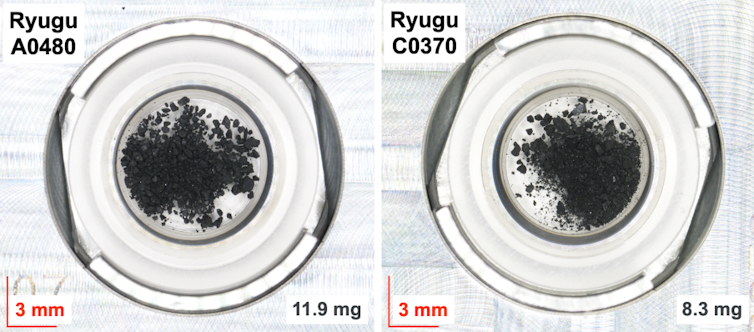
JAXA/JAMSTEC
Key components of genetic material – in space
The new results align with previous findings on space rocks. The Murchison meteorite that fell in Australia in 1969, and the Orgueil meteorite in France, 1864, have previously yielded a rich variety of organic molecules, including nucleobases.
Of course, meteorites that land on Earth can be contaminated by their journey and landing. But pristine samples from NASA’s mission to asteroid Bennu also yielded all five nucleobases in 2025.
Asteroids such as Ryugu, Bennu, and the parent body of the Orgueil meteorite are remnants of the early Solar System. They can preserve materials largely unchanged for about 4.5 billion years.
Interestingly, these asteroids show chemical differences. Murchison is enriched in purines, while Bennu and Orgueil contain more pyrimidines. It is thought this balance may be influenced by ammonia, a key molecule that can shape which nucleobases can form.
By peering into Ryugu’s relatively pristine samples and comparing them with meteorites like Murchison and Orgueil, researchers are tracing the cosmic journey of life’s probable molecular ingredients.
Their results suggest key components of genetic material may have formed in space and later delivered to the early Earth. In other words, the story of life on our planet may be deeply connected to the chemistry of such ancient asteroids.
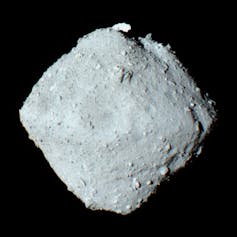
JAXA/Hayabusa2
A path for the ingredients of life
Together, these discoveries show that carbon-rich asteroids throughout the Solar System contain diverse prebiotic chemistry. However, the precise mixture of molecules – such as the balance between purines and pyrimidines – varies depending on the asteroid’s chemical environment and history.
Because the Ryugu samples were collected directly in space and protected from Earth’s contamination, they provide one of the clearest views of ancient Solar System chemistry.
The discovery of all five nucleobases on Ryugu suggests the molecular ingredients of life may have been already forming in space billions of years ago. Asteroids may have helped deliver those ingredients to the early Earth – making the origin of life part of a much larger cosmic chemical story.