

Breaking Update: Here’s a clear explanation of the latest developments related to Breaking News:Apple’s H2 change for AirPods Max 2 is primed for upgrades– What Just Happened and why it matters right now.
In a new interview, Apple execs talk about how and why the AirPods Max 2 update significantly boost its performance. The ultimate aim is making future models only limited by acoustic physics.
Apple’s update to the AirPods Max 2 are what we would call a spec-bump update. As detailed in our review, the new model looks exactly like the previous one, but with all of its changes being internal.
It’s a reuse of a five-year-old design with no real exterior improvements, but a change in its processing capabilities.
In an interview with TechRadar, Apple VP of Platform Architecture Tim Millet and Director of Audio Product Marketing Eric Treski justify the update to the H1 chip and the new digital amplifier, and the future potential of the changes.
Max H2 headroom
Starting off the interview, Millet says that Apple designs chips for the product. Since it keeps its chips in-house and not sold elsewhere, Apple’s design team has the “luxury” of building with specific products in mind.
The H2 is an audio streaming processor that was co-designed by acoustics and firmware teams. According to Millet, the goal was to make sure that the chips were “only limited by the physics.”
The change from the H1 to the H2 chip provides a considerable increase in processing performance, especially for headphones. Millet insists that some of the processing handled by the H2 exceeds that of a Mac for the same tasks.
This improvement is down to the H2 being made specifically for audio. This also makes it deliverable in such small form factors.
This includes “giga-operations of floating point implemented in the most efficient way possible,” Millet adds. All of this to cut down latency, as tricking the mind with audio is hard if you have it.
Better ANC through processing
Apple boasted that the AirPods Max 2 has a 1.5x improvement when it comes to active noise cancellation. Startlingly, this is entirely driven through processing, as no related physical components were changed at all.
The actual design of the AirPods Max 2 was not changed from the original form at all, Treski says. This makes the feat of improving the ANC by so much a massive feat, he adds.
The 1.5-times improvement extends across an average of all frequencies picked up by the headphones, not a specific frequency band, Tresky insists. There’s no cherry-picking of frequency ranges, which will translate into better blocking of louder or high-pitched sounds.
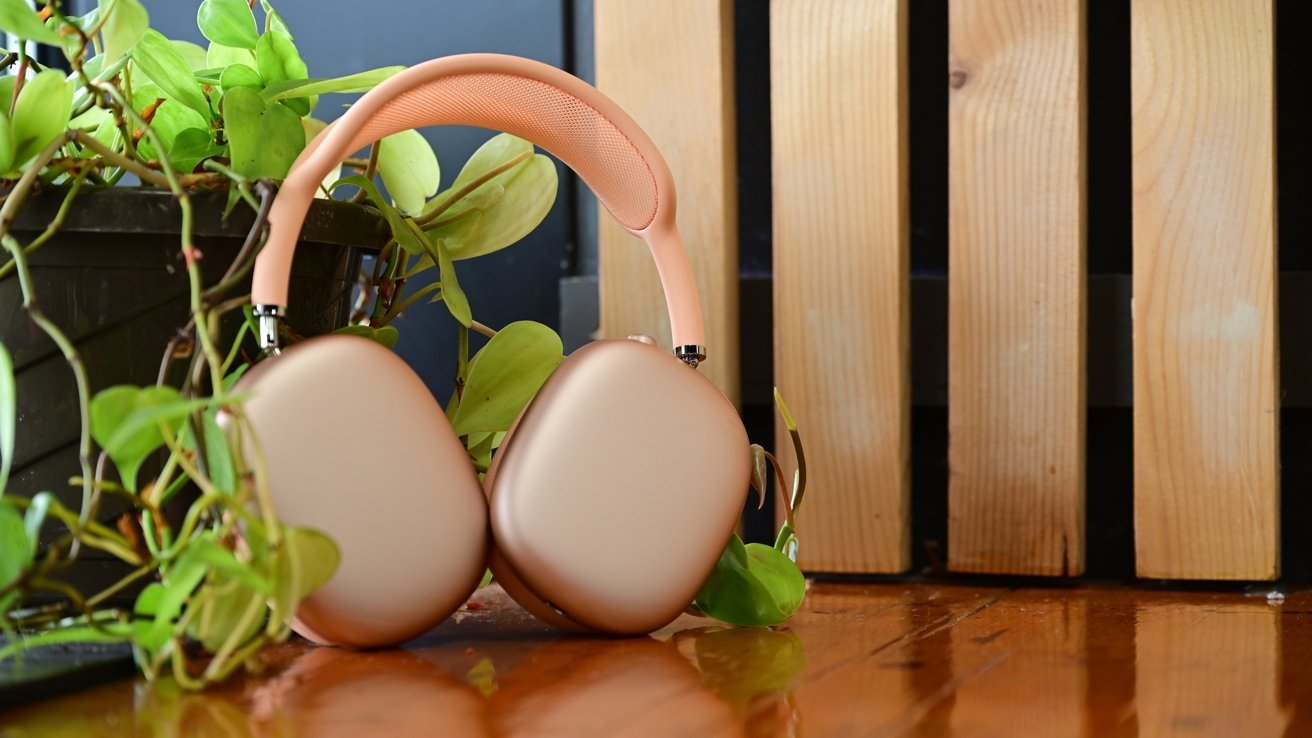
AirPods Max 2 have the H2 chip.
Beating the first model’s ANC in this way is all through changes to processing performance and changes to algorithms running on the H2.
The chip change also brought with it some new features, including Adaptive Audio. To block some sounds while letting others through required the H2’s processing capabilities and significant headroom for more.
Digital amplifier effects
The H2 was the key change for most of the features of the AirPods Max 2, but it wasn’t the only one. There was also a switch to a new digital amplifier, borrowed from the AirPods Pro 3.
Changing the amplifier was an audio quality play to reduce distortion and to improve the reference accuracy. Even so, Treski says that the change provides “a lot more headroom to sort of play with” and to get more clarity.
It’s a change that also impacts other elements of the headphones. For example, Treski says that Adaptive EQ now runs continuously and cannot be switched off.
The Adaptive EQ uses the air-correcting mic as a reference mic and updates at 48,000 times per second at the higher frequency ranges. Treski explains that it is really important to perform this in real-time, especially when using ANC.
Personalized Spatial Audio also benefits from the changes. Under the previous AirPods Max, which didn’t have Personalized Spatial Audio, Apple had to make a single profile for all users, forcing the engineers to be a little more conservative.
With personalization, Treski says Apple can “take more liberties” with the system.
H2 as a platform
Other features like Live Translation, Conversation Awareness, Voice Isolation, and others all use the same architecture. To Apple, this is more about creating a system, rather than working to add a single specific feature.
Millet proposes that H2 is a platform that has “continued headroom,” and that the features the AirPods Max 2 ships with are not the eventual ceiling for its capability.
Much like how AirPods Pro has received software updates expanding their remit over time, you can expect similar from the AirPods Max 2.
Apple’s engineers have seemingly settled on strong hardware as a base, and has given themselves room to add more software-based functionality in the future.
This is a choice that relies on Apple retaining the same physical design over time, but to look inward for change.