


Explained: This article explains the political background, key decisions, and possible outcomes related to Explained : Is Indian Cinema Losing its Moral Voice? and Its Impact and why it matters right now.
Nations, among other things, are repositories of memory wherein some memories console, others caution, and a few haunt. India, as a modern republic, was born carrying all three sets of memories. The midnight of freedom in 1947 was illuminated by the promise of self-rule, yes, but also shadowed by the inferno of Partition. It was a moment when history moved with brutal velocity, tearing apart geographies, rupturing identities, and leaving millions suspended between belonging and exile.
The violence that unfolded across the Radcliffe Line was a civilisational fracture. Neighbours turned into adversaries, homes into memories, and memory into an inheritance of pain. In such a moment, the easier path for a newly independent nation would have been to retreat into the comfort of majoritarian certainty, to define itself in opposition to the “other” that Partition had so violently produced. India, of course, chose otherwise.
The leadership of the freedom movement—figures like Mahatma Gandhi, Jawaharlal Nehru, Maulana Azad, and Sardar Vallabhbhai Patel—understood that the true test of Independence lay in the ethical imagination of the republic. They envisioned India as a conversation among diversities, not a fortress of identity. Secularism, in this sense, was a necessity. It was a political articulation of a civilisational habit of coexistence.
Yet, ideas do not survive by proclamation alone. They require cultural reinforcement, a continuous retelling across mediums that shape public consciousness. This, among others, is the argument Benedict Anderson makes in Imagined Communities. In the decades immediately following Independence, Indian cinema arose to this responsibility with remarkable sensitivity. It did not shy away from the wounds of Partition but refused to turn them into spectacles of hatred.
Let us consider Dhool Ka Phool (1959), where a child born out of wedlock becomes the site of a profound moral inquiry. The iconic line: “Tu Hindu banega na Musalman banega, insaan ki aulaad hai, insaan banega [You shall become neither Hindu nor Muslim, you are born of a human, and a human you shall become],” was a philosophical assertion of the primacy of humanity over imposed identities. In a nation still reeling from the aftershocks of Partition, such narratives offered a vocabulary of healing, a way to imagine coexistence beyond inherited divisions.
Or take Garm Hava (1974), a quiet yet deeply affecting portrayal of a Muslim family navigating the uncertainties of post-Partition India. The film resists grand declarations. Instead, it dwells in silences, in the hesitant footsteps of its protagonist, in the pauses that carry more weight than words, in the unspoken anxieties of belonging. It reminds us that the trauma of what historians have called “The Long Partition” seeped into the textures of everyday life, shaping decisions, distorting certainties, and recasting hope itself.
Even Mother India (1957), often read as nationalist epic, is fundamentally a story of moral resilience. It constructs the nation as an ethical ideal, one that demands sacrifice, justice, and compassion. The “mother” here is not exclusionary; she embodies a collective conscience. These films, among many others, held together a fragile social fabric by reminding audiences of a shared moral universe. They acknowledged differences but resisted the temptation to weaponise them. In short, they sought to heal, not reopen wounds.
When films repeatedly frame certain communities as threats or others as perpetual victims, they reconfigure the moral imagination of the audience. Here, a theatre in Delhi screening The Kashmir Files, on March 21, 2022.
| Photo Credit:
Sajjad Hussain/AFP
It is against this backdrop that the contemporary cinematic landscape invites closer scrutiny. In recent years, we have witnessed films such as The Kashmir Files, The Kerala Story, and Dhurandhar, each claiming to present a certain “truth”, a corrective to what is perceived as historical silence or distortion. The issue, however, is not whether cinema should engage with difficult or contested histories, which it must. The pressing question is how it chooses to do so and how the language of cinema is mobilised: is it mobilised as a tool of inquiry or of persuasion?
The past as a settled moral verdict
What distinguishes many of these recent productions is not their subject matter but their narrative intent. Complexity is often replaced with certainty, and nuance yields to assertion. The past is not explored as a terrain of competing memories but presented as a settled moral verdict. In this process, history risks being reduced to a script, selectively curated to evoke rage, consolidate identities, and affirm preconceived narratives.
Take The Kashmir Files, for instance. The tragedy it invokes is undeniable and demands acknowledgement. Yet, the cinematic treatment has been critiqued for collapsing a deeply complex historical context into a binary moral frame. Suffering, instead of becoming a site for empathy across communities, is mobilised to reinforce division. Similarly, The Kerala Story operates within a framework that blurs the line between representation and exaggeration. By amplifying selective narratives without adequate contextual grounding, it risks transforming individual experiences into generalised suspicion. The consequence is not greater understanding but heightened polarisation.
The recent Dhurandhar series unambiguously situates itself firmly within the terrain of contemporary political contestation, where storytelling increasingly risks mirroring power rather than questioning it. In such narratives, cinema appears to drift toward alignment with dominant currents, privileging affirmation over inquiry and spectacle over critical engagement. Eroded in this process is the capacity of art to stand apart from its moment, to question it, unsettle it, and hold a mirror that does not flatter but reveals.
Let me clarify: the concern here is neither censorship nor the policing of artistic expression. At stake is something far more foundational. It is the recognition that a vibrant democracy derives its strength from the coexistence of multiple narratives, including those that unsettle, question, and challenge dominant perspectives.
However, when a discernible pattern begins to emerge where a significant strand of cultural production repeatedly gravitates towards a singular, majoritarian imagination, it compels us to pause. Such a trend is not merely an aesthetic shift; it is a commentary on the state of our public discourse. For when storytelling becomes unidirectional, it risks narrowing the space for dissent, flattening complexity, and, in the process, eroding the delicate architecture of plurality and shared existence that sustains the idea of India. Cinema, after all, is not a neutral medium because it shapes perceptions, influences emotions, and, over time, constructs what a society comes to accept as “common sense”. When films repeatedly frame certain communities as threats or others as perpetual victims, they reconfigure the moral imagination of the audience.
This is where the contrast with earlier cinema becomes instructive. Films like Garm Hava did not deny pain; they contextualised it. They invited viewers to inhabit the lives of those different from themselves, to recognise shared vulnerabilities. In doing so, they expanded the boundaries of empathy and compassion. Today, much of what passes for “realist” or “truth-telling” cinema risks doing the opposite by narrowing empathy, confining it within the boundaries of identity, and, in extreme cases, transforming it into a tool of exclusion. The “other” is no longer a fellow citizen with a different story but a perpetual adversary in a moral narrative.
When cultural narratives undermine plural ethos of India
The implications of this shift extend beyond cinema, touching upon the very idea of India. The republic was envisioned as a space where multiple identities could coexist without fear and where citizenship was not contingent upon cultural conformity. This vision is enshrined in the Constitution, a document that reflects both the trauma of Partition and the determination to transcend it. When cultural narratives begin to undermine this ethos, they actively participate in its transformation. The danger lies not in any single film but in the cumulative effect of many such narratives, each reinforcing a worldview in which coexistence appears fragile, and suspicion becomes normalised.
There is another dimension to this reckoning that demands attention where cinema is also about projection, in both senses of the word. It projects images onto a screen, but it equally projects an image of a civilisation outward, onto the world. Bollywood has long been one of India’s most consequential instruments of soft power, one of the largest centres of cultural production on the planet, reaching audiences across South Asia, the Middle East, Africa, and beyond. For decades, it projected an India that was plural, romantic, contradictory, and irrepressibly alive. It is a country that the world genuinely loves. But what image are we projecting now? Is it not one of insecurity, suspicion, and communal grievance? The consequences are already visible: some of these films have been banned in several countries that we call our allies.
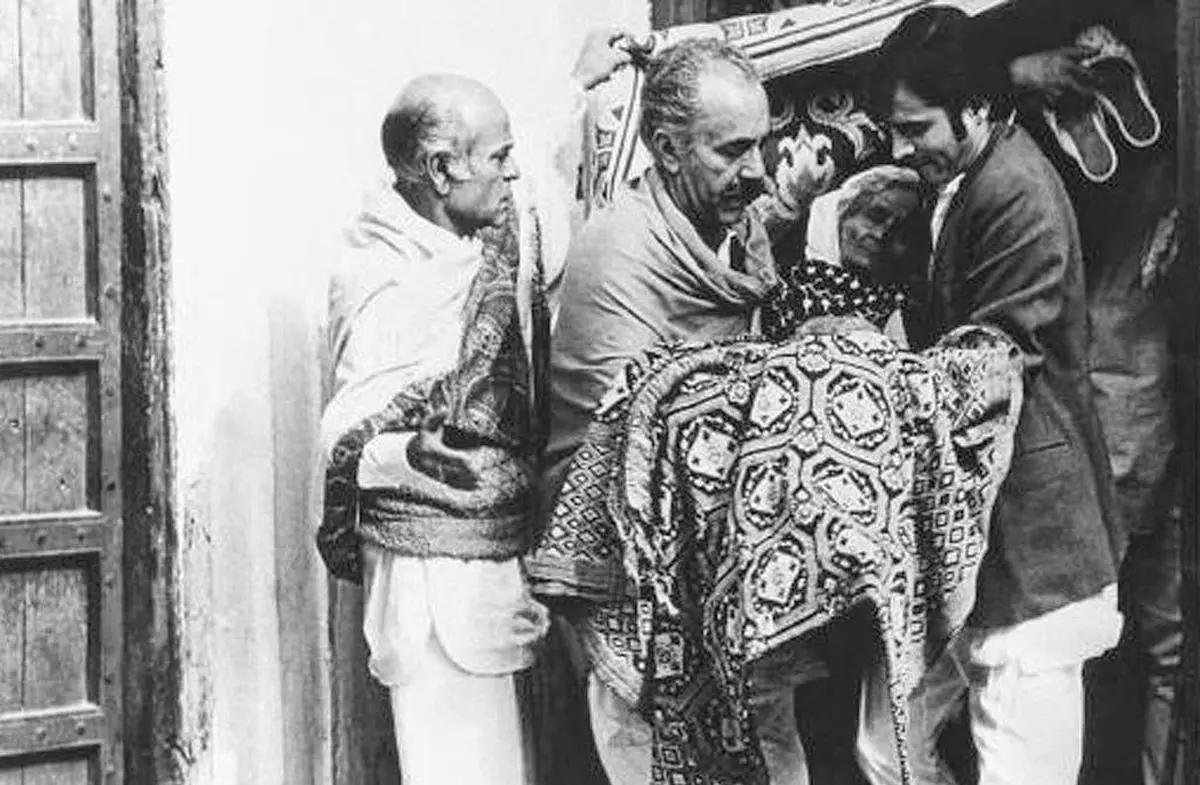
A still from Garm Hava (1973), a quiet yet deeply affecting portrayal of a Muslim family navigating the uncertainties of post-Partition India.
| Photo Credit:
The Hindu Archives
There is a deeper anxiety here that I find difficult to dismiss. In our eagerness to tell certain stories, are we engaged in a kind of self-orientalism, confirming to the world the very stereotypes it has long held of the Global South as a place convulsed by religious fanaticism, ethnic violence, and irredeemable division? The West, of course, carries no spotless record in this regard. In these times of resurgent aggression and open war, it has become easier to understand the damage Hollywood has inflicted across generations by repeatedly representing entire peoples as less than fully human, a representational violence that, as history has shown, can make actual violence feel not only permissible but righteous.
In such a moment, it becomes imperative to return to the foundational question: what kinds of stories do we wish to tell ourselves? Stories that reopen wounds or that acknowledge them while seeking healing? Stories that simplify history into binaries or that embrace its complexity? The answer will shape not only our cinema but our collective future. I am among the millions of Indians who believe that the idea of India has always been an unfinished project. It cannot be sustained by nostalgia alone, nor can it survive on denial. It requires a continuous engagement with both memory and morality.
World history offers a sobering lesson: reopening wounds is easy; it demands little more than selective memory and amplified grievance. Healing, however, requires imagination, moral courage, and an unwavering commitment to the idea that diversity is not a problem to be solved but richness to be cherished.
It is in this context that our stories acquire significance beyond their frames. They are not isolated acts of creation; they are interventions in how a society remembers, relates, and ultimately reimagines itself. The question, therefore, is not simply what we choose to narrate, but how and to what end. Do our stories still carry the courage to heal, or have they begun to find comfort in reopening what history had hoped to mend?
Manoj Kumar Jha is a member of the Rajya Sabha from the Rashtriya Janata Dal.
Also Read | Manufactured fame, manufactured consent
Also Read | Slick fascist flick