

Breaking Update: Here’s a clear explanation of the latest developments related to Breaking News:Unravelling formation mechanism of materials used in sensing can enhance performance gas sensors and lithium-ion batteries– What Just Happened and why it matters right now.
Scientists have unraveled the long-standing mystery behind the formation of mesoporous tin oxide (SnO) beads, an advanced material widely used in sensing and energy applications. This can help control the size, shape and related parameters of the particles which are critical for enhancing performance in gas sensors, lithium-ion batteries, and advanced solar cells.
Mesoporous SnO₂ beads are valued for their high surface area and tunable porosity, yet the detailed mechanism of their formation remains unclear. Earlier models proposed that crystalline nanoparticles form during the solvothermal stage and subsequently assemble into beads.
A team of researchers at the International Advanced Research Centre for Powder Metallurgy and New Materials (ARCI), Hyderabad, an autonomous institute of the Department of Science and Technology (DST) has resolved the long-standing scientific ambiguity and provided a definitive model for their formation.
They have demonstrated that the as-prepared beads are actually amorphous. They consist of a tin-rich organic network with nanoscale heterogeneities of approximately 1.2 to 1.4 nanometres. Crystalline primary SnO₂ particles do not form during the solvothermal process conducted at 140 to 180 degrees Celsius. Instead, crystallization begins only during calcination at 400 degrees Celsius and above.
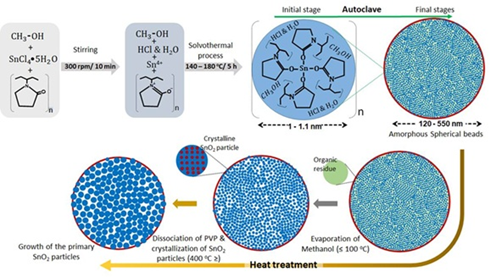
Fig 1: Formation of mesoporous SnO₂ beads from tin-rich complex networks and amorphous spheres formed during stirring and solvothermal treatment, to crystalline primary SnO₂ particles and mesoporous structure development during calcination above 400 °C as PVP decomposes.
Upon calcination, polyvinyl pyrrolidone decomposes, generating interconnected voids that evolve into the mesoporous architecture. Crystallization and pore formation occur simultaneously. The growth follows the classical Ostwald ripening mechanism, in which larger particles grow at the expense of smaller ones to reduce surface energy. A coarsening exponent of about 0.3 confirms that the process is governed by volumetric diffusion.
Small Angle X-ray Scattering analysis, an advanced characterization technique to measure the nano features in the material, provided bulk-averaged structural information over sample volumes several orders of magnitude larger than those accessible through conventional TEM. This enabled precise identification of nanoscale heterogeneities within the amorphous beads and established a direct link between microstructural evolution and crystallization behaviour.
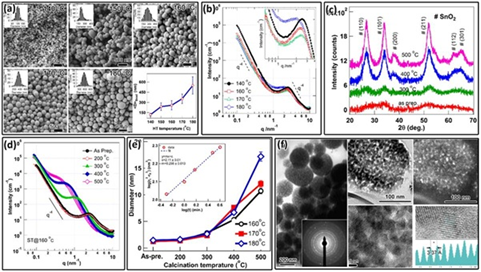
Fig 2 : (a) SEM micrographs showing the morphology of as-prepared beads synthesized at different solvothermal temperatures; (b) SAXS profiles of the as-prepared beads; (c) XRD patterns of beads after heat treatment at various temperatures; (d) SAXS profiles of heat-treated beads highlighting changes in microstructure; (e) Primary particle size as a function of calcination temperature, with the inset depicting Ostwald ripening behaviour of beads calcined at 500°C for varying durations; (f) TEM images illustrating the hierarchical structure of beads at different length scales.
The mechanistic insight gained from this study enables fine-tuning of synthesis parameters to control particle size, porosity, and crystallinity, which are critical for enhancing the effectivity of the particles in their applications.
This research published in the Indian Journal of Physics positions SnO₂ as a reference system for understanding other mesoporous metal oxides such as TiO₂, ZnO, and Fe₂O₃.
The findings strengthen ARCI’s leadership in advanced materials research and open new pathways for engineering high-performance materials for energy, environmental, and sensing technologies.
Publication link: https://doi.org/10.1007/s12648-024-03419-6)
For further information, please contact suresh[at]arci[dot]res[dot]in or easwar[at]arci[dot]res[dot]in