


Tech Explained: Here’s a simplified explanation of the latest technology update around Tech Explained: Miller Lecture Bridges Tech, Humanity with Microsoft Director of AI, Venture Ecosystems in Simple Termsand what it means for users..
Taylor Black, director of AI & Venture Ecosystems in the Office of the Chief Technology Officer at Microsoft, spoke on “What Has Silicon Valley to do with Jerusalem? A Conversation with Taylor Black about AI, Higher Education, and Catholicism with Professor Dr. Thomas P. Harmon,” for the Annual Miller Lecture on March 21, 2026 in Jones Hall at University of St. Thomas. The conversation between college friends Black and Dr. Harmon, led to a rich and deep philosophical unpacking of humanity’s role in AI.
Black, a senior innovation leader at Microsoft, where he works on artificial intelligence strategy, venture ecosystems, and emerging technologies, has spent more than two decades at the intersection of technology, entrepreneurship, and higher education, helping organizations translate cutting‑edge innovation into durable institutional and cultural impact.
In his time at Microsoft, he has noticed a palpable shift in the questions and concerns of colleagues.
“In the last couple of years, I have secular colleagues coming to me asking me what it means to be human as a result of this technology called artificial intelligence,” he said during the conversation. “I’ve been in tech for a very long time and this is the first time that they have come to me with this question. It’s strange in many ways to have that Jerusalem sort of question come to the Silicon Valley sphere.”
In addition to his role at Microsoft, Black serves as the founding director of the Institute for Artificial Intelligence and Emerging Technologies at The Catholic University of America. His work bridges technical innovation with the Catholic intellectual tradition, engaging questions of human dignity, intelligence, formation, and the future of higher education in an AI‑driven world.
“Tertullian’s original question — ‘What has Athens to do with Jerusalem?’ — was a challenge about whether faith and reason could coexist,” he said. “Today we face a version of that question with higher stakes and faster timelines: What has Silicon Valley to do with Jerusalem? The answer matters enormously, because the people building AI are making implicit anthropological claims with every design decision — about what intelligence is, what persons are, what work is for.”
Black said the Catholic intellectual tradition has centuries of developed thought on exactly those questions.
“A Catholic university is one of the few places left in the world where you can hold the technical and the theological in genuine tension without either side dismissing the other,” he said. “UST has cultivated that kind of serious, integrated inquiry, and that’s precisely why a conversation like this belongs here.”
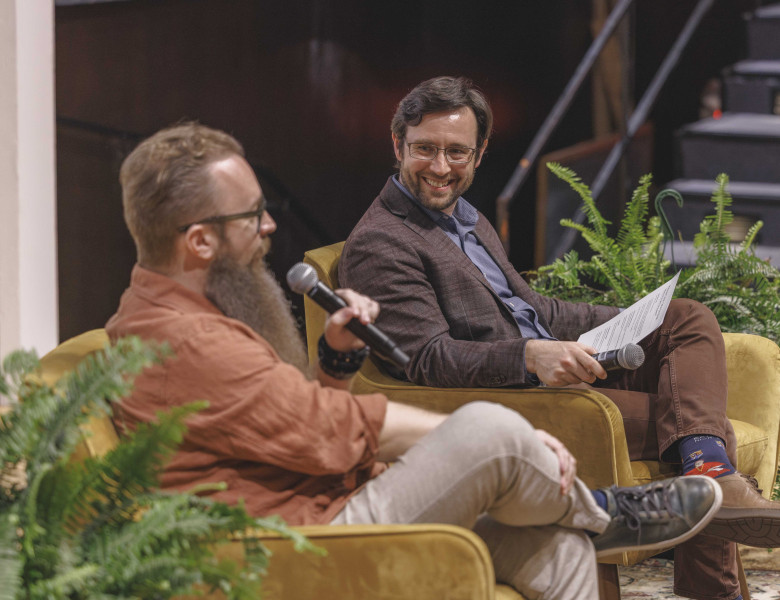 Dr. Harmon, professor and Scanlan Foundation Chair in Theology and Division Dean of the Core and Centers for Excellence, said that having Black address this topic right now is critical because his background and experience make him uniquely suited to shed light on this technological-cultural moment.
“Taylor is a man who is working at one of the most consequential tech firms in the world on the most important new technology of our generation,” Dr. Harmon said. “He brings with him a study of Thomistic philosophy from his days at Boston College and Gonzaga, a dedication to serving the Church eventually as a deacon, a heart for service, and a desire to make technology serve people rather than the other way around—people not just in a secular sense, but people created in the image of God and finding their perfection in communion with God.”
Dr. Harmon said Black has a perspective not only as a high-level technologist, but as a philosopher, as clergy-in-training, and as an advisor to the Vatican on AI.
“Not to mention, he’s just a lot of fun,” Dr. Harmon said.
A familial conversation between two college friends, the evening was filled with deep insights and moral seriousness, but also with laughter and enjoyment.
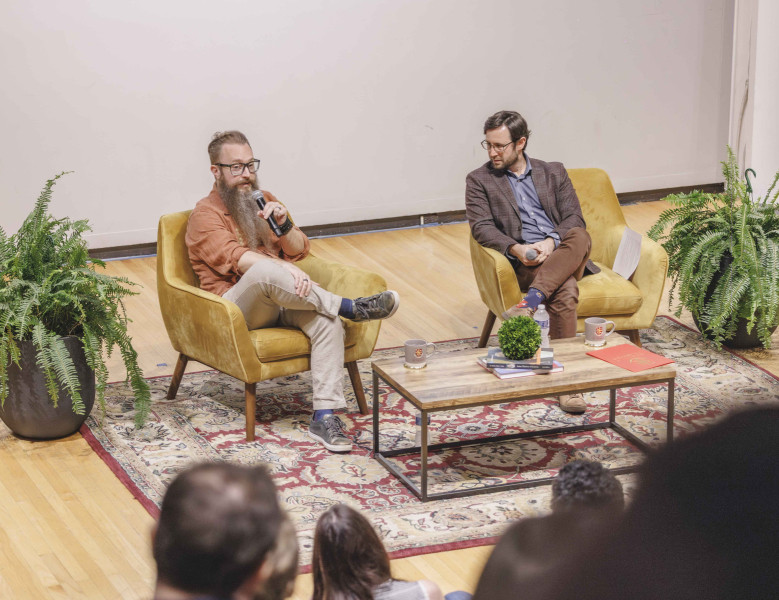 One topic explored deeply was the “Human in the Loop” — the idea that these tools have to have some human oversight “of some kind”— Black emphasizing “of some kind.” He mentioned how this means that it’s important to have someone with good decision-making skills as the “Human in the Loop.” This idea brings up notions of human formation and judgement, which can have massive long time outcomes.
“We take a long time to understand the impacts and ramifications — as novel and cool as it can be,” Black said during the discussion. “We can do great good with this as well.”
He mentioned questions of human worth (when you see the tools as better than they are) become existential questions.
“There’s a certain sense in which this is a great opportunity for us to kind of reexamine the nature of work,” Black said. “The use of the tools ends up being a really important thing there. This makes the human ask of themselves ‘Why am I here?’ Thinking about whether a tool is able to do one’s job has been shaken people so much to their core. Then the question is, ‘What was I living for in the first place?’ Being able to catch a colleague in that mode of thought is incredibly delightful and I think we’re experiencing that in unprecedented ways across all of our culture and society at the moment.”
He said it is interesting how religion and a better understanding of the human person is making great inroads right now within technology.
“Last summer, Microsoft Research had a project entitled, ‘Technology for Religious Empowerment’” Black said. “Out of that research project came six design principles for designing AI for our religious-based customers in particular. The researchers who are part of that project presented their work to several of our internal business units who immediately took up the suggestions with regard to the design principles in those contexts and have started implementing them across our stack. I find this fascinating.”
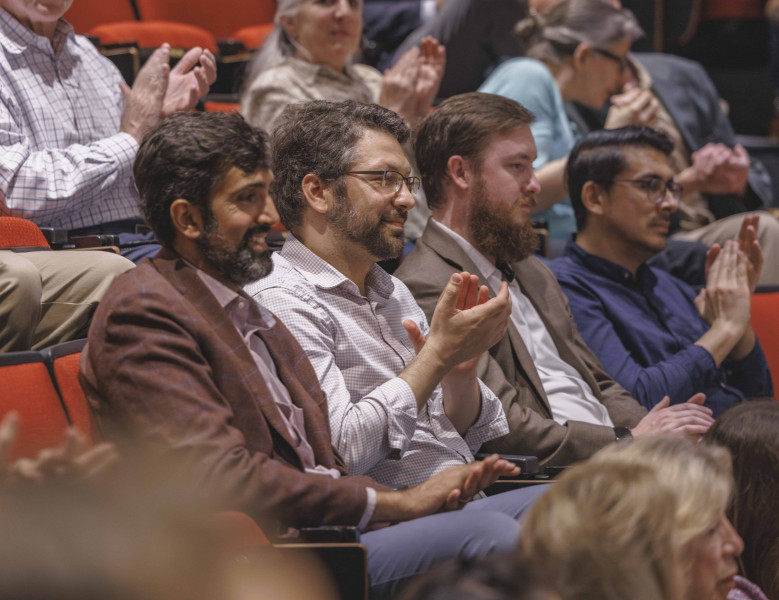 After a rich discussion and spirited Q&A, Dr. Harmon suggested that what rises to the surface is the importance of education and human formation.
“It does seem to me that you can’t ever really get away from the problem of judgment here because the [large language model] LLM can give you some really sophisticated answers and it can also give you another really sophisticated answer that contradicts the one that it just gave you,” Dr. Harmon said. “It’s got no conscience about it. So doesn’t that really just highlight the importance of actual formative education for people who are going to use the tool?”
He expanded on this thought of how critical human formation is, particularly as it relates to education for all people.
“I do think that this is the direction that education has to increasingly focus— on forming people who make responsible and correct judgments of truth about things because it’s going to be impossible for us to avoid those sorts of judgments given the technologies that are going to be available to everyone,” he said.
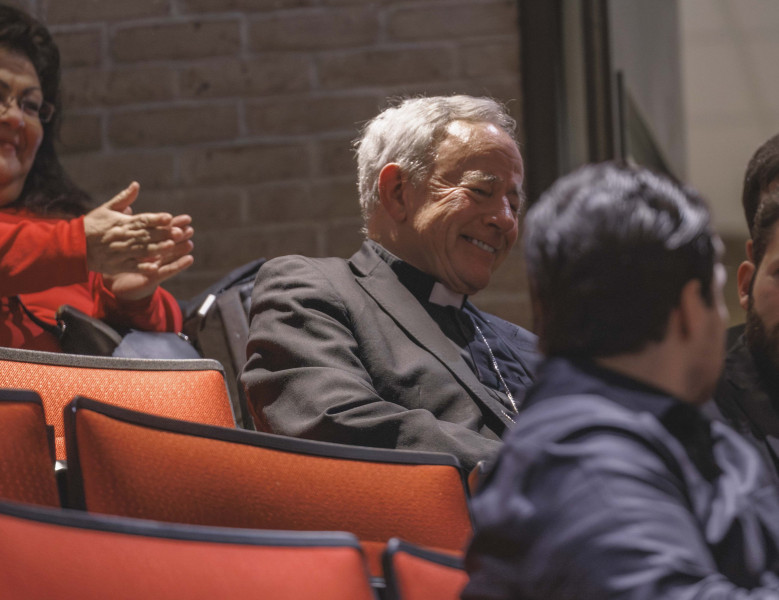 Watch the full conversation on the University of St. Thomas YouTube Channel.
Black was delighted to be a part of the Archbishop Miller Lecture, which features a wide-ranging conversation on how developments in Silicon Valley intersect with theology, ethics, and the mission of Catholic universities. The Miller Lecture was established through the generosity of the John W. and Alida M. Considine Foundation in honor of Archbishop J. Michael Miller, CSB.