


Case Explained:This article breaks down the legal background, charges, and implications of Case Explained: Courts’ Fight Over ‘Cop City’ Protests Raises Questions About Terrorism Laws and Environmental Activism – Legal Perspective
ATLANTA—On a recent March morning, a large monitor at the front of a DeKalb County courtroom flickered to life as Superior Court Judge David B. Irwin appeared over Zoom. The hearing—with attorneys and out-of-state defendants joining remotely—centered on a question with national implications: Can activists who protested Atlanta’s controversial police training center be prosecuted as domestic terrorists?
The case has stretched on for nearly three years, outlasting both the clearing of the forest and the opening of the training center.
Protests against the Atlanta Public Safety Training Center, dubbed “Cop City” by critics, sparked the charges. If upheld, protesters could face sentences of up to 35 years in prison, a ruling that could influence how other states apply terrorism to protest movements.
“What I don’t understand is, this has been going on for three years,” Irwin said during the hearing. “To me, it troubles me that it’s taken three years.”
The courtroom proceedings mark the latest chapter in a saga that has drawn national attention to climate and environmental protest, policing and the boundaries of dissent.
The legal fight is rooted in protests that erupted around Atlanta’s Public Safety Training Center, a facility built on roughly 85 acres within the South River watershed, part of a larger forest corridor surrounding the former Atlanta Prison Farm.
Opposition to the project intensified during a broader reckoning over policing following the murder of George Floyd in 2020. In Atlanta, outrage had already grown after police fatally shot Rayshard Brooks outside a Wendy’s restaurant in south Atlanta, less than five miles from the training center site.
Together, those events turned local opposition into a national protest movement.
Long before Atlanta expanded into southeast DeKalb County, the forest formed part of the ancestral territory of the Muscogee (Creek) Nation. Muscogee communities historically called the area Weelaunee, meaning “brown water,” a reference to the streams and wetlands that shape the surrounding watershed.
In the 1830s, Muscogee people were forcibly removed along the Trail of Tears, and the land was later converted into plantations worked by enslaved people of African and Indigenous descent. It was later converted into a prison farm, where agricultural penal labor continued well into the 1900s. After the prison farm closed, parts of the property were occasionally used by police for training exercises, including a firing range—a precursor for the large training complex constructed on the land today.
City officials argue the complex replaces outdated training facilities and improves emergency readiness. Opponents say that it erased precious green space from an already strained watershed.
Domestic Terrorism or Political Dissent?
Defense attorneys urged the court to toss out domestic terrorism charges against activists swept up in the protests. They argue prosecutors leaned on a vague law that risks criminalizing political dissent and has let the case drag on for years, violating the defendants’ constitutional right to a speedy trial.
Prosecutors defended the delay, saying the investigation involves vast amounts of digital evidence still under review.
Irwin held off on an immediate decision, instructing both sides to file additional legal briefs by April 1, a move that extends the case even further.
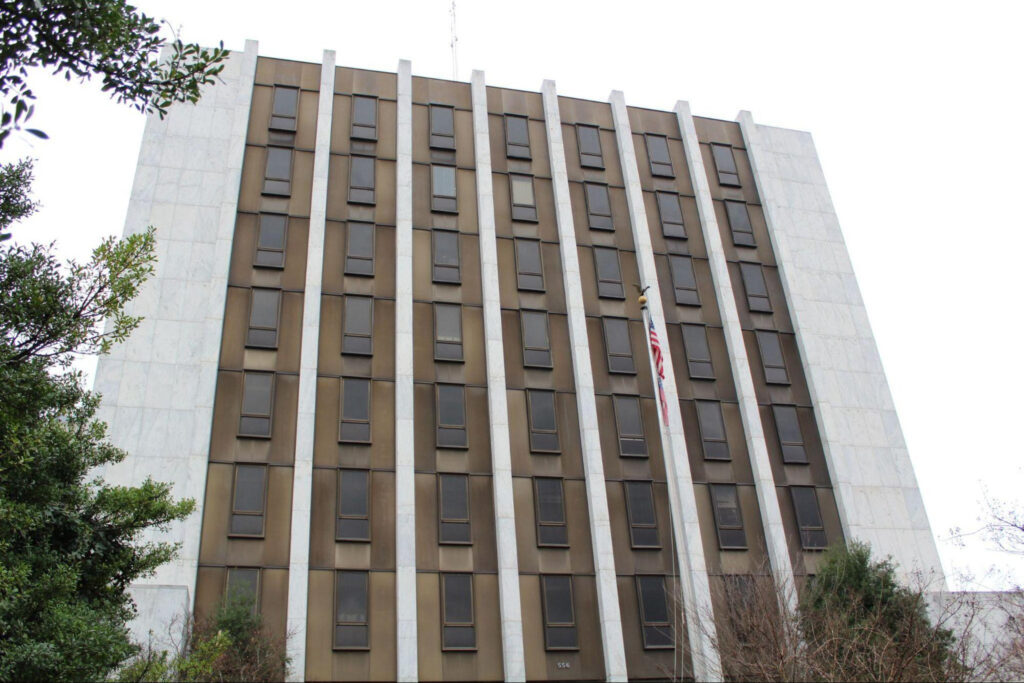
The case is quickly becoming a national test of how states deploy terrorism laws against protest movements tied to environmental issues.
Defense attorney Xavier de Janon said the statute is unconstitutionally vague. “Because of how the statute is written, people in Georgia cannot determine when political speech is lawful,” he said. “Our argument is that the statute is facially unconstitutional and unconstitutional as applied to my clients.”
The prosecution countered that the charges match the gravity of violence seen during some demonstrations, insisting the law should apply when protests cross the line into destruction.
The charges stem from 2023 protests that erupted as construction began on the $118 million training complex in southeast DeKalb County.
Investigators allege a group entered the construction site, setting fire to equipment and police vehicles, while hurling rocks, fireworks and Molotov cocktails.
Just hours later, nearly a thousand activists gathered nearby at the South River Music Festival, a protest gathering deep in the forest surrounding the site.
Assistant Attorney General John Fowler described what investigators say happened that night at the construction site. “Over 150 to 200 people gathered together, nearly dressed in all black from head to toe,” Fowler said. “Everybody except for one person covered their face.”
“That sounds like ICE to me,” Irwin interjected.
The festival was part of a broader wave of “Defend the Atlanta Forest” demonstrations, uniting activists, musicians, faith leaders and organizers from across the nation. Organizers described it as both a protest and a community gathering meant to highlight environmental concerns tied to the training center and to mourn the death of environmental activist Manuel Esteban Paez Terán, or Tortuguita, who was killed in the forest.
Law enforcement officers fatally shot Terán in January 2023 during a raid on protest encampments in the forest. Authorities said Terán fired first, but activists and family members dispute that account and have filed a civil rights lawsuit.
Terán’s death further galvanized the movement, drawing protestors from across the country to Atlanta.
The festival featured several artists under the banner “Peace. Love. Unite. Respect.”
Authorities maintained their stance that some of those involved in the earlier attack later blended into the crowd at the nearby festival grounds. “There have been hundreds of incidents involving people in this extremist movement,” Fowler emphasized to the court. “Property damage, shooting at police officers, shooting at citizens, injuring citizens. We had over 50 arsons at one point.”
Officers from several agencies later descended on the festival grounds, launching a mass arrest operation that detained dozens of people under a slew of charges. Authorities claim some of those arrested were suspected of participating in the earlier attack on construction equipment.
In Fulton and DeKalb, Different Approaches
The protests have spawned parallel criminal cases in both Fulton and DeKalb counties.
In Fulton County, prosecutors brought sweeping racketeering charges under Georgia’s Racketeer Influenced and Corrupt Organizations Act, or RICO, accusing dozens of activists of participating in a coordinated campaign to halt construction of the training center.
Jonathan Nash, an Emory University School of Law professor, said federal RICO laws were first enacted in 1970 to combat organized crime but were later applied to a wide range of cases, including corporate fraud, political corruption and large-scale conspiracy prosecutions. Over time, however, he said that prosecutors have applied the statutes more broadly.
The prosecution’s strategy faltered last year when a judge ruled the attorney general’s office lacked authorization from Gov. Brian Kemp to pursue the RICO charges and dismissed the case. The state is appealing that decision.
In contrast, the DeKalb cases zero in on arrests directly tied to the construction site and the music festival. Unlike in Fulton, several defendants in DeKalb have yet to be indicted and remain stuck in legal limbo.
De Janon said the state is effectively pursuing the same events twice.
“The state seems to want two bites of the apple,” he told the court. “It’s not that the state can’t indict, it’s that the state has decided not to indict here in DeKalb because the state did indict in Fulton.”
The DeKalb County charges hinge on Georgia’s domestic terrorism statute, a rarely used law first passed in 2002 after the Sept. 11 attacks. The statute lets prosecutors elevate crimes like arson or property damage to terrorism if they are meant to sway government policy.
Historically, the law has been used only in a handful of cases, most often involving alleged plots of mass violence or anti-government extremist activity.
The law was significantly expanded in 2017 after the white supremacist rally in Charlottesville, Virginia, where a car attack killed a counterprotester—an act that was denounced as an act of terrorism by authorities.
Georgia lawmakers later widened the definition of domestic terrorism and stiffened penalties, letting prosecutors file felony charges for crimes intended to intimidate civilians or influence government policy. Defense attorneys argue this language is dangerously vague when used against protest movements.
Legal experts say the Cop City prosecutions are among the first major tests of this statute against a protest movement.
Prosecutors insist the alleged arson and property destruction fit the law’s definition, while defense attorneys counter that the statute is being stretched far beyond what lawmakers intended.
The line drawn in the state’s domestic terrorism statute “between protected speech and criminal conduct is not clear,” one motion to dismiss states. “The failure of precision gives far too little notice of prescribed conduct and leaves far too much discretion in the hands of the prosecutor.”
That shift in discretion has drawn scrutiny from civil rights organizations. In a statement, the American Civil Liberties Union of Georgia warned that applying terrorism statutes to protest activity could chill constitutionally protected speech.
Nash, who studies and teaches environmental law and courts, said cases like this could influence how future protests unfold.
“If people know certain behavior could lead to serious criminal charges, that may affect how they act,” he said. “Some people might be less inclined to participate if they believe that there’s a risk they could face significant penalties.”
“This law was designed to address violent acts intended to terrorize the public,” de Janon said. “What the state has done here is attempt to apply it to political protest.”
“All Americans have the right to peacefully protest,” Georgia Attorney General Chris Carr emphasized in a public safety warning. “No American has the right to destroy property, loot businesses, or attack law enforcement officers.”
This story is funded by readers like you.
Our nonprofit newsroom provides award-winning climate coverage free of charge and advertising. We rely on donations from readers like you to keep going. Please donate now to support our work.
The prosecution changed hands in an unusual twist. In June 2023, DeKalb County District Attorney Sherry Boston’s office stepped away from the case, citing worries over conflicts and the investigation’s complexity. Boston said the evidence and charges have “revealed a fundamental difference in prosecutorial philosophy.”
Carr’s office took over the case entirely, a relatively rare move in Georgia prosecutions that shifted control from the local district attorney to the state’s top prosecutor.
“Our office is fully committed to moving forward with the prosecution of those who have engaged in or supported violent acts surrounding the Public Safety Training Center,” Carr said on Twitter (now X). “We will not waver when it comes to keeping Georgians safe and putting a stop to violent crime in our state.”
Defense motions argue the drawn-out prosecution has already upended the lives of those accused.
One filing cites “lost job opportunities, stigmatization as a ‘domestic terrorist,’ and the fear and anxiety that is naturally attendant to serious criminal charges.” Others allege problems finding stable housing, continuing their education or being present for critical family events.
De Janon said the consequences extend far beyond the courtroom. “My clients have had to endure three years of every single record check showing domestic terrorism,” he said. “This label on their record without indictment, no trial.”
“The defendants are suffering as a result of just having something hanging over them,” the judge concurred.
Prosecutors say the delays reflect the scale of the investigation.
“There are terabytes and terabytes and terabytes of information,” Fowler said. “This might be the most discovery anybody’s seen on a case.”
Judge Irwin was skeptical.
“But this isn’t the Epstein files,” he countered.
Not-so-Speedy Trials
Another defense attorney argued that the prolonged prosecution has become politically charged, pointing to Carr’s bid for governor. “I believe he needs them as a live political issue in his campaign,” attorney Matt Bass told the court.
Prosecutors denied the hindrance was intentional.
A separate ruling over the delay has already complicated the prosecution’s strategy.
Last year, another DeKalb County Superior Court judge dismissed domestic terrorism charges against one protester tied to the same demonstrations, ruling that the state had violated constitutional speedy trial protections.
In that decision, the court found the roughly 29-month delay before trial was presumptively prejudicial and concluded the prosecution appeared to have delayed the case to gain a tactical advantage.
Defense attorneys in the remaining cases cited that ruling as further evidence that the charges should be dismissed.
“The longer the State can keep Defendant accused, making an example of them and others,” one motion states, “the easier it is for the State to support its interests without opposition.”
The Urban Forest
As these prosecutions proceed, a parallel debate revolves around climate change, forest cover and the appropriateness of the new training center. Researchers said it may take years to fully measure the center’s environmental footprint. Some changes, however, began the moment the trees came down.
Urban forests serve as natural shields against climate change, said Greg Levine, executive director of Trees Atlanta, a nonprofit community group that protects and improves Atlanta’s urban forest. They soak up stormwater, filter pollution and cool neighborhoods during heat waves, helping to counter the urban heat island effect that bakes dense cities.
“Urban forests are one of the most important climate tools cities have,” said Levine. “When you lose large areas of canopy, you lose those benefits.”
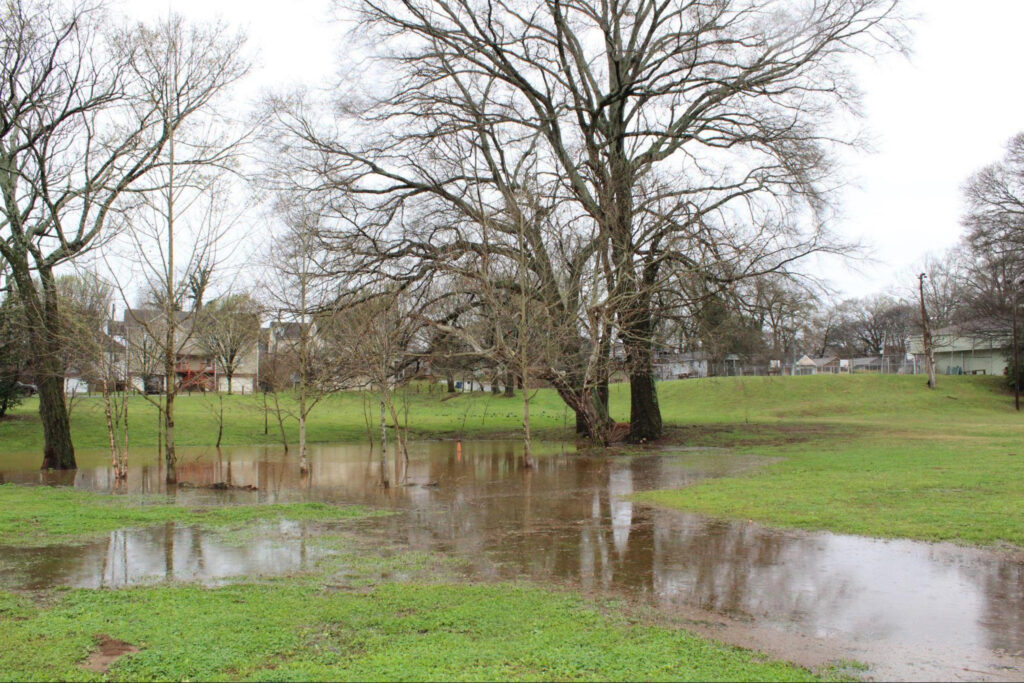
Atlanta has long worn the nickname “city in a forest,” but relentless development is steadily thinning its leafy canopy. Environmental researchers estimate that every day, about half an acre of the forest vanishes as the metro area sprawls outward.
“Tree loss is a big problem in Atlanta and across Georgia,” Levine said. “We are seeing thousands of acres of trees being cut down along highways, suburban sprawl and data centers that clear hundreds of acres of forests. It is difficult, or impossible, to replant trees at the rate they are being taken down.”
Environmental advocates warn the stakes extend far beyond the loss of trees.
The forest drains into the South River watershed, where communities have long struggled with flooding and sewage contamination.
In neighborhoods like Peoplestown, a majority-Black community on Atlanta’s south side, residents have learned to keep a wary eye on the sky.
When storm clouds gather, heavy rain can swamp the old sewer system, sending murky, foul-smelling water surging into streets, cars and homes. Much of that runoff ends up in Intrenchment Creek, the watershed encircling the training center.
Dr. Jacqueline Echols, president of the South River Watershed Alliance, said communities of color have shouldered the heaviest burden.
“Black communities in south DeKalb have borne the brunt of the country’s water and sewer failures,” Echols told Atlanta Press Collective.
Her organization has filed federal civil rights complaints regarding the project’s environmental impacts.
A Controversial Land Swap
Debates over the forest stretch beyond the training center itself.
Just south of the training center, Key Road Park runs along a tranquil, wooded stretch of the South River watershed adjacent to Intrenchment Creek Park in south DeKalb County. The parks now sit at the heart of fierce debates over development, environmental protection and the future of this land.
Five years ago, DeKalb County swapped roughly 40 acres of this land with Ryan Millsap, a private developer and former CEO of Blackhall Studios.
Critics argue the deal sacrificed public green space in exchange for economic promises that have yet to materialize. Local advocates have launched an oppositional campaign called “Stop the Swap.”
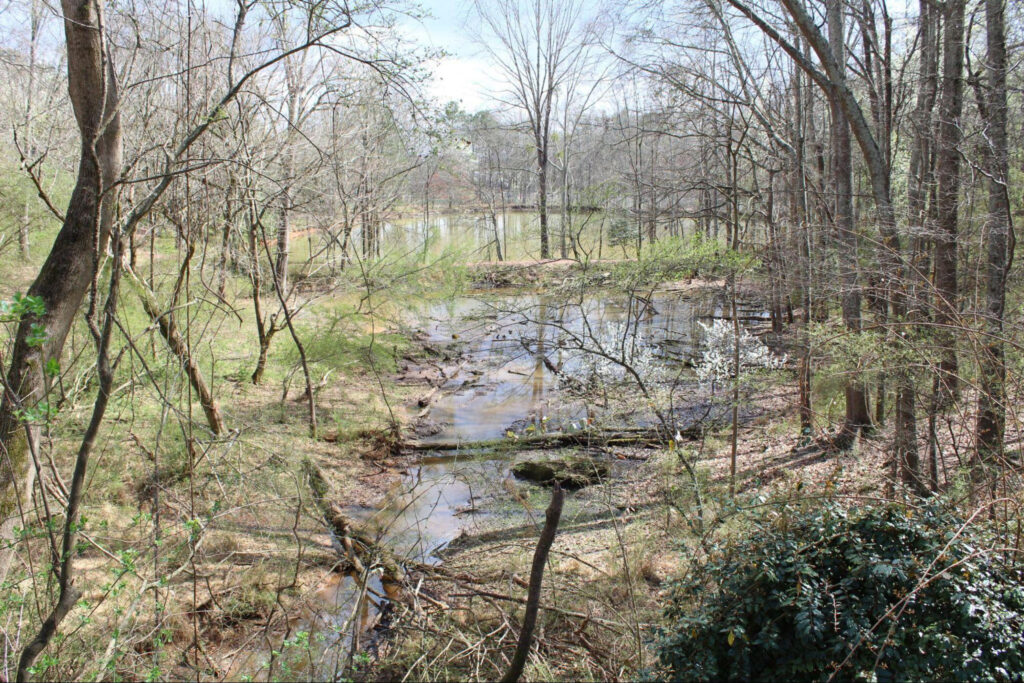
Echols said the land was originally dedicated for public use and should remain parkland. “The swap of 40 acres of Intrenchment Creek Park to a private developer never should have happened,” Echols wrote in a blog published on the South River Watershed Alliance’s website. “Public park land should remain available to the people who rely on it.”
They worry the land could soon host energy-hungry infrastructure like data centers, which demand vast amounts of electricity and water in a region already under environmental strain.
Colliding Pressures
The Georgia case is playing out as the term “domestic terrorism” becomes ever more hotly debated in national politics.
Former Homeland Security Secretary Kristi Noem recently used the term to describe protesters killed during a federal immigration raid in Minneapolis, drawing criticism from civil liberties groups who warned the label was being applied too broadly.
De Janon said the Cop City prosecutions raise similar concerns.
“Historically, governments have used ‘domestic terrorism’ labels against people who oppose power,” he said.
As Atlanta expands and the Southeast warms, battles over forests, policing and development are increasingly colliding. The National Climate Assessment reports the region has warmed by 2 degrees Fahrenheit since the late 1800s, with scientists predicting more extreme heat and heavier rains ahead—trends sure to fuel fierce debate over land use, infrastructure and environmental protection.
Across the country, governments are turning more often to harsh criminal laws against protests over pipelines, mining projects and other infrastructure, hinting that such clashes may soon become the norm.
About This Story
Perhaps you noticed: This story, like all the news we publish, is free to read. That’s because Inside Climate News is a 501c3 nonprofit organization. We do not charge a subscription fee, lock our news behind a paywall, or clutter our website with ads. We make our news on climate and the environment freely available to you and anyone who wants it.
That’s not all. We also share our news for free with scores of other media organizations around the country. Many of them can’t afford to do environmental journalism of their own. We’ve built bureaus from coast to coast to report local stories, collaborate with local newsrooms and co-publish articles so that this vital work is shared as widely as possible.
Two of us launched ICN in 2007. Six years later we earned a Pulitzer Prize for National Reporting, and now we run the oldest and largest dedicated climate newsroom in the nation. We tell the story in all its complexity. We hold polluters accountable. We expose environmental injustice. We debunk misinformation. We scrutinize solutions and inspire action.
Donations from readers like you fund every aspect of what we do. If you don’t already, will you support our ongoing work, our reporting on the biggest crisis facing our planet, and help us reach even more readers in more places?
Please take a moment to make a tax-deductible donation. Every one of them makes a difference.
Thank you,