


Tech Explained: Here’s a simplified explanation of the latest technology update around Tech Explained: AI And Hydroponics Driving Climate-Resilient, Pesticide-Free, Nutrient-Rich Crops in Simple Termsand what it means for users..
Bengaluru: As climate change, shrinking farmland, and water scarcity put increasing pressure on agriculture, technology-driven farming is emerging as a critical solution in India.
In a country highly vulnerable to climate variability, precision-managed farming is gaining ground as a viable alternative. A Bengaluru-based agritech startup, HapphyGreenz (A unit of Agrowvitz Innovations Pvt Ltd.), launched in 2023, is at the forefront of this shift, integrating artificial intelligence (AI), hydroponics, and precision farming to build climate-resilient food systems.
Rajender Satyanarayana, founder of Agrowvitz Innovations (Image Credit: Agrowvitz Innovations)
Founded by tech pioneers Bharathi Athinarayanan and Rajender Satyanarayana, the venture aims to make sustainable, nutrient-rich food more accessible through software-led farm management powered by automation and intelligent systems. Anchored in the UN’s Zero Hunger goal, their vision is to make India nutritionally secure, beginning with urban ecosystems.
Using hydroponic systems, HapphyGreenz grows pesticide-free leafy greens using up to 90–95 per cent less water than conventional farming. By replacing soil with nutrient-enriched water and leveraging an AI-powered “digital agronomist” to monitor plant health and optimise growth, the system ensures consistent, high-quality yields regardless of weather conditions.
NeoX Tower: Compact Farming for Urban India
Compact vertical ‘NeoX’ grow towers, occupying just four square feet and supporting up to 40 plants, are designed for urban households and small entrepreneurs, using closed-loop water recycling to maximise efficiency and minimise waste.
The precision-grown produce is already meeting global quality benchmarks, with supplies reaching international flight catering services where hygiene and just-in-time harvesting are critical. Currently, around 100 kilograms of fresh produce are transported daily, reflecting both scalability and operational reliability.
HapphyGreenz: Building Green Campuses
Beyond cultivation, the startup is expanding through its training vertical, HapphyGreenz Hydroponics Academy, while building a broader ecosystem through academic partnerships. It is creating “green campuses” as live innovation labs, where students gain hands-on experience through training programs, conduct research, and explore agriculture as a viable livelihood through integrating hydroponic systems.
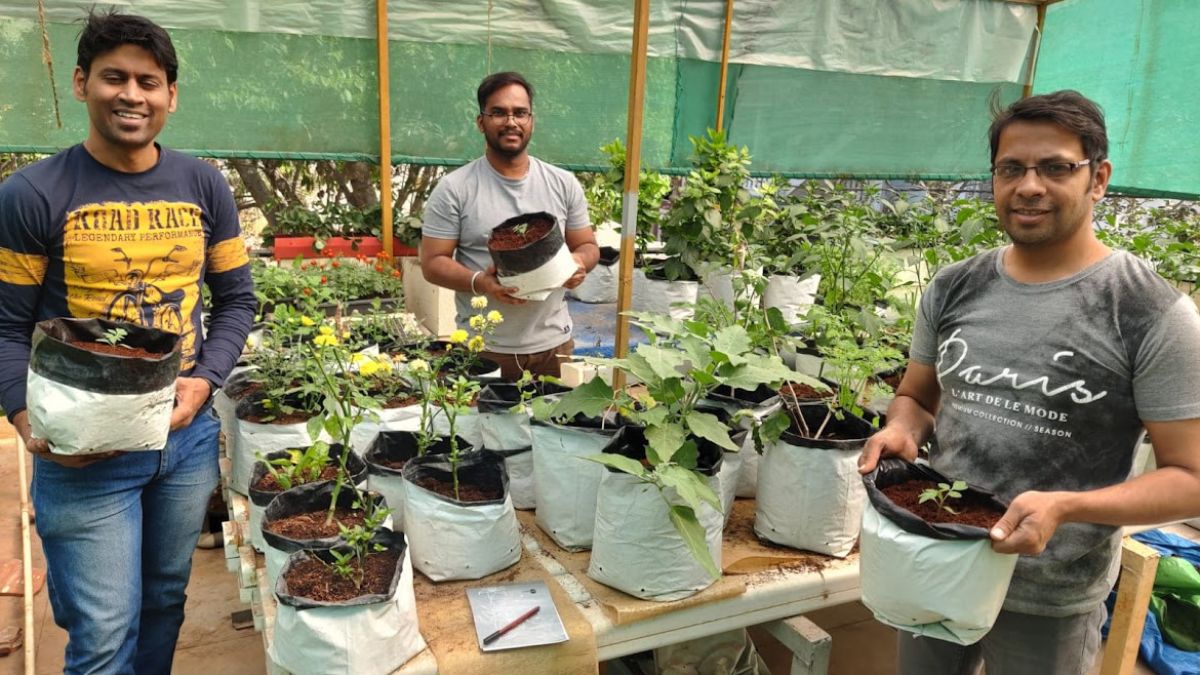
In picture – Bharathi Athinarayanan (on the left) and Rajender Satyanarayana (on the right) along with their colleague (at the centre). (Image Credit: Agrowvitz Innovations)
Collaborations with NGOs are further driving inclusivity, enabling individuals with physical or mild cognitive disabilities to participate in farming through simplified, process-driven systems supporting livelihoods while promoting an inclusive agricultural model.
In an exclusive interview with ETV Bharat, Agrowvitz Founders & Co-CEOs Bharathi Athinarayanan and Rajender Satyanarayana spoke about Hydroponic farming and its advantages.
Inside HapphyGreenz’s Hydroponics Model:
Hydroponics, as Bharathi explained, is an age-old agricultural practice dating back to around 4000 BC. On how Hydroponics differs from traditional farming, he said that in earlier times, people naturally practised water-based cultivation near rivers. As settlements expanded and farming moved away from water sources, soil-based agriculture became more common. In hydroponics, plants are grown using water enriched with essential nutrients instead of soil. The roots absorb this nutrient-rich water, which, along with sunlight, enables photosynthesis – converting nutrients into energy, enabling efficient plant growth. By delivering precise nutrition directly to plants, hydroponics ensures faster, healthier growth.
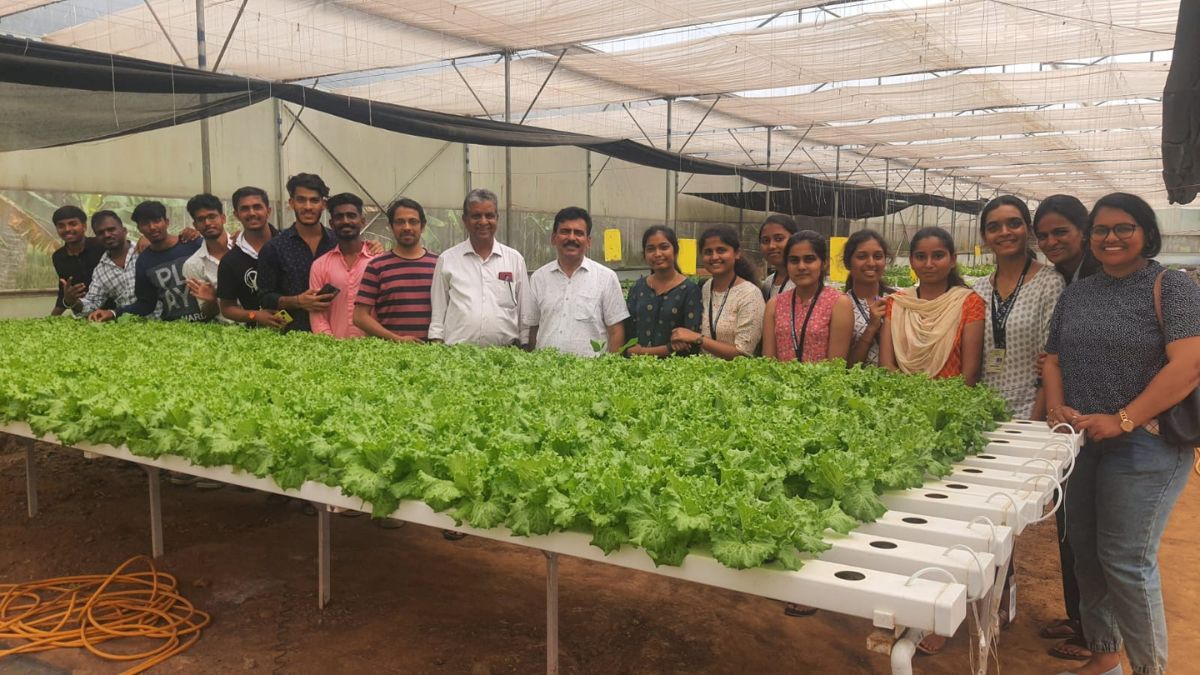
HapphyGreenz team showcasing their plants grown via hydroponics (Image Credit: Agrowvitz Innovations)
Founders’ Story: The Inspiration Behind the Shift from Technology into Farming-
Bharathi said the idea took shape in 2022 after observing a clear gap in food quality and nutrition levels. “Produce sourced from regions like Coimbatore had better taste and nutritional value compared to what was available in metro cities like Bengaluru,” he noted. His experience in the fitness industry further revealed deficiencies among people, like low Vitamin D becoming increasingly common, often linked to broader health and behavioural issues. This led him to explore hydroponics as a way to bridge the nutrition gap. After initial research and a proof of concept, they acquired a farm and began operations.
Rajender Satyanarayana added that with over two decades in the software industry, he wanted to build solutions with long-term impact. Identifying food and nutrition as a critical challenge, the team focused on creating a sustainable, urban-friendly farming model. Starting with a small MVP, they validated the concept before scaling it into a full-fledged venture.
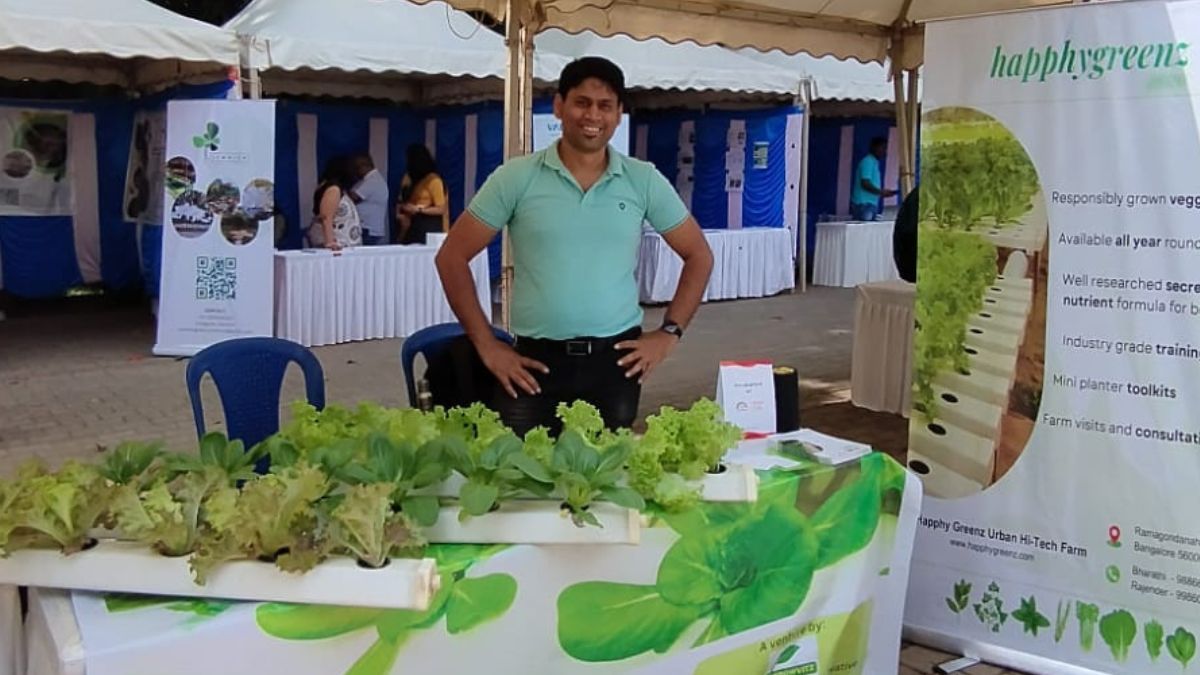
Bharathi Athinarayanan showcasing plants grown through hydroponics. (Image Credit: Agrowvitz Innovations)
Competitive Landscape in India
Agrowvitz is part of a rapidly evolving hydroponics landscape in India. Companies like Kryzen Biotech, Brio Hydroponics, INHYDRO, AQUAHYD, and HydroHealth are also driving innovation through turnkey farm solutions, greenhouse automation, and market-linked models. Together, these players signal a broader transformation from traditional agriculture to a technology-led ecosystem defined by precision, predictability, and sustainability.
Replying to how HapphyGreenz positions itself within this competitive ecosystem, Bharathi explained that HapphyGreenz is a full-stack agricultural platform focused on soilless (hydroponic) farming. The startup currently manages 30–40 acres in and around Bengaluru through its partner farms.
Farmer-Centric, Asset-Light Model
Rajender said, “We engage directly with farmers, educating them on hydroponics and helping them adopt advanced soilless farming techniques. We procure their produce, enabling them to earn better prices. This model improves farmers’ incomes and also ensures the supply of high-quality food.” He added that farmers typically become proficient in hydroponics within just one or two crop cycles, from seeding to transplanting to harvesting.
Customers can purchase fresh, pesticide-free vegetables, grow their own food at home using compact grow towers, or opt for ready-to-eat, nutritious salads. Operating on an asset-light model, HapphyGreenz doesn’t own farms; however, enable partner farmers to adopt hydroponic systems, helping increase their income.
Agrow AI: A Digital Agronomist for Growers-
Replying to how Agrow AI increases operational effectiveness, Bharathi explained that the AI app enhances efficiency in two key ways. First, it acts as a virtual “plant coach” for beginners, guiding them through every step from transplanting to harvesting using computer vision and interactive support. The app identifies nutrient deficiencies or infections and tracks growth cycles, creating a complete support ecosystem. Second, the platform is evolving into a community marketplace, enabling users to connect, exchange produce, and collaborate.
Rajender added, “For urban users, maintaining consistency in hydroponics remains a key challenge.” Powered by generative AI, the system aims to simplify farming practices while building a self-sustaining, community-driven ecosystem.
Scaling Hydroponics: From Home Setups to Commercial Farming
Discussing the basic requirements for setting up the system, Rajender said that Hydroponics is a highly standardised and controlled method of farming with minimal unknown variables. Conducted in polyhouse structures under controlled environmental conditions, it ensures consistent yield and uniform quality throughout the crop cycle. He suggested starting small on a terrace or balcony, much like their initial MVP approach. Later, growers can scale up, with around half an acre considered the minimum for a viable commercial setup.
Explaining city-scale adoption, he noted that while the initial investment may be higher, hydroponics delivers 50–70 per cent faster yields, for instance, spinach can grow in 25–30 days instead of 45–60. Vertical farming further increases yield per square foot, and the produce is completely pesticide-free, with nutrients delivered in a bioavailable form.
The model is highly scalable when implemented commercially. Instead of large, centralised farms, the focus is on building multiple smaller farms closer to consumption hubs, reducing carbon footprint. The long-term vision is to enable households to grow their own food, with surplus shared within local communities, Rajender added.
Data-Driven Farming for an Uncertain Climate
Bharathi said hydroponics is inherently predictable and software-mapped, enabling accurate yield forecasting. For instance, if a target is 5 kg, it can be reliably achieved. He explained that each stage, i.e., seeding, transplanting, and harvesting, is standardised and mapped through software. Yield calculations are precise: if one plant produces around 100 grams, farmers can determine exactly how many plants are needed to meet a specific demand and commit to delivery timelines with confidence.
Rajender explained that with standardised processes and systems tailored to different plant types, yields become predictable and largely independent of climate variations, making year-round cultivation simpler and more reliable.
This data-driven approach allows farmers to plan production, stagger cycles, and align output with market demand, making farming more resilient, efficient, and less dependent on climate uncertainties. Rajender concluded, “While technology will be central, affordability remains a key challenge. Stronger support through government initiatives, academic partnerships, and scalable pilot models is essential.” Bharathi noted that introducing farming at the school level can foster self-sufficiency and reshape perceptions, paving the way for a sustainable and inclusive food ecosystem.
As climate pressures intensify, the convergence of technology and agriculture could redefine how India grows, distributes, and consumes food, making hydroponics a promising pathway toward future food security.