

Breaking Update: Here’s a clear explanation of the latest developments related to Breaking News:Scientists find ways of understanding role of molecular clouds near Milky Way disc in star formation– What Just Happened and why it matters right now.
Scientists tracing small molecular clouds located near the Milky Way disc have “seen” the skeleton of the magnetic field surrounding them for the first time to better understand its role in star formation.
For decades, astronomers have known that gravity pulls molecular clouds inward to form stars, while internal pressure pushes them outward. But there is a third, silent player in this tug-of-war: the Magnetic Field.
L1604 and L121 are small molecular clouds, modest stellar nurseries with L1604 lying toward the Galactic anticenter and L121 toward the crowded Galactic center.
As magnetic fields are invisible, the research team from Aryabhatta Research Institute of Observational Sciences (ARIES) an autonomous institute of Department of Science and Technology (DST) and Assam University used R-band polarimetry with the ARIES Imaging Polarimeter (AIMPOL) on the 104-cm ARIES telescope at Nainital to measure how starlight from distant stars becomes polarized as it passes through dust in the molecular clouds. When starlight hits dust grains aligned by a magnetic field, the light vibrates in a specific direction. By mapping thousands of these light waves, the team “saw” the skeleton of the magnetic fields surrounding L1604 and L121 for the first time.
The researchers found two very different personalities. The two clouds also lie at very different distances-L1604 at around 816 parsecs and L121 nearly seven times closer at just 124 parsecs. The L1604 cloud is highly dense and more massive and has enough material to possibly form many new stars. L121 is located toward the center of the Galaxy. It is less dense and less massive than L1604, but has a stronger magnetic field. Moreover, its magnetic field morphology appears more orderly, suggesting it hasn’t yet been warped by the violent gravitational collapse that characterizes more active star-forming regions.
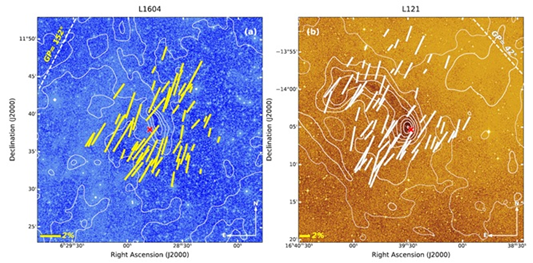
Fig: Polarization maps of dark clouds L1604 and L121. Solid lines represent the polarization vector corresponding background stars overlaid on the composite DSS images of the respective clouds. The orientation of the Galactic Plane (GP) is marked with a dashed line. The cross denotes the central position of each cloud. Contours of the Herschel SPIRE 500 μm dust continuum emission are over plotted.
By calculating the magnetic field strength the scientists found that both clouds are firmly sub-critical, meaning the magnetic fields are comfortably strong enough to resist gravitational collapse across the full body of both clouds. The magnetic fields are not “just barely” holding on -they dominate over both gravity and turbulence, with magnetic energy exceeding turbulent kinetic energy, which in turn exceeds gravitational energy at the envelope scale. However, in the dense cores nestled deep within these clouds, gravity may be quietly gaining the upper hand, making these cores the true cradles of future star birth even as the surrounding envelope remains magnetically protected.
This story isn’t just about two clouds; it’s about the “recipe” for a star. By showing exactly how magnetic fields wrap around and permeate these small clouds, the study reveals that magnetism is the invisible hand that slows star formation, preventing the galaxy from turning all its gas into stars at once.
L1604 and L121 are now more than just dark spots on a map; they are active laboratories where we can watch the fundamental forces of the universe, gravity and magnetism, dance in a delicate, million-year-long embrace.
For more details, please contact: Dr. Jeewan C Pandey (jeewan[at]aries[dot]res[dot]in), Gulafsha Begam Choudhaury (gulafsha[at]aries[dot]res[dot]in) and Dr. Bhaskar Jyoti Barman (bhaskarjyotibarman86[at]gmail[dot]com.