

Market Update: We break down the business implications, market impact, and expert insights related to Market Update: How to Support Local Small Businesses in 2026 – Full Analysis.
Small businesses often advocate for consumers to buy locally and the message seems to be resonating. Recent data from Faire showed that Americans are willing to spend almost $2,000 more a year to support their favorite local shops, about an extra $150 a month. Seventy-five of those surveyed also said that the pandemic enhanced their appreciation of local businesses.
These consumers’ purchases go a long way toward growing communities and creating jobs — and local businesses should also contribute. When small businesses practice what they preach by making business-to-business (B2B) purchases in their own community, that spending can have a ripple effect on the area. If you want to help another small business but aren’t sure how, read our guide on supporting fellow local enterprises.
How small businesses can support fellow local small businesses
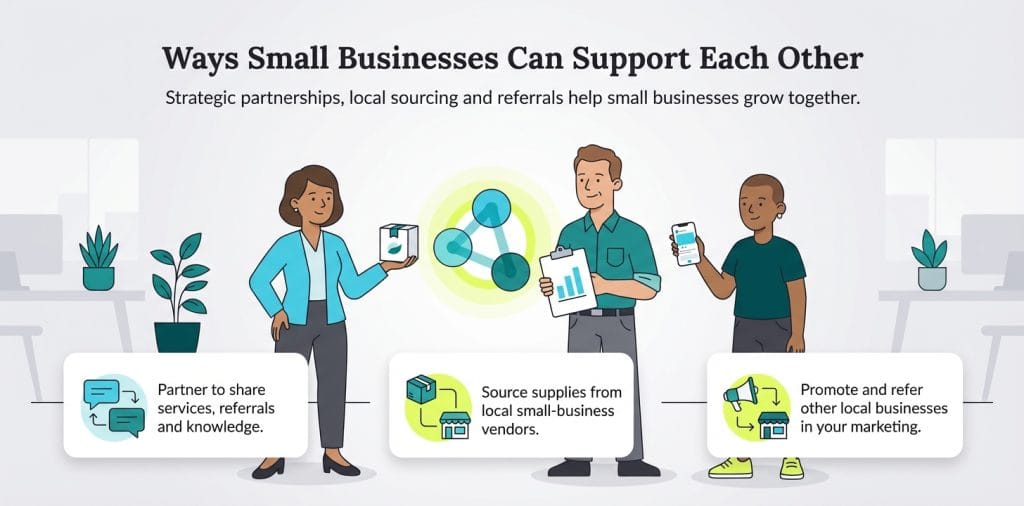
If you want to support another small business, here are four easy ways to get started. Even choosing just one strategy can make a big difference in your community.
Partner up for mutually beneficial interactions.
Small business owners can support one another through mutually beneficial interactions that lead to referrals for one another, according to Shilonda Downing, founder of Virtual Work Team.
“When I speak with my current clients and potential clients, I’m always thinking of ways my team and I can benefit them,” Downing told us. “If I feel that one of my clients can assist another, I always make the connection. It’s a part we can all play as small business owners to help one another.”
Tyler Rice, founder and CEO of Animas Marketing, added that trading goods and services and sharing knowledge through public meetups and workshops.
Utilize another small business as your supplier.
Craig Ross, president of Infantile Industries LLC, said that some small businesses will use large ones for supplies until they meet someone local who can support them.
“Price is always a key component but, in today’s world, what’s old is new again,” he added. “Relationships matter. In a digital world, we long to get close to those we work with. That is where small business shines. We know our clients. We know their clients. Their success is our success.”
Going with another small business over a large company for supplies might also have unexpected benefits. “If there’s a particular service needed for your business, you can skip the big-box stores and work with other local business owners and make beneficial connections that you might not have originally thought about,” Rice said.
There might be some financial implications when switching from a larger-scale operation to a small business for supplies, but you have a better chance of reducing expenses by working with a small business than a larger one whose priority might just be money.
Include other small businesses in your marketing efforts.
You can promote other small businesses by including them in your social media marketing strategy. Engaging with their social media content and reposting interesting work they’re doing is a great way to support other small businesses.
Vasiliki Gkarmini, co-founder of Next Door Goddess, said that including other small businesses in gift guides or newsletters is a perfect example of promoting another small business. “For example, we will show our jewelry alongside other products of small businesses or sold by small business owners and include links to their websites,” Gkarmini explained.
This could increase your own sales and improve those of other small businesses in your area.
Refer customers to other businesses.
“One of my favorite ways of supporting other small businesses is through referrals,” said John Ross, CEO of Test Prep Insight. “Anytime we get a customer that asks us for a product or service that we don’t provide, I don’t just suggest they Google it. That almost inevitably ends up with them finding some mega-company to fill their need.”
Instead, Ross recommends other small businesses he knows will do a quality job. This small act goes a long way, as a referral usually carries heavy weight and will help another small business nab a sale.
This also makes your business look generous, as customers may view it as good customer service because you’re helping your customers even if it doesn’t result in a sale. This could increase your sales in the long run. [Related article: Like PB&J: Customer Service as a Marketing Strategy]
Commercial purchases go further when made locally, helping to create more jobs, reinvest more dollars into the local economy and show more Americans what small businesses are all about.
How supporting local businesses impacts other small businesses
Small businesses can empower their communities in many ways. Here are a few ways your support for local small businesses can have a significant impact.
1. You invest in your community rather than a big corporation.
Studies show that small retailers selling to consumers or other businesses results in community reinvestment, job creation and giving back. Imagine the boost that could occur if small business owners across all categories made their commercial purchases ― from paper supplies to booking travel to scheduling information technology services ― locally.
According to the American Independent Business Alliance, 48 percent of every purchase at a local store is reinvested in the community, compared to 14 percent recirculated from chain stores. Plus, 45.9 percent of Americans work for a small business, according to the U.S. Chamber of Commerce, making local companies an important employer for the community.
Large businesses could start to see the negative impacts of this on their own business, resulting in big companies collaborating with smaller companies. “This movement could push large-scale businesses to collaborate with, invest in or mentor the smaller ones and help them increase their market share, which would increase the appeal of large businesses and help small businesses as well,” Gkarmini said.
2. Small businesses stand out from the crowd by featuring small batch pieces.
Beyond the economic benefit, small business owners must stand out from the crowd to better serve their customers. Statistics show consumers are willing to support them if they do. In other words, consumers want small businesses to do things differently from the big-box stores. They not only recognize the disparity between small businesses and national chains but also appreciate the qualities that make small businesses unique.
If small business owners use national chain suppliers for all their commercial needs, they risk losing some of the qualities that make their businesses distinctive. Instead, small businesses should keep their inventories unique and their business practices special by doing things the local way. Little things like free gift-wrapping for significant holidays, complimentary bottled water on hot days or hot cocoa when it’s cold and customer-driven charitable donations can make all the difference.
3. You help make supporting local businesses, not big-box stores, the standard.
Of course, practicing what you preach is all about setting the right example. Imagine what customers might think if they chose to visit your business rather than ordering what they need online and then while in your store, they see an Amazon shipment arriving. That doesn’t encourage them to continue buying locally.
Customers value small businesses for their connection to the local community. Set a good example for customers by recommending and promoting the other local businesses you have worked with or enjoy frequenting. That way, customers know your business is doing its part to support the community.
4. The more small businesses, the better.
Finally, owners should shift their business expenses locally because small businesses are stronger when they work together. You can connect with nearby businesses and leaders through Main Street organizations and “buy local” campaigns.
By implementing these strategies, you can optimize local purchasing and build a stronger community while still maintaining your business’s productivity and profitability.
Bill Brunelle contributed to the reporting and writing in this article. Source interviews were conducted for a previous version of this article.