


Breaking Update: Here’s a clear explanation of the latest developments related to Breaking News:The bane of growing up: How unpaid work make Indian women to forgo exercise – The South First– What Just Happened and why it matters right now.
India measures women’s health in surveys conducted once every few years. It weighs them, draws and tests their blood, asks what they eat, sees how they spend their time. It does not ask what they have given up. Nor does it ask when — and why.

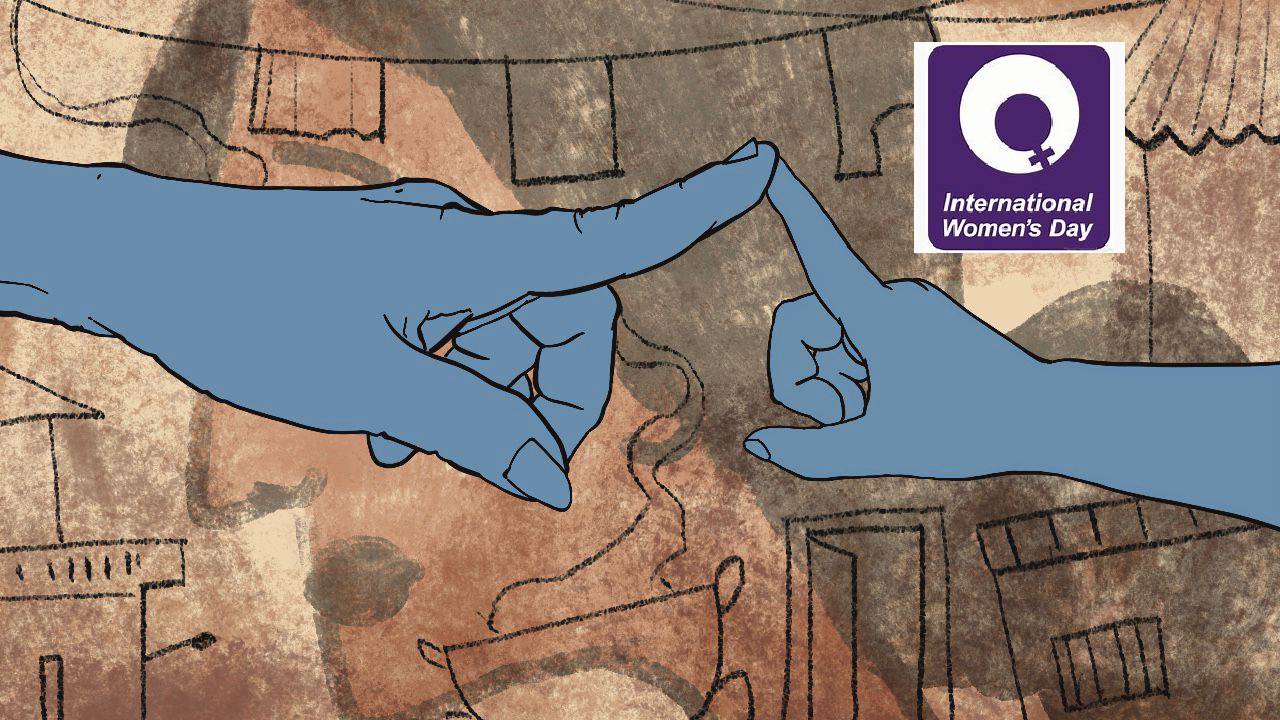
As a girl grows up, time and societal norms close around her, similar to a door shutting forever.
Synopsis: When a girl grows into a woman in India, especially in a rural setting, her priority becomes her family, and her health takes a backseat. The girl who had engaged in physical activities like games with friends seldom finds time to exercise once she becomes an adult. She considers the household chores as physical activities, but that is not the case. By the time she finds time, she will be a senior citizen in the company of many lifestyle diseases — something that could have been avoided if she had enough time at her disposal during her younger days.
Picture a school in rural India. It is recess time, and the atmosphere echoes with collective chatter and excited shrieks. Some girls, mostly aged around nine or 10, are playing hopscotch. A few others are running, playing tag.
Fast forward 20 years. The girls are now in their late 20s or early 30s, married, and with families to care for. The excited chatter and games played have been relegated to memory. They wake up early, cook, and attend to other household chores, sleep and repeat. Looking after their families have become their priority.
India’s Time Use Survey 2024 recorded that children aged six to 14 spent between 1 hour and 23 minutes a day in physical activity. The survey further found that females aged 15 to 59 spent 5 hours and 5 minutes a day on unpaid domestic work. Their male counterparts spared 86 minutes for the same chores.
The study pointed to a reality that has been hiding in plain sight. As a girl grows up, time and societal norms close around her, similar to a door shutting forever in a sudden gust.
Also Read: Women bearing hidden health costs of extreme heat
The bane of growing up
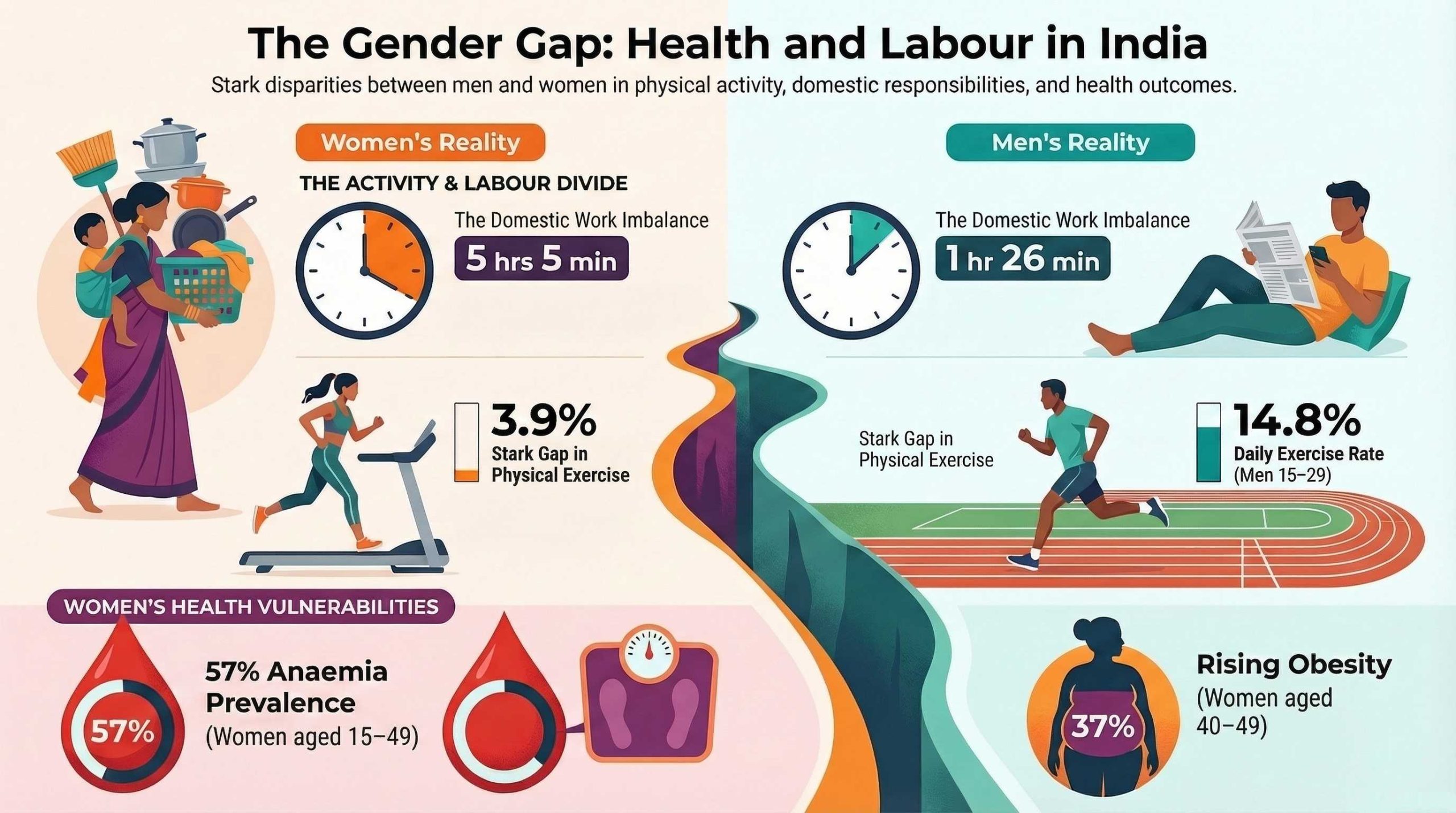
Among women aged 15 to 29, only 3.9% were engaged in sports or exercise. Among those who exercised, an average session lasted 46 minutes. In the case of men, 14.8% — nearly four times — participated in some sports or exercise, each session lasting 64 minutes on average.
The Time Use Survey stopped tracking women’s sports participation as a distinct category after the age of 29. The sample became too small to count. It was not a data failure, but a statement: by the time a woman crossed 30, very few exercised. The related data ceased to register as a statistical phenomenon worth measuring separately.
An ICMR-INDIAB study, published in The Lancet Diabetes and Endocrinology in 2023, found that generalised obesity climbed from around 5% among women aged 15 to 19 to 37% as they reached the ages of 40 to 49.
The same study found abdominal obesity in women at 49.6%, against 28.8% in men. Abdominal fat surrounds the organs. It drives insulin resistance, raises the risk of type 2 diabetes and accelerates cardiovascular disease. It also responds directly to sustained aerobic exercise. But that exercise requires time, and the Time Use Survey made it clear: time does not exist for most women.
Also Read: Women live more years in ill health than men
Does housework count as exercise?
Ask any woman engaged in 5 hours of domestic work whether she exercises. She will almost say yes. She considers the tiring household chores as a form of physical exercise.
Dr E Ravi Shankar, Consultant Endocrinologist at Apollo Hospitals in Hyderabad, presented three scenarios. (i) The worst: a person who neither does housework nor structured exercise — entirely sedentary; (ii) The best: someone with domestic help but compensates through the gym, tennis or similar activity; and (iii) Most Indian women’s life: domestic work, no structured exercise.
“Household work today does not involve the same level of physical exertion that our grandparents experienced. Technology and appliances have replaced many of these activities,” Dr Shankar told South First.
Dr Vidya Tickoo, Consultant Endocrinologist and Diabetologist at Yashoda Hospitals, was more definitive. Exercise has a specific definition: a repetitive physical activity performed in a structured manner to improve fitness. It encompasses cardio (where the heart rate must reach a target threshold for cardiovascular benefit), progressive strength training and flexibility work. Household tasks do not systematically fulfil any of these criteria.
“Household work can be very tiring. Because it is physically demanding and monotonous, many women count it as exercise. While it is certainly better than idling all day, it should not be considered a substitute,” Dr Tickoo told South First.
Dr Shanker added a historical dimension that made the current situation starker. The grandmother who ground flour using a pestle and mortar for 2 hours worked her upper body at an intensity no modern appliance could replicate. The granddaughter, on the other hand, pressed a button on a grinder and stood at a gas hob.
“The fatigue feels similar. But the metabolic benefit is not similar,” he said.
The plate she fills but does not design
Add food to this picture. The ICMR-INDIAB dietary study, published in Nature Medicine in November 2025, examined the eating patterns of 18,090 adults.
Indian diets derived 62.3% of total daily energy from carbohydrates — among the highest proportions in the world. The main sources have been white rice, milled whole wheat flour and added sugar. Protein contributed just 12% of energy intake, below the national recommendation of 15%.
The study found something specific about women: compared to men, they consumed fewer calories and less protein, but more added sugar and more saturated fat. They ate less, but what they ate worked against them in particular ways.
The Time Use Survey added texture: women ate their meals in 87 minutes across the entire day, 7 minutes less than men. The woman who cooked for 3 hours and 30 minutes sat down for a meal last and left first.
“Many women prioritise feeding the rest of the family. They give the best portions — including protein-rich items — to other family members and are satisfied with whatever is left. Sometimes they even eat leftovers just to avoid wasting food,” Dr Shankar said.
The metabolic consequence has been measured. Those with the highest carbohydrate intakes faced a 30% higher likelihood of newly diagnosed type 2 diabetes and a 22% higher likelihood of generalised obesity. The highest consumers of white rice specifically carried a 19% to 26% higher risk of diabetes, prediabetes and abdominal obesity.
Replacing just 5% of carbohydrate calories with protein from pulses, legumes or dairy was associated with an 11 to 18% lower likelihood of diabetes and prediabetes. But protein costs more. The woman in the Time Use Survey cooked what the public distribution system has subsidised — mostly white rice and wheat flour.
Also Read: Empowering women, nourishing lives
The blood that cannot carry oxygen
There is another quieter crisis. The National Family Health Survey 2019–21 found that 57% of women aged 15 to 49 have anaemia — a figure that rose from 53% in the previous survey round. More than half of Indian women in their reproductive and working years carried haemoglobin too low to move oxygen efficiently to working muscles.
Anaemia does not make a woman feel just tired. It raises her heart rate during exertion, shortens endurance and makes even moderate physical activity feel harder. A woman who tries to begin exercising with undiagnosed anaemia does not lack willpower. Her blood physiologically cannot support sustained aerobic effort.
The NFHS also recorded that women who breastfed carried the highest anaemia burden, at 61%. These women were in the years when the domestic workload peaked. The Time Use Survey showed 32.8% of women managing caregiving for over 2 hours a day, against 17% of men who averaged 73 minutes. The most physically depleted women carried the most unpaid labour.
Also Read: Breast cancer to cause a million deaths a year
The shame
In March 2026, Ipsos published a global survey of 14,500 adults across 14 countries. It examined how people with obesity experienced their condition.
India sat at the most damaging end of nearly every measure. Among Indians living with obesity, 50% frequently felt self-conscious about their weight, and 49% were perceived as lazy. In Austria, those numbers dropped to 19% and 18%, respectively.
India also led the world in one specific belief: 75% of people with obesity agreed that diet and exercise alone could solve it. The global average is two in three persons. The nation that structurally removes women’s time for exercise holds the world’s strongest conviction that the solution is personal discipline.
This belief produces a particular injury. The Ipsos study found that 70% of people with obesity avoided social, leisure or romantic activities in the past year because of their weight.
The burden fell harder on women, on younger adults aged 18 to 45, and on those in employment — the age group the Time Use Survey identified as the one where exercise disappeared, and the age group where metabolic risk began to climb.
When people with obesity consult a doctor in India, 66% received only lifestyle-focused advice: eat less, exercise more. The NFHS recorded that 57% of the same women were anaemic. An anaemic woman told to exercise more has received medically incomplete advice. Her fatigue has a physiological cause that mere willpower cannot address.
Also Read: Young, obese women at higher risk of surgical site infections
What the numbers hide
The ICMR-INDIAB dietary study found that 61% of the study population qualified as physically inactive.
Among urban women, 65% were physically inactive compared to 56% of men. But the Time Use Survey complicated what inactivity meant when applied to women. A woman who spent 5 hours and 5 minutes on domestic work cannot be considered sedentary. She lifts, bends, scrubs, carries, and stands the heat for hours. None of it counted.
The metabolic benefit of exercise came from chosen, sustained aerobic activity that raised the heart rate, built muscle and reduced visceral fat. Domestic labour, no matter how relentless, does not produce this effect.
The ICMR-INDIAB Lancet study noted that in 2021, 101 million Indians had diabetes, and 315 million had hypertension. Abdominal obesity affected 351 million people. These numbers did not accumulate overnight. They accumulated over decades.
The Time Use Survey recorded one more detail, making the picture clearer. Women aged 60 and above showed leisure time rising to 3 hours and 26 minutes per participant, closing in on men’s 3 hours and 40 minutes. This is subsequent to the loosened domestic stranglehold, and children leaving. and shrinking cooking load. But by age 60, hypertension has caught up with one in four women.
Also Read: Rice, wheat today have less nutritional quality
The prescription that arrives too late
The Nature Medicine study ended with a call for a clear policy: subsidise pulses and legumes through the public distribution system rather than refined grains; shift toward healthier cooking oils; build state-level nutritional strategies because food habits vary dramatically across India.
The ICMR-INDIAB Lancet study called for state-specific NCD strategies. The Ipsos study urged healthcare systems to move beyond lifestyle advice toward clinical management of obesity. The NFHS called implicitly for anaemia treatment at scale.
The girls who played hopscotch had time because no one claimed it. When they became women, others demanded and claimed their time. The diseases women developed at 40 were not the failure of their choices.
India measures the health of its women in surveys conducted once every few years. It weighs them, draws and tests their blood, asks what they eat, and asks how they spend their hours. It does not ask what they had given up. It does not ask when — and why.
(Edited by Majnu Babu).
