


Tech Explained: Here’s a simplified explanation of the latest technology update around Tech Explained: Can Middleweight Models And Global Partnerships Power Its AI Ambitions? in Simple Termsand what it means for users..
Pratyush Kumar, cofounder and CEO of Sarvam AI interating with Prime Minister Narendra Modi at India AI Impact Summit 2026 (Image Credit: X/Narendra Modi)
By Krishnanand
India’s ambition to build “sovereign AI” has shifted from rhetoric to execution. At the AI Impact Summit in Delhi, policymakers, startup founders, and global technology leaders shared a common message—artificial intelligence is now central to India’s economic and strategic future. But a big question remains. What model should India follow?
India’s present approach now broadly spans three pillars: state-backed compute infrastructure, domestic foundation model development and partnerships with global firms. The core question is not whether India can immediately rival American or Chinese frontier labs such as ChatGPT or Chinese DeepSeek, but how it defines sovereignty in a deeply interconnected AI ecosystem.
What is Sovereign AI?
Sovereign AI generally refers to a country’s ability to build, deploy, and control advanced AI systems without excessive reliance on foreign providers. That can mean training domestic foundation models, hosting compute infrastructure within the country, and embedding local languages and cultural context into systems. It means retaining strategic autonomy in sensitive sectors.
Changing perception of AI Bigwigs
At the summit, one of the central figures in the global AI ecosystem, Sam Altman of OpenAI, described India’s AI energy as unmatched, noting that it is OpenAI’s second-largest market and among the fastest-growing for developer adoption. He emphasised that India is now building across the entire AI stack—from data centres to models to applications—marking a shift from earlier perceptions of India primarily as a consumer market.

OpenAI CEO Sam Altman met Prime Minister Narendra Modi on the sidelines of the AI Impact Summit (ANI Photo)
In his interactions with Indian stakeholders at the India AI Impact Summit, Altman described India as transitioning from an AI consumer to an AI builder, citing its vast developer base, rapid adoption of coding tools, and strong startup momentum.
This was seen as a significant departure from his earlier statement made in 2023, when Altman advised the country against training frontier models, calling the endeavour “hopeless”. In his interactions with Indian stakeholders two years later, Altman clarified that the statement was made in a different context that no company, including an Indian AI company, can develop a top-end foundational model under a budget of $10 million.
While praising the energy of Indian AI startups at the AI Impact Summit in New Delhi, he, however, remained candid about the constraints faced by India in developing frontier AI models due to compute shortages, energy requirements, and the enormous capital required to develop frontier models. In his view, India can build sovereign AI—but not cheaply.
Different types of AI models
At present, the global AI frontier model (heavy-weight models) remains dominated by a handful of American and Chinese firms building huge, compute-intensive systems. AI models are often categorised by parameters, or the number of connections between artificial neurons. Lightweight AI models, typically in the 7–30 billion parameter range, can run on laptops or high-end smartphones. Middleweight AI models, around 30–100 billion parameters or more, require dedicated servers.
At the end of the spectrum, there are heavyweight or frontier models—running into the hundreds of billions or over a trillion parameters. They demand vast data-centre infrastructure, specialised GPUs, and billions of dollars in capital expenditure.
Frontier systems such as OpenAI’s ChatGPT, Google’s Gemini, or Microsoft’s CoPilot are part of this heavyweight class, also known as frontier AI models.
Altman has repeatedly argued that building such models is not a $10 million exercise anywhere in the world. It is a capital-and-energy-intensive undertaking. For India, this creates a strategic dilemma. Does sovereignty require competing in the heavyweight division, or can middleweight and lightweight systems deliver most of the economic benefits at a fraction of the cost?
Indian AI players – Hype versus Potential
One of the most prominent domestic efforts comes from AI startups such as Sarvam AI, Gnani AI and BharatGen. In the AI Summit, Sarvam unveiled a 30-billion-parameter lightweight model and a 105-billion-parameter middleweight model built from scratch. By focusing on open-source releases and competitive performance within its weight class, Sarvam is trying to position itself as a practical alternative for developers and enterprises seeking flexibility without heavyweight costs.
Sarvam 105B model follows the same MoE design, activating 9B parameters per token to combine large-scale capability with efficient execution.
With a 128K context window, it is built for more demanding tasks including complex reasoning, agentic task completion, tool use, coding,… pic.twitter.com/gyvkuBpWIb
— Sarvam (@SarvamAI) February 19, 2026
Another Indian AI startup, Gnani.ai, also launched an indigenous voice-to-voice artificial intelligence model at the AI Summit. It claims that, unlike conventional systems that convert speech into text before generating a response, this model processes speech directly into speech and reduces response time. This makes it more suitable for high-volume, real-time sectors such as banking, travel, logistics, hospitality, manufacturing, and government citizen services.
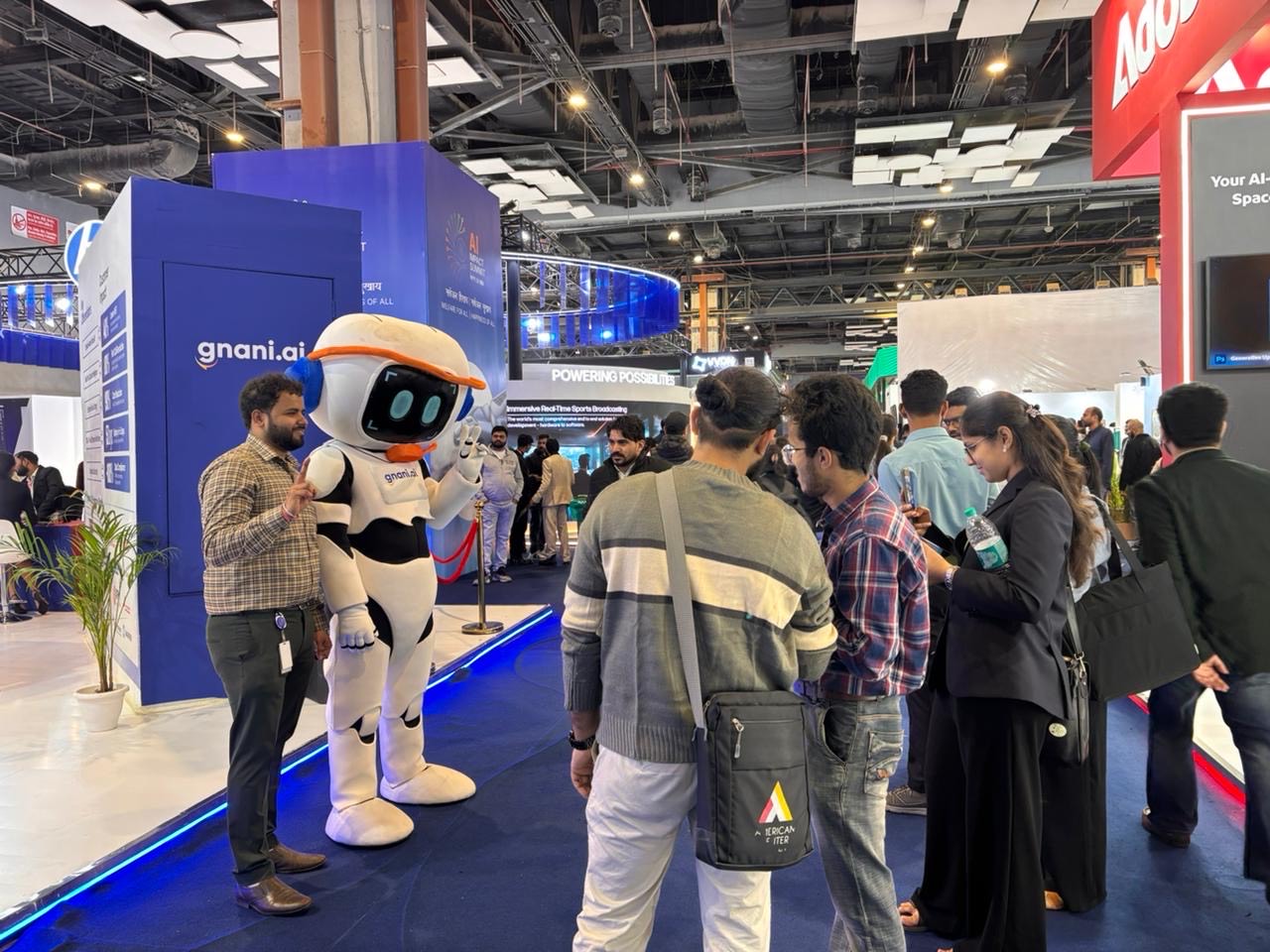
ndia’s Homegrown “Voice OS” by Gnani.ai Promises Real-Time, Multilingual AI Conversations Across Sectors (ETV Bharat)
Chip giant NVIDIA is also deepening its localisation efforts in India, recognising that a lack of enough compute capacity is the real bottleneck in AI development. The company has expanded partnerships with Indian data-centre operators, startups, and research institutions, while supporting AI skilling initiatives and language-focused model development.
For example, as earlier reported by ETV Bharat, BharatGen’s AI model, Param2 17B MoE, is built on NVIDIA AI Enterprise. This end-to-end training pipeline uses NVIDIA’s Base Command Manager (BCM), which integrates with Slurm and supports workflows utilising NVIDIA’s open libraries NeMo-RL to manage and scale AI training. It ensures that the AI model offers scalability and performance.
NVIDIA’s engagement also reflects a broader trend that sovereign AI does not mean technological isolation. Even other middle-weight AI powers that are seeking strategic autonomy, such as the UK, France, and Germany, also rely on global semiconductor supply chains and hardware ecosystems.
By embedding itself within India’s AI infrastructure ecosystem, NVIDIA is both enabling local capability and strengthening its position in one of the world’s fastest-growing AI markets.
Inaugurated the India AI Impact Expo 2026 at Bharat Mandapam.
Being here among innovators, researchers and tech enthusiasts gives a glimpse of the extraordinary potential of AI, Indian talent and innovation. Together, we will shape solutions not just for India but for the… pic.twitter.com/G370iXYAXm
— Narendra Modi (@narendramodi) February 16, 2026
Another approach is followed by Krutrim, backed by the Ola group, which aims to build a full-stack AI ecosystem spanning foundation models, cloud infrastructure, and chips, with an emphasis on Indian language support and domestic data hosting. This strategy reflects a belief that strategic autonomy requires vertical integration—but it also carries significant capital and infrastructure demands.
Middle Path – Mixing Global Models with Local Storage
A hybrid path is emerging through partnerships such as the one between Tata Consultancy Services and OpenAI, under which advanced proprietary models are deployed through Indian data centres.
Proponents of this model view this as pragmatic sovereignty—keeping data local while leveraging global top-end AI capabilities.
On the other hand, critics of this model argue that ultimate control remains with foreign model developers. For many sectors, however, this blended model may offer the fastest route to scale.
Ultimately, India’s AI strategy appears to be based on three pillars. These include nurturing domestic model builders such as Sarvam AI, Gnani.ai, Bharat Ai among others, expanding local infrastructure with global technology partners on the lines of TCS and OpenAI’s partnership, and accelerating real-world adoption across sectors.