


A gift from the Robertson Family Fund will support studies on coral and seagrass population, furthering coastal conservation and restoration efforts.
Florida Atlantic University’s Harbor Branch Oceanographic Institute received a $300,000 gift from the Robertson Family Fund for marine research. The funding will support studies on coral and seagrass populations, supporting coastal conservation and restoration efforts.
This gift, presented by Geoff Robertson, demonstrates the family’s continued commitment to FAU Harbor Branch’s research efforts in the region. A prior gift from his parents, Bill and Maud Robertson, and other members of the Robertson family, established the Robertson Coral Reef Research & Conservation Program in 2004.
“I am so pleased to be continuing the legacy started by my parents to support environmental science at FAU Harbor Branch,” said Geoff Robertson. “I grew up visiting the area and learning about the research being done here. Protecting our coastal environment for future generations is a long-standing cause important to my family.”
The donation will support coral research and postdoctoral training through the Roberston Coral Reef Research & Conservation Program. Coral reef ecosystems are key centers of biodiversity, critical habitats for fisheries, and protectors of coastlines. Motivated by recent coral declines due to disease, coral bleaching and human-driven impacts, the program team – led by Joshua Voss, Ph.D., research professor – has expanded efforts to discover and conserve deeper coral reefs. The team also is working to develop novel methods for intervention and restoration on shallower coastal reefs.
“Gifts like these ensure the continued success of Harbor Branch’s research and conservation and restoration efforts for critical habitats in our own backyard and beyond,” said James M. Sullivan, Ph.D., executive director of FAU Harbor Branch. “Generational giving from friends in the community has a tremendous impact, helping us to reach significant scientific milestones.”
The Seagrass Ecology & Ecosystem Science Lab, led by Rachel Brewton, Ph.D., assistant research professor, will also receive support from the gift. Seagrass meadows form the foundation of a healthy and resilient coastline, providing essential habitats for juvenile fish, serving as a food resource for manatees and sea turtles, stabilizing sediments and preventing shoreline erosion during storms. Poor water quality and harmful algal blooms have led to a 60% decline in seagrass cover throughout the Indian River Lagoon (IRL). FAU Harbor Branch researchers are cultivating seagrass for restoration experiments in depleted areas, investigating how this habitat loss has impacted fisheries and coastal ecosystems, and identifying the path forward for large-scale, sustainable restoration in the IRL.
Based in St. Lucie County, FAU Harbor Branch’s 144-acre campus along the IRL employs more than 200 scientists, engineers, educators, staff and students. The institute pursues solution-oriented research on critical issues affecting coastal zones, oceans and human well-being.
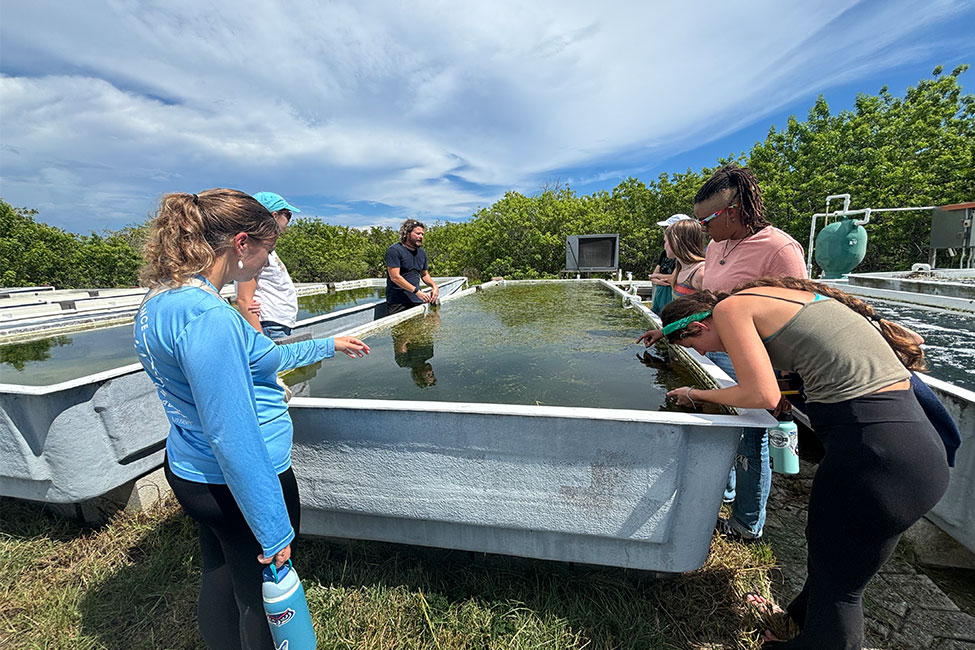
Part of the gift will support the Seagrass Ecology & Ecosystem Science Lab where researchers are cultivating seagrass for restoration experiments in depleted areas of the Indian River Lagoon.
-FAU-