


Case Explained:This article breaks down the legal background, charges, and implications of Case Explained: Prohibitive policies drove organised crime in Australia 100 years ago. It’s happening again – Legal Perspective
Organised crime has a long history in Australia. For more than a century, criminal groups have accumulated vast fortunes, committed countless acts of intimidation and coercion and, at times, extreme and spectacular violence.
In the process, they have become a recurring feature of public concern, media sensationalism and political debate.
There’s the razor gangs operating in Sydney during the 1920s, and the underbelly gangland conflict in Melbourne during the 1990s and early 2000s. Now we have the nationwide “tobacco wars”.
All of this organised crime shares something in common: it’s centred around competition for control of the country’s highly profitable illicit markets.
But if we look back at the responses to organised crime and black markets in Australia’s history, we can see governments are making many of the same mistakes now as they did a century ago.
Changing times, changing vices
While organised crime has shown remarkable continuity, the specific markets it exploits have changed over time.
Each period produces its own anxieties about the harmfulness of different behaviours. These are shaped by prevailing social norms, the familiarity or novelty of what is deemed “deviant” and the political priorities of the day. As these factors shift, so too does whether and how different goods and services are regulated.
In his recent book, Ian Shaw recounts the exploits of Squizzy Taylor. He was a flamboyant criminal in early 20th century Melbourne with a penchant for fine suits, horse racing and armed robbery.
Wikimedia Commons
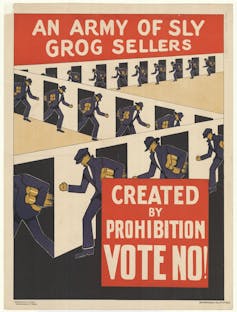
Yet the most reliable sources of income for Taylor and his contemporaries were not spectacular crimes, but illicit markets, particularly illegal gambling, sex work, and alcohol, commonly known as sly grog.
At the time, each of these commodities was subject to outright prohibition or extraordinary restrictions intended to reduce harm. For alcohol, this included mandatory 6pm closure times for licensed establishments.
While restrictive regulations likely reduced overall consumption, they also ensured the consumption which continued occurred in more dangerous, exploitative and unregulated settings.
Sex workers were routinely exploited by pimps and corrupt police. Gambling continued to extract money from vulnerable participants, with debts and disputes enforced through intimidation and violence. The widespread consumption of sly grog continued in beer houses run not by licensed publicans, but by organised crime groups.
The State Library of New South Wales
But the biggest danger remained the extraordinary profits flowing into the hands of these groups. The size and profitability of these illicit markets created powerful financial incentives that spilled over into deadly conflicts.
These affected not just gangsters fighting one another, but innocent bystanders as well.
Today, all three of these once-vibrant criminal markets are now largely regulated, but not too strictly. That doesn’t mean they are necessarily free from harm. But there is broad public acceptance that effective regulation produces better outcomes than leaving control in the hands of criminal organisations.
Regulation helps protect the safety of both consumers and suppliers. And instead of vast profits flowing into the hands of organised crime groups, they go into the pockets of legal business owners and provide a major source of income for the government through taxation.
Illicit markets in contemporary Australia
Australia continues to grapple with illicit markets where prohibition or extreme restriction remains the dominant policy response.
A 2025 Australian Institute of Criminology report lays bare the extraordinary costs of serious and organised crime. They were estimated to be up to A$82.3 billion for 2023–24.
The single most costly organised crime activity, and the greatest source of revenue for criminal groups, concerns illicit drugs. Expenditure on the five main illicit drugs – cannabis, cocaine, methamphetamine, MDMA (ecstasy), and heroin – was estimated at A$11.2 billion.

Joe Castro/AAP
This figure does not include Australia’s fastest growing illicit drug market, nicotine, with expenditure recently estimated to be A$7.2 billion.
As with earlier black markets, demand for illicit drugs has remained strong despite them being banned.
In the case of nicotine, recent policy changes – high levels of taxation on tobacco and the prohibition of consumer vapes – have accelerated the shift towards criminal supply. Organised crime groups now supply a dominant share of this once largely legal market.
The false promise of prohibition
Australia’s approach to managing our largest contemporary illicit markets is eerily similar to that of earlier periods in history. It’s an escalating reliance on restrictions, penalties and police powers in an effort to disrupt supply and “crush” organised crime.
As in decades prior, this approach has been ineffective. Australian drug law enforcement expenditure tripled from A$1.2 billion in 2009–10 to more than $3.5 billion in 2020–21.
This massive investment was intended to make illicit drugs more expensive and harder to obtain. Law enforcement agencies have done their best with this vast amount of taxpayer money, producing record levels of arrests and seizures year after year.
But claims that arrests or seizures “break the business model” or “put a dent in organised crime” are hollow.
In reality, illicit drugs remain just as easy to find, purity has increased, and prices for every major drug type have declined substantially in real terms.
Methamphetamine, for example, is as readily available as it was 15 years ago but at roughly half the price, once adjusted for inflation.

Joel Carrett/AAP
These outcomes reflect research indicating that intensifying law enforcement beyond a minimal level produces sharply diminishing returns.
They also closely resemble earlier attempts to suppress gambling, sex work and alcohol through prohibition. These attempts reduced legal supply without eliminating demand and, in doing so, strengthened organised crime.
What this means for illicit markets today
Some illicit markets remain beyond the pale and can never reasonably be subject to regulation. Those that necessarily involve inflicting harm and suffering on others, such as trading in child exploitation material or stolen goods, fit squarely into this category.
But other illicit markets warrant reconsideration in light of Australia’s own historical experience. This is particularly the case for those involving widely used goods or substances consumed by consenting adults, such as illicit drugs and nicotine.
This does not mean we should throw away all legal restrictions. Regulation means control – not laissez-faire.
Completely unregulated markets are risky. They give commercial interests strong incentives to promote consumption through advertising and 24/7 delivery. There is a strong case to be made that gambling, for example, should be subject to stricter regulation than is currently the case.
À lire aussi :
This 6-point plan can ease Australia’s gambling problems – if our government has the guts
At the other extreme, overly restrictive policies that generate large illicit markets provide ready access to unregulated products, enrich and empower organised crime and are highly resistant to law enforcement.
The most promising path often lies between these two positions. For example, a 2025 New South Wales government inquiry recommended the current prohibition on cannabis should be overturned in favour of decriminalisation, and that a staged process towards a legal, regulated market be considered and assessed.
Australia has confronted these dilemmas before. When widely used goods and services were pushed out of legal supply while demand persisted, organised crime flourished. When those same markets were brought into the open and subject to effective regulation, criminal influence receded.
This approach would not only help protect the wellbeing of consumers. It would also deprive the Squizzy Taylors of today – people such as the alleged illegal tobacco kingpin Kaz Hamad – of their most important source of income, thereby removing a major incentive for violence on our streets.