


Case Explained:This article breaks down the legal background, charges, and implications of Case Explained: How to interfere with jury trials, and lose – Legal Perspective

The British government’s proscription of Palestine Action as a terrorist organisation was dealt two serious blows this month. Not only was the decision to ban the group found unlawful in High Court, a jury refused to convict six of its activists — the so-called Filton 6 — for dismantling an Israeli arms factory in Bristol in 2024.
The Filton 6 were cleared of aggravated burglary — the most serious charge they faced. Crown prosecutors are now planning to retry the defendants on the charges the jury failed to reach a verdict on: criminal damage and, for three of them, violent disorder.
The verdict came in the face of clear and well documented political pressure.
In the months before the trial, in what campaigners said amounted to direct interference in the case, then-home secretary Yvette Cooper told the public there was “disturbing information” about Palestine Action that she could not share because of the ongoing criminal proceedings, hinting at having “intelligence” about “future attacks” by the group.
Despite a widening clampdown on the legal avenues available to defend protesters in court, and in face of a the government moving to effectively brand and treat the defendants as terrorists while they were on remand – barristers ensured the jury understood its unique constitutional role in holding power to account.
Here’s how they did it, and how the government and arms lobby sought to stop them.
‘Great courage and independence’
The defendants were accused of causing £1 million worth of damage to an Elbit Systems UK facility in Filton on 6 August, 2024. They used a repurposed prison van to break in, and sledgehammers to destroy equipment they believed could be used by the Israeli military in Gaza, including, reportedly, “killer” quadcopter drones.
Against charges of criminal damage, activists can argue that they had a lawful excuse to carry out their action to prevent harm.
During the trial, a juror penned a note to the judge: If the defendants genuinely believed their action would save lives, and they felt morally compelled to destroy weapons they believed would be used to kill civilians in Gaza, would that amount to a lawful excuse?
“That’s not something you need to consider,” judge Justice Johnson replied. He ruled the defendants’ key legal defence — that their actions could be justified as a “lawful excuse” aimed at preventing a far graver crime of genocide — inadmissible. In other words, he deemed their motives and the context of the genocide in Gaza irrelevant to the criminal damage charge.
He also deemed inadmissible much of the evidence about Elbit Systems and its UK subsidiaries. Elbit is one of Israel’s largest arms firms, and produces approximately 85% of the IDF’s drones and land-based equipment that it boasts has been “battle tested” on Palestinian bodies.
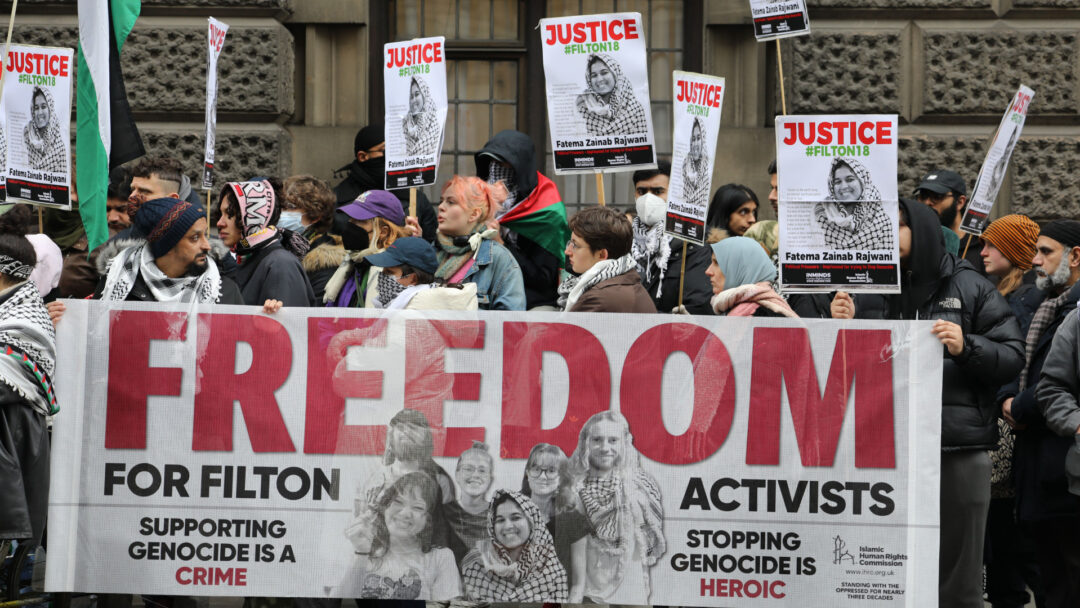
While Justice Johnson ruled potential defences were effectively inadmissible and limited contextual evidence about Elbit’s role in Israel’s genocide in Gaza, he could not “by law” direct the jury to convict the defendants. This is something defence barrister, Rajiv Menon, wanted to ensure the jury would understand.
In his closing statement, Menon told jurors: “You could be forgiven for thinking that His Lordship is in fact directing you, as a matter of law, to convict… But you would be wrong… No judge in any criminal case is allowed to direct a jury to convict any defendant of any criminal charge, whatever the evidence might be… Please remember that fundamental principle at all times when you retire [to consider your verdicts].”
In great detail, Menon traced the independence of the jury back to 1670, when two Quakers were prosecuted for preaching to an assembly when it was a crime to do so. After they stood trial at the Old Bailey, the judge directed the jury to convict, but they refused. The judge fined them and remanded them in custody, yet some refused to pay and forced a hearing at a higher court, which they won.
More than 355 years on, Menon urged the jury to clear the defendants: “It will undoubtedly take great courage and independence to do so. But the facts ultimately are solely for you. Please don’t forget that. And don’t worry, the good news is that we’ve moved on since 1670: there is no prospect of you being imprisoned or fined for the factual conclusions you reach.”
Menon made clear that while the judge and prosecution argued they had no legal defence for criminal damage, it was up to the jury to decide on the evidence, not them. He added: “But what happened is that His Lordship has withdrawn that defence as a matter of law, and that’s the true position that we find ourselves in… So where does that leave you, the members of the jury?”
Evidence of lobbying
This is not the first time a judge has withdrawn this legal defence in high-profile protest cases involving allegations of “significant” criminal damage. After a series of acquittals in Palestine Action cases in the early 2020s, the clearing of the Colston Four statue topplers in Bristol in 2021 and various Just Stop Oil climate activists, the Attorney General pushed for tougher restrictions.
There is evidence of lobbying from Elbit Systems to push the government for stronger measures to be taken against Palestine Action protesters, long before they were proscribed as a terrorist organisation in July 2025. It’s also clear that ‘action points’ from meetings between ministers and the company were passed to anti-terrorism officials.
The use of anti-terror laws against pro-Palestine activists and the eventual proscription of Palestine Action can be traced back to a 2022 meeting between then-Conservative home secretary Priti Patel and the Elbit Systems UK boss Martin Fausset. Records of the meeting, though heavily redacted, show that Patel sought to “reassure” Fausset that the government was taking the “criminal protest acts” seriously. Notes from the discussion included “next steps” that were forwarded by Patel to two directors of home office anti-terrorism strategies.
In early 2024, Elbit Systems UK lobbied the Home Office for a speedy retrial of Palestine Action’s founders, Huda Ammori and Richard Barnard, after a jury refused to convict them of various charges, mostly related to criminal damage of Elbit factories in the UK, following a trial in London. A letter sent to then-policing minister Chris Philip, by Elbit UK’s security director Chris Morgan described Ammori and Barnard as the “controlling minds” of Palestine Action and wrote: “It is very much in the public interest for this trial to be re-heard at the earliest opportunity”. The Crown Prosecution Service (CPS) later ordered a retrial of the activists, which is scheduled for 2027.
In November that year, it appears that Home Office officials had briefed Jerusalem Post journalists that it was considering banning Palestine Action. The following month, three officials from then-home secretary Yvette Cooper’s Home Office held a secret meeting with three representatives from Elbit, according to documents released to Declassified.
Conflict of interest
Also in 2024, Lord Walney, an ‘independent’ advisor on political violence and disruption, published a report for the government that recommended Palestine Action be proscribed as a terrorist group. Walney’s independence was questioned, at the time and now, as he previously held paid positions for the defence lobby and formerly chaired Labour Friends of Israel.
Asked about this in a Channel 4 Dispatches documentary that aired shortly after the Filton verdict, Walney said: “The UK is a friend of Israel,” before being asked if that is the right position to take given the mass slaughter of civilians that has been going on in Gaza. He responded: “What you say on that is highly contested… Israel does not, and I don’t think the UK government accepts your characterisation of the conflict.”
While Elbit and the wider arms lobby clearly has the ear of government ministers, some senior civil servants in the Home Office are worried about the consequences of the tough action the state is taking to stifle protest in the UK, with some telling the Dispatches they and many of their colleagues thought the proscription of the group was “wrong”.
They said the ban, and other new powers granted to the police to limit repeated street protests, were “part of the same attempt to curtail the right to freedom of speech”.
Cooper’s contempt
Juries refusing to convict activists of a proscribed terrorist group is a huge blow for the government, and campaigners have argued that former home secretary Yvette Cooper deliberately tried to interfere with proceedings to influence the verdict.
The Filton activists’ action happened almost a year before Palestine Action was banned, but they were effectively treated as terrorists while on remand, and Cooper, on the day the group was proscribed, shared statements with the media. In an opinion piece for the Observer (paywall), Cooper wrote that there was “disturbing information” about Palestine Action that she could not share because of the ongoing criminal proceedings, hinting at having “intelligence” about “future attacks” by the group.

Defend Our Juries, which campaigns for jurors’ absolute right to acquit defendants according to their conscience, said her statements in the media amounted to contempt of court. They wrote to the Attorney General outlining that Cooper had “irreparably prejudiced the jury” by presenting the prosecution’s allegations in ongoing Palestine Action trials as a matter of established fact, when they were contested allegations and by making vague, unsubstantiated allegations regarding intelligence concerning “future attacks”.
In the letter, the activist group called for Cooper to be held accountable for contempt of court, which carries heavy fines or imprisonment. It said: “We are not naïve regarding the political obstacles to commencing contempt of court proceedings against the home secretary. But if the rule of law means anything, it is that no-one is above the law, most particularly the rich and powerful, such as Elbit Systems UK and Yvette Cooper. It is particularly egregious for a home secretary to abuse their office in this way, to present a false and misleading picture of those who face serious criminal charges.”
Power to the people
Inside the courtroom, defence barristers also sought to ensure the jury was aware of their absolute right to clear the defendants – and the importance of their independence from the judiciary.
In his closing remarks, defence barrister in the Filton 6 case Tom Wainwright alluded to government plans to crush the absolute right to a trial by jury. (These plans were drafted by defence secretary David Lammy, who also notably refused to meet Palestine Action hunger strikers. The latter refused food and water while on remand in a protest over the government’s complicity in Israel’s genocide in Gaza, and their treatment as terrorists inside.)
“It is the only just and fair system for deciding guilt or innocence. That decision, that power, should not be in the hands of any one individual, because one person may not be properly representative of our society.
“There is a risk they may have a singular viewpoint, narrow experience, may bring conscious or unconscious bias and prejudice. These decisions should be made by the community, with your collective experience, common sense, integrity,” Wainwright added.
“This isn’t the first time that this suggestion’s been made, removing juries, so perhaps the real question is why is it that from time to time those in power want to take away the right to trial by jury? And the reason may be that the jury system gives power to the people.”
The fight’s not over
While the Filton defendants were acquitted of the aggravated burglary charges, they now face the ordeal of a retrial in relation to the other charges against them which did not end in verdicts. And though the government has also indicated it will appeal the High Court decision on the ban of Palestine Action, it is possible that that ruling could later be overturned by a higher court.
The High Court’s decision, however, signals that there is unease, “even within the normally highly conservative judiciary,” which is reflected in the wide opposition to Palestine Action’s proscription, according to Lindsey German, national convenor of the Stop the War Coalition.
Writing in Counterfire, German said the Labour government’s attempt to keep pursuing protesters will do nothing to aid the unpopularity of the prime minister. “His eventual demise cannot be long in coming,” German adds. “We need to ensure that we keep up the pressure over both Palestine and the right to protest, and that Labour is forced to change tack.”
After the Filton verdicts earlier this month, at a case management hearing this week, prosecutors dropped aggravated burglary charges against 18 defendants accused of taking part in the action. All of them continue to face criminal damage charges, and some are also charged with violent disorder
Five of them, three of whom had been held in custody for about 18 months, were granted conditional bail following the case management hearing. Bail applications for another eight of the 18 are expected to be heard on Friday.
Reacting to the aggravated burglary charges being dropped, Naila Ahmed, head of campaigns at human rights organisation Cage International, said: “It’s an incredible feeling, and just one in the long list of victories that we hope will continue to come.”
Independent. Investigative. Indispensable.
Investigative journalism strengthens democracy – it’s a necessity, not a luxury.
The Cable is Bristol’s independent, investigative newsroom. Owned and steered by more than 2,600 members, we produce award-winning journalism that digs deep into what’s happening in Bristol.
We are on a mission to become sustainable, and to do that we need more members. Will you help us get there?
Join the Cable today