


Tech Explained: Here’s a simplified explanation of the latest technology update around Tech Explained: What Golden Quotes Did Tech Giants Share at the “AI-Everywhere” Davos? in Simple Termsand what it means for users..
First of all, actually, the title of this article is a bit sensational: this year may not be the Davos with the strongest AI flavor.
However, at the World Economic Forum, AI has undoubtedly become an issue closely related to the world economy: more than 84 world leaders, 800 CEOs, and thousands of other participants gathered in Davos, Switzerland, to attend the annual meeting in the Alps.
At this year’s Davos, there is no longer any discussion around “Will AI change the world?” Instead, the focus is on two more difficult-to-answer and more conflicting propositions: “How radical is the timeline of AI?” and “How should the costs, benefits, and risks of AI be distributed in society? Which groups will bear the impact first, and which groups will reap the benefits first?”
On-site, several hosts brought up a long-debated topic: Is the AI industry in a bubble – that is, the valuations of companies far exceed their currently realizable actual values? Industry leaders responded from different perspectives, but the conclusions tend to be the same: everything is okay.
Whether it’s about the AI timeline or the impact of AI on employment, the big shots had direct confrontations in their speeches. This made this year’s Davos more watchable.
01
Elon Musk:
There will be an AI smarter than humans this year
Different from other tech big shots who often frequent Davos, Elon Musk, who frequently drops golden quotes on social media and even once described Davos as “extremely boring,” is actually participating in the Davos Forum for the first time. Although he joined the agenda as a last-minute guest, he still contributed many memorable moments: not only the moment when he claimed to be an “alien,” but also the bold statement that “by the end of 2026, AI will surpass human intelligence.”
Elon Musk at the Davos Forum | Photo source: Visual China
“We may have an AI smarter than any human by the end of this year; at the latest, it won’t be later than next year.”
This radical timeline may be the most radical one among the AGI timeline predictions from tech big shots at this year’s Davos.
Musk’s main narrative is to attribute the value of AI to “executors in the physical world (robots)“, emphasizing that future production and services will be completed by a large number of robots. At the same time, this is also the core worldview of his “technology-driven abundance”: when robots drive the marginal production cost extremely low, society will enter a state of “extremely abundant supply.”
At a certain stage, goods and services will be extremely abundant because I predict that there will be more robots than humans.
Musk predicts that the popularization of artificial intelligence and robot technology will bring unprecedented global economic expansion, and ultimately make work unnecessary; he also expects that “by 2030 or 2031, AI will be smarter than the collective wisdom of all humans.”
“If you have billions of humanoid robots – and I think there will be – I think everyone on Earth will have one and want one, because you’ll want a robot – provided it’s safe enough – to take care of your children, look after your pets… There aren’t enough young people to take care of the elderly. So if you have a robot that can take care of and protect your elderly parents, that would be great. I think we’ll all end up having these.”
In addition to these predictions, Musk did give a more specific timeline: he expects Tesla to start selling the humanoid robot Optimus to the public by the end of next year.
“I think what I want to say in the end is that I encourage everyone to stay optimistic and be excited about the future,” Musk said.
He added: “Overall, in terms of quality of life, it’s better to be on the optimistic side, even if you’re proven wrong in the end, than to be a pessimist, even if you’re right.”
02
Microsoft CEO Satya Nadella:
Big companies are more likely to be disrupted in the AI era
Compared with other big mouths, Microsoft CEO Satya Nadella, who has always presented a low-key image, doesn’t have exaggerated golden quotes. His words seem more suitable for the Davos occasion. Therefore, he ties AI to the hard constraints of the macroeconomy, making it impossible for people to continue to use “the model is very powerful” to avoid real problems.
In his speech, Nadella also put forward a concept that can more easily strike a chord with the public: society’s tolerance for the AI industry.
If AI just consumes scarce energy to generate a large number of tokens without improving health, education, and industrial outcomes, society will quickly lose the willingness to continue tolerating this resource consumption.
Nadella believes that the reason why the expansion of Internet infrastructure has been accepted in the past few decades is not that it has no cost, but that the returns are obvious enough. If AI presents the image of a “power-consuming machine” in the short term and the returns are not visible, it will trigger a public backlash.
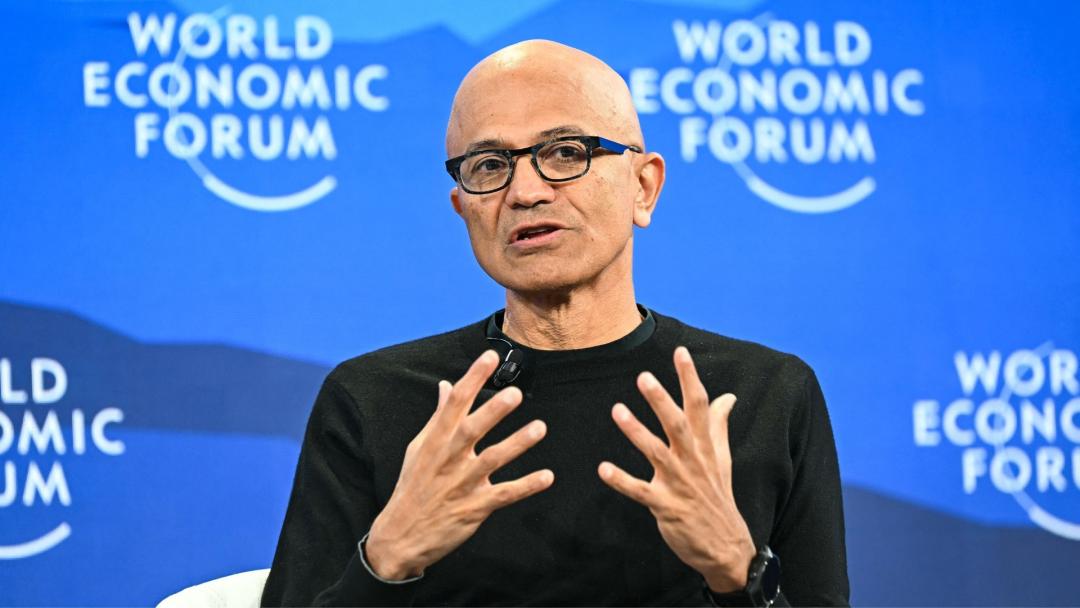
Microsoft CEO Satya Nadella at the Davos Forum | Photo source: Techrader
The backlash may not be just empty talk. It is more likely to appear in practical ways: it will be more difficult to select locations for data centers, the grid connection will be slower, the supervision of energy consumption and emissions will be stricter, the distribution of public financial resources will be more controversial, and the monopoly issues of big tech companies will also be reignited.
Under the same logic, Nadella also presented his judgment on the solution to the AI bubble: the benefits need to be spread more evenly and inclusively.
To prevent AI from eventually becoming a bubble, the benefits must be spread more evenly and inclusively.
It sounds like a value judgment, but this is actually a business judgment from the Microsoft CEO: insufficient spread means insufficient market capacity, which means that valuations are based on a few industries and a few high-purchasing-power groups.
This kind of argument doesn’t seem strange at Davos. After all, there are a large number of multinational enterprise managers among the audience. The questions they care most about are very simple: Can I afford to use it? Can it improve efficiency after use? Can it transform the organization? Nadella repeatedly emphasizes the workflow, which is shifting the discussion from “technology supply” to “organizational demand.”
Nadella compares the current situation with the 1980s: at that time, computing technology reshaped the workplace, opened up new growth and productivity spaces, and gave rise to a new type of workers. “We created a whole new category called ‘knowledge work.’ People began to really use computers and amplify our goals with software,” he said. “I think the same thing will happen in the context of AI.”
The real value that enterprises can obtain does not come from the intelligence of the model. It comes from the reconstruction of processes, permissions, responsibilities, and collaboration methods. When AI enters an enterprise, it often becomes a management project.
“For large organizations,” Nadella said, “there is a fundamental challenge: if your change speed cannot keep up with the possibilities that technology can achieve, you will be taught a lesson by smaller companies – they can achieve scale with these tools.”
Saying this is more like the language of Davos than any parameter indicators.
03
Jensen Huang: Embodied intelligence is a once-in-a-generation opportunity
In addition to the old saying of “AI should be regarded as an infrastructure budget rather than a single-point IT procurement,” Jensen Huang talked more about the construction plans for more supporting facilities at Davos: trying to mobilize the patience of capital, encourage the government to regard AI as an infrastructure issue, and mobilize the industrial chain to prepare for the next wave of implementation.
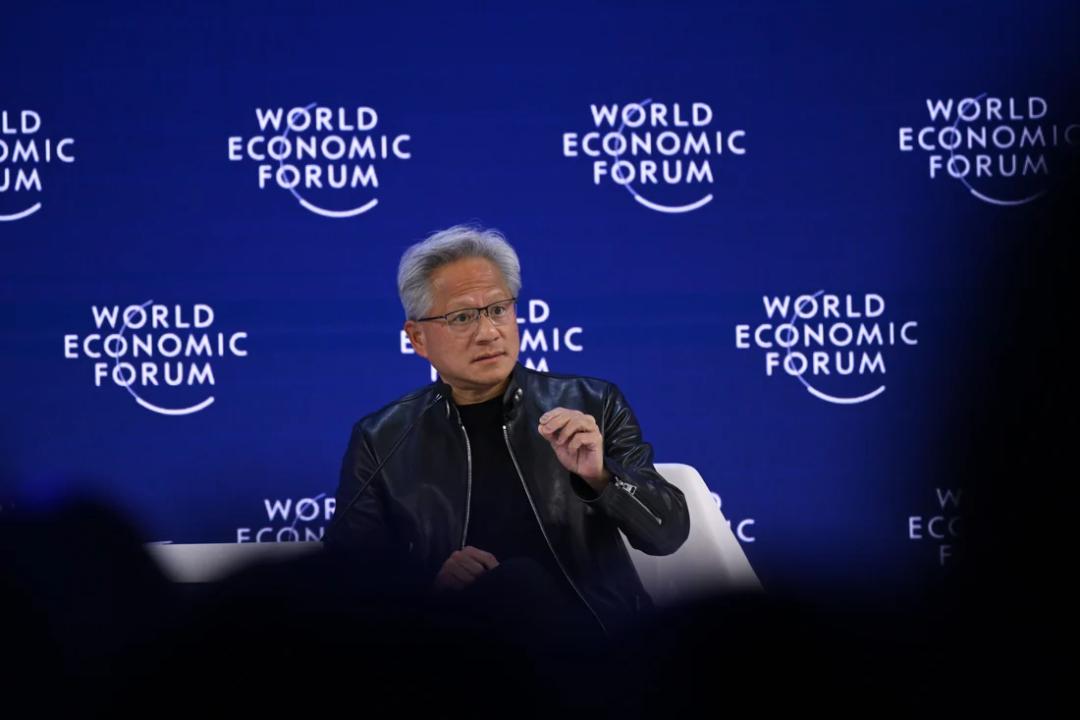
Jensen Huang promoted the topics of sovereign computing power and AI infrastructure at Davos | Photo source: Visual China
“This is the largest infrastructure construction in human history.
Jensen Huang describes AI as a “five-layer cake.” From bottom to top, they are “energy,” “chips and computing infrastructure,” “cloud data centers,” “AI models,” and the most important application layer.
According to Jensen Huang’s introduction, each layer needs to be built, operated, maintained, secured, and continuously expanded. Each layer corresponds to its own bottlenecks, suppliers, and political problems. Each layer also corresponds to a bill.
The top layer, where hardware is finally converted into profits, is what he calls the place where economic benefits will “ultimately” be generated. He depicts a world where AI penetrates into financial services, healthcare, manufacturing, and all areas where inefficiencies can still be compressed.
In addition to these, Jensen Huang also frequently led the topic to the startup level in the dialogue, saying that 2025 was one of the strongest years in venture capital fundraising records. Most of the capital flowed to “AI-native companies,” and this capital will be the starting point for downstream employment creation. Capital drives the application layer, and infrastructure and the labor force follow.
Embodied intelligence is a once-in-a-generation opportunity
Jensen Huang believes that for countries with a strong industrial foundation, “robots are a ‘once-in-a-generation’ opportunity,” and he said that if a country wants to play a leading role in the AI construction wave, factories, machines, and industrial systems capable of learning in the real world are still a blue ocean full of huge opportunities.
AI will not eliminate jobs; it will redistribute job content
Jensen Huang took healthcare as an example: in his view, AI has become a “key tool” in radiology, but “there are more radiologists than ever.” He added, “If you deduce from first principles, this is not surprising,” and advocated that AI accelerates the film-reading task, allowing people to invest their time in higher-value and higher-risk aspects.
Jensen Huang said that the United States is facing a “shortage of about 5 million nurses,” and one of the reasons is that “nurses spend nearly half of their time on medical record-keeping and paperwork.” He mentioned using AI for medical record-keeping and transcription and claimed that the productivity cycle will ultimately lead to more recruitment. “AI is improving productivity, so hospitals want to hire more people.”
This may be the version of the story that the audience at Davos wants to hear the most: AI expands service capabilities, improves outcomes, and at the same time keeps the labor narrative stable.
04
Demis Hassabis:
AGI may still take 5 – 10 years
As the de facto leader of Google’s AI products, every statement about AI by Demis Hassabis, the co-founder and CEO of DeepMind, is regarded as the stance and signal of Google/DeepMind. Especially the dialogue with Anthropic CEO Dario Amodei was widely shared on social media.
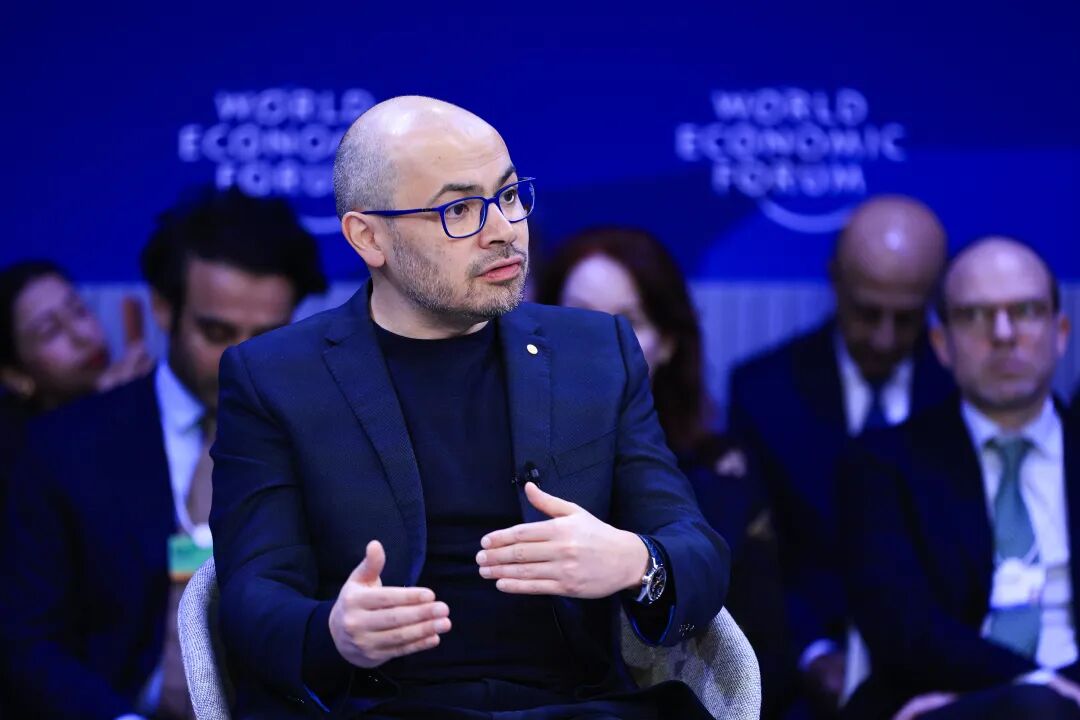
The confrontation between Hassabis and Dario was one of the most watchable dialogues at this year’s Davos | Photo source: Visual China
But he is also in a very delicate position: he has to maintain the stance of a technology leader and avoid presenting an overly radical timeline in public to avoid creating unnecessary panic in policy and society.
So you’ll see that the most frequently quoted golden quote from him this year is a relatively conservative judgment:
“AGI may still take 5 – 10 years.”
This statement not only directly conflicts with Musk’s radical judgment of “having AGI this year,” but also has an obvious difference from the earlier judgments of the founders of Anthropic and OpenAI, who respectively said that AGI may appear as early as 2026 or 2027.
Hassabis believes that the path to achieving human-level artificial general intelligence (AGI) is becoming clearer – but still lacks “some key elements.” He believes that AGI will take another 5 to 10 years to arrive. But he didn’t clarify what these key elements are specifically.
Like many people at Davos, Hassabis also expressed his concern about the impact of AI on entry-level jobs in the dialogue: “If I were talking to a group of undergraduates now, I would tell them to be very proficient in using these tools.”
05
Dario Amodei:
It’s only 6 – 12 months away before the model can complete software end-to-end
If you want to select the AI figure with the most intense flavor of gunpowder at this year’s Davos, Dario Amodei is most likely the answer: after all, Anthropic was founded because Dario was worried that OpenAI didn’t prioritize safety enough in AI development, so he left the company and founded Anthropic. He has also established a reputation in the industry for “frankly talking about technology risks.”
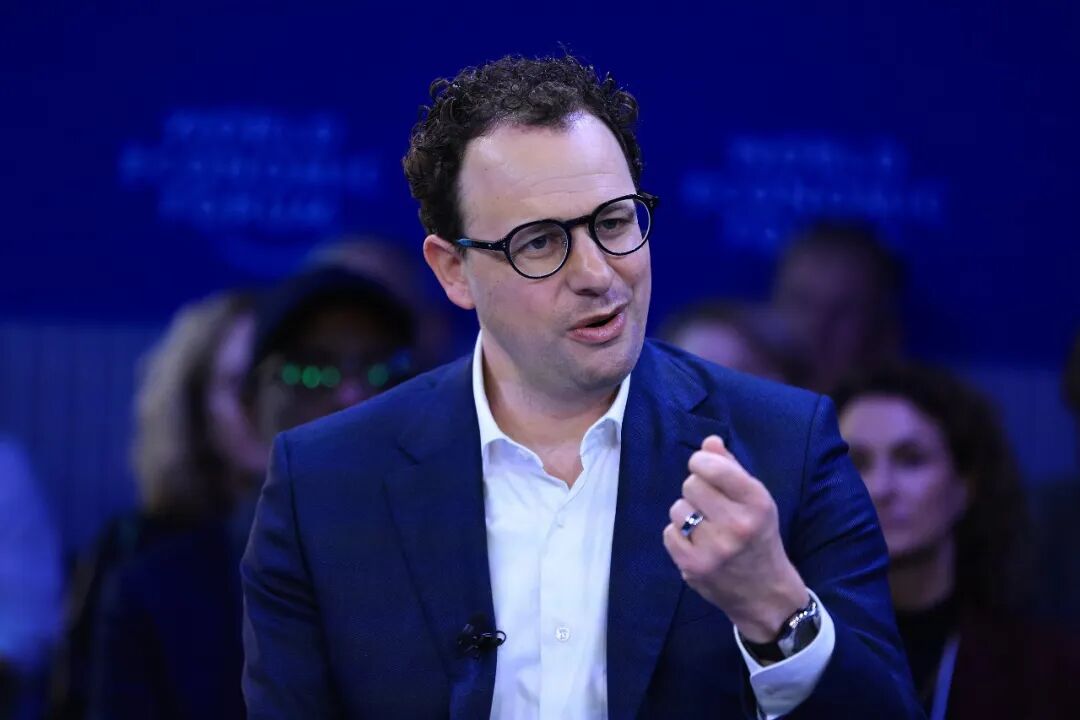
Dario contributed the most gunpowder-filled golden quotes at this year’s Davos | Photo source: Visual China
As the one directly “facing off” with the DeepMind CEO, Dario is one of the big shots with the most intense flavor of gunpowder on-site this year. But the reason why he has such a strong flavor of gunpowder is not entirely because of his unrestrained remarks, but because he was discussing the most difficult question throughout: how can society withstand a “rewrite” in a short time.
“I don’t write code anymore… I let the model write it, and I edit it.”
In addition to complaining about the change in his own work style, Dario’s flavor of gunpowder mainly comes from a “sense of contradiction”: he believes that the changes brought by AI will be very fast, but he also pessimistically believes that society can’t keep up.
“I think people are almost completely unaware of what’s about to happen and how large the scale is,” he said.
“Every three to six months, there is a polarity reversal: the media is first extremely excited about the technological capabilities, thinking that it will change everything; then after a while, they say it’s all a bubble and about to burst,” he said. “What I see is a smooth exponential curve… The pace of progress has always been very stable.”