


Tech Explained: Here’s a simplified explanation of the latest technology update around Tech Explained: Transforming Healthcare with Technology in the AI Era (Part 3) | ASUS Pressroom in Simple Termsand what it means for users..
Healthcare worldwide is at a crossroads. Aging populations, chronic disease, and a global shortage of medical professionals are straining traditional systems. Artificial Intelligence offers a transformative path forward—reshaping how care is delivered, decisions are made, and resources are optimized. In this three-part series, I explore how AI is redefining healthcare: from continuous patient monitoring, to driving systemic efficiency, to building the foundations of a smart, AI-centric medical future.
In the final article in this series, we look ahead to the future of healthcare: an AI-centric ecosystem that integrates virtual and physical realms. We discuss ASUS’s vision for smart healthcare architecture, combining digital platforms, advanced devices, and secure data systems to create a connected, patient-centric model for tomorrow’s hospitals and communities.
ASUS MH Series Clinical Displays
Building the Future of Medical Care
ASUS Chairman Jonney Shih stated at the 2024 Institute for Biotechnology and Medicine Industry (IBMI) annual meeting that, “future healthcare will be AI-centric, ultimately building a smart healthcare Cyber-Physical System (CPS) that integrates virtual and physical realms.” This declaration heralds a new era where healthcare is widely connected and transcends digital barriers.
At ASUS, we have created a three-tiered architecture to manage our healthcare portfolio: smart digital infrastructure, smart healthcare digital platforms, and smart healthcare digital applications. To achieve this, we pragmatically promote the deep integration of ICT technology with medical practice, and implement every innovative application by adhering to four principles:
- Continuous Investment in R&D and Talent Development: We actively invest in medical information systems, focusing on the research and development of imaging and physiological algorithms, mobile medical devices, and cloud-assisted AI edge computing. Our goal is to pursue technological autonomy, flexibly adapt to rapidly iterating demands, and ensure every innovation is brought to fruition.
- Adherence to Medical Certifications and Quality Systems: By establishing QMS/ISO 13485 in accordance with international medical device regulations, actively obtaining regulatory certifications from various countries, and securing certifications for our products, such as the ASUS VivoWatch, ASUS Handheld Wireless Ultrasound, and ASUS Medical Displays, we ensure our products meet clinical needs and effectively support medical practices.
- High Emphasis on Cybersecurity Standards: This covers ISO 27001 / 27701 / 27017 / 27018 certifications for cybersecurity and privacy, completing HIPAA assessments, and building medical-grade data governance and operational resilience.
- Integration of ASUS Group Resources: This includes connecting group resources such as ASUS Cloud, Taiwan AI Cloud, Taiwan Health and Bio DataBank Technology (THBC), and ONYX Healthcare alongside deep collaboration with the National Health Research Institutes (NHRI). The upshot is a comprehensive medical technology ecosystem covering everything from data and computing power to clinical application implementation.
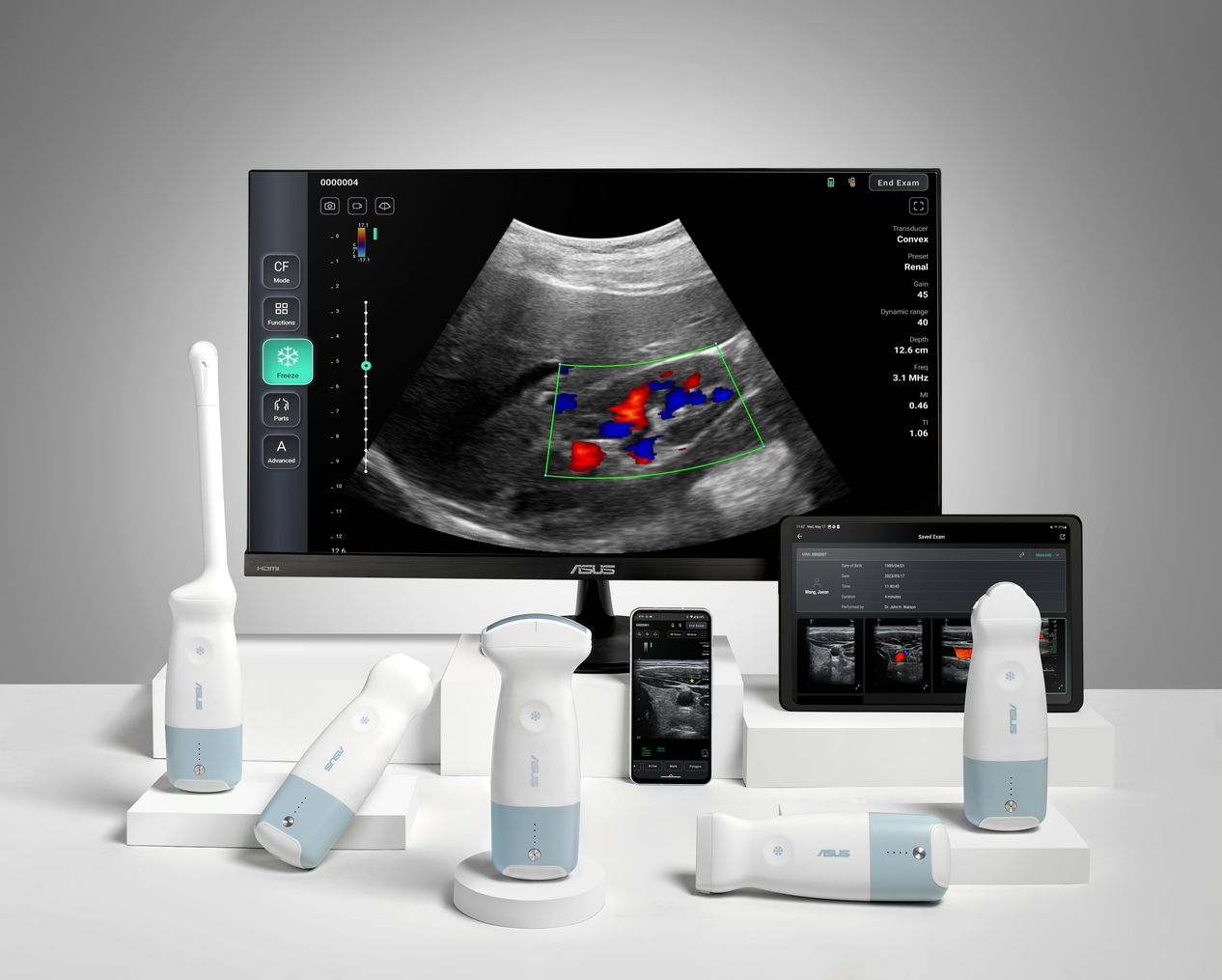
ASUS Handheld Ultrasound Solution LU800
ASUS’s smart healthcare product portfolio covers multiple domains. In medical imaging, the ASUS Handheld Wireless Ultrasound significantly enhances the mobility and accessibility of ultrasound examinations, moving traditional fixed equipment to the bedside and realizing the patient-centric vision of POCUS (Point-of-Care Ultrasound). Additionally, the long-term continuous dynamic data from the ASUS VivoWatch complements the fragmented information gathered during past clinical visits, echoing the spirit of “Continuous Monitoring of patients.” It also forms the foundation for Remote Health and Hospital-at-Home initiatives, extending healthcare resources from hospitals to homes and communities.
Furthermore, by integrating medical information systems and assisting internal hospital processes, the ASUS xHIS Next-Generation Medical Information Platform and AI-powered voice solution for nursing integrate hospital information and provide automated documentation, thus reducing administrative burdens. Likewise, the ASUS VivoWatch, Ward Monitoring and Early Warning System improve medical resource allocation by monitoring patient conditions in real-time, helping hospitals efficiently allocate personnel and medical resources. Additionally, the EndoAim Endoscopy-Assisted System enhances the efficiency of lesion detection during endoscopy through computer assistance. When it comes to personalized treatment, the ASUS VivoWatch AI Health Assistant platform and THBC Health Data Platform integrate medical records and physiological data to offer personalized medical advice.
ASUS Invites Healthcare Leaders to Explore an AI-Driven Medical Future Together
AI is comprehensively transforming the operational model of traditional medical services, from diagnosis and data analysis to personalized treatment and telehealth. It not only enhances clinical efficiency and diagnostic accuracy but also makes medical decisions more aligned with the individual needs of physicians, hospitals, and patients. It also breaks down geographical barriers by extending high-quality medical capabilities to remote areas. AI is not just a technology; it is a powerful tool for hospitals and medical teams to improve service capabilities, optimize processes, and enhance the quality of care. It is driving a faster, more precise, and smarter healthcare ecosystem, and defining an entirely new medical landscape for future hospitals and patients.
Returning to my original intention for writing this series of articles, I once again thank Dr. Lin Huan-ran for using ASUS products in his research and publishing his findings. I sincerely invite visionary and innovative physicians and medical teams to try ASUS products in their clinical work and research projects. ASUS can provide comprehensive support, from computing resources and AI model training to hardware development and software system integration. On the rapidly evolving path of smart healthcare, we look forward to walking alongside you to co-create a new future for medicine.
Transforming Healthcare with Technology in the AI Era (Part 1)
Transforming Healthcare with Technology in the AI Era (Part 2)