

Explained: This article explains the political background, key decisions, and possible outcomes related to Explained : Indian Maximalism: Art as Feminist Refusal and Its Impact and why it matters right now.
In Indian art spaces, excess is not a neutral entity. When women artists indulge in art that is visually dense, colourful and layered with multiple narratives in one frame, they are often reduced to being decorative, excessive and “too much” for the viewers to understand. These qualities are framed more as indulgent rather than as something intellectual or political.
What if that “too much” is not an artistic constraint? But a feminist refusal to stick to the traditional?
Defining Indian Maximalism in the Art Space
Maximalism is a concept that is undergoing a resurgence in the art scene. Defined by vibrance, intentional excess and deliberate accumulation, it is effectively challenging the existing restrained approach in artistic practices today by focussing on presenting multiple narratives for the viewers to engage in various ways.
Indian maximalism has recently found its voice that was lost in the minimalist art trend. Our cultural history has thrived on the ‘more is more’ philosophy. From Mughal miniature paintings to murals in metro cities like Delhi and Mumbai, from the famous kitschy truck art to Indian folk art, the concept has long existed before the Western minimalist practices found their way in Indian art and fashion.
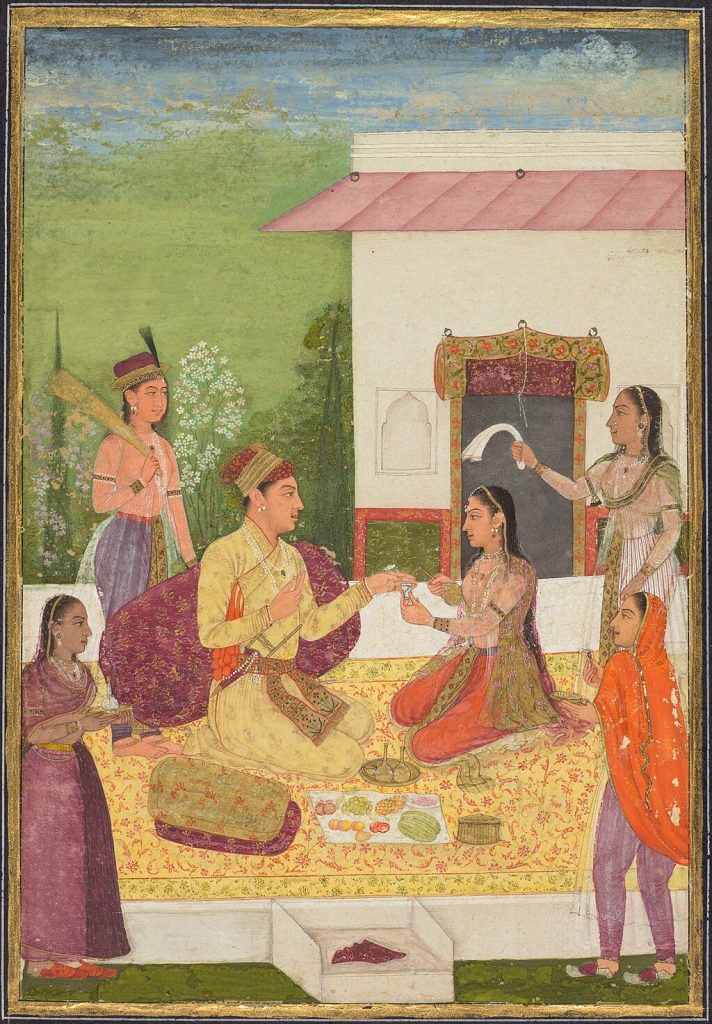
Historically, women have been the custodians and practitioners of folk and tribal art, such as Madhubani painting, Warli Art, Rangoli/Kolam, all of which incorporate the basic tenets of maximalism. Artists such as Arpita Singh, Sita Devi, Mahasundari Devi, and Nilima Sheikh have used it widely in their works to talk about complex issues and make themselves heard in the male-dominated art world.
Taste and Curation Being Political and Gendered
However, Indian galleries continue to privilege simplicity and understatement in the pieces they showcase. Muted colours and larger spaces adorn the gallery walls and are considered the epitome of artistic intellectualism. This affects the curatorial decisions dictating the collective taste of the viewers visiting the space. Artistic taste, in turn, becomes political and is also extremely gendered.
Compared to minimalism, maximalism is inherently feminine as it is associated with ornament, emotions and vibrancy, things that were often devalued in the predominantly patriarchal spaces. Therefore, it was often ignored for decades in the art spaces, despite being historically present. When women make this deliberate stylistic choice in art, their work is often admired just for its beauty, reducing its interpretation to its aesthetic choice and not for the political and intellectual weight it exhibits.
This is where curation becomes a feminist issue, where it not only decides what is shown, but also how it is interpreted.
Visual Density as Feminist Strategy
The overtly congested frames is a pre-requisite in Arpita Singh’s paintings. The New Delhi-based veteran artist uses various motifs and colours to develop multi-layered narratives blending nostalgia with social commentary. In My Lollipop City: Gemini Rising (2005), you see men in traditional black and white that are more numerous in the painting compared to the women, highlighting the dominance of men in Indian bureaucracy that further the patriarchal structures. The canvas is filled to the point of visual claustrophobia.
Her seminal work, Devi Pistol Wali (1990), depicts a woman (or in this case Devi) clad in a widow’s white saree with no speck of makeup. Two hands hold mangoes, while one holds flowers and the other her own pallu. One, in stark contrast, is holding a pistol pointing towards a man dressed in black and white. The figures are so closely intertwined that it forces the viewer to derive meaning and analyse it through the overlapping. Devi Pistol Wali, for instance, shows the looming threats an Indian woman faces through the scattered motifs all around the frame.
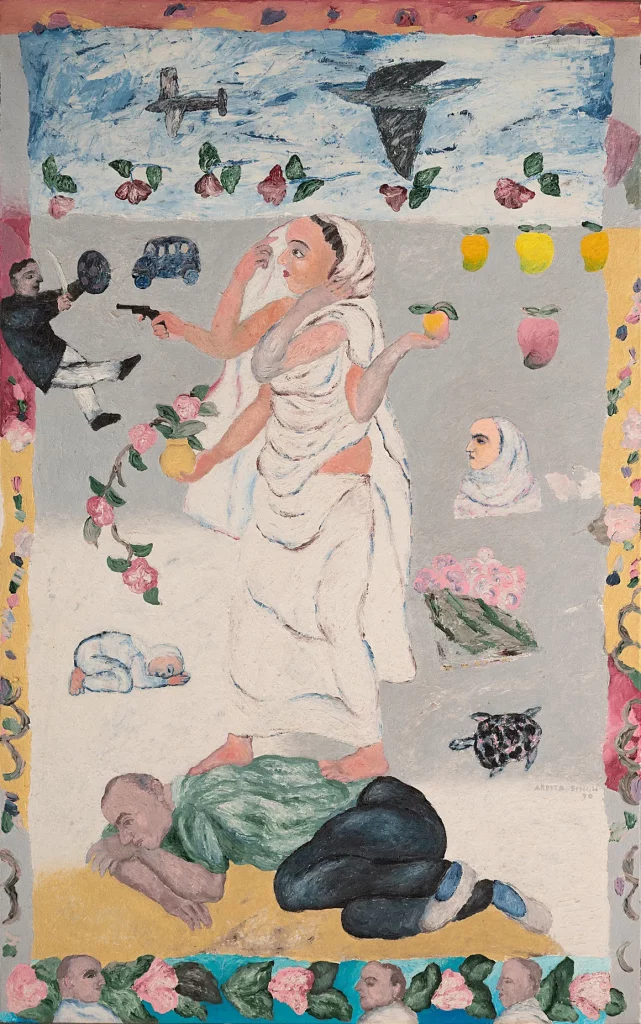
Her experience with kantha, a famous embroidery technique from West Bengal, is visible in the repetitive usage of motifs and how they are overlaid and stitched together. The canvas becomes a place where memory, political anxiety, and fantasy are held together like stitched pieces of fabric. One may reduce it to chaos and noise, but it is more than just compositional excess. It gives more visibility to the feminist roots of Kantha as a practice that is historically passed down from a mother to a daughter in a family.
Miniature Traditions and Layered Memory
Miniature painting is popularly seen as a celebration of Indian history. With its intricate storytelling across various frames in one canvas, it is often reduced to aesthetics and heritage.
Nilima Sheikh uses the same techniques, but her focus is on the sordid reality of Indian women and minorities. When Champa Grew Up is one such example. The 12-painting series chronicles the tragic story of Champa, a young girl known to Sheikh, who was forced into an arranged marriage. She became the victim of dowry death after her husband and in-laws harassed her. Each frame has repetitive motifs using natural pigments such as gum arabic, patterned borders and sequential imagery without just relying on one climactic moment for definition. She uses wasli paper, handmade paper used traditionally for miniature painting. Ornament here becomes a narrative device and not just a decorative addition. Earlier dismissed in women’s work as nostalgic, the miniature techniques are used for scathing feminist critique.
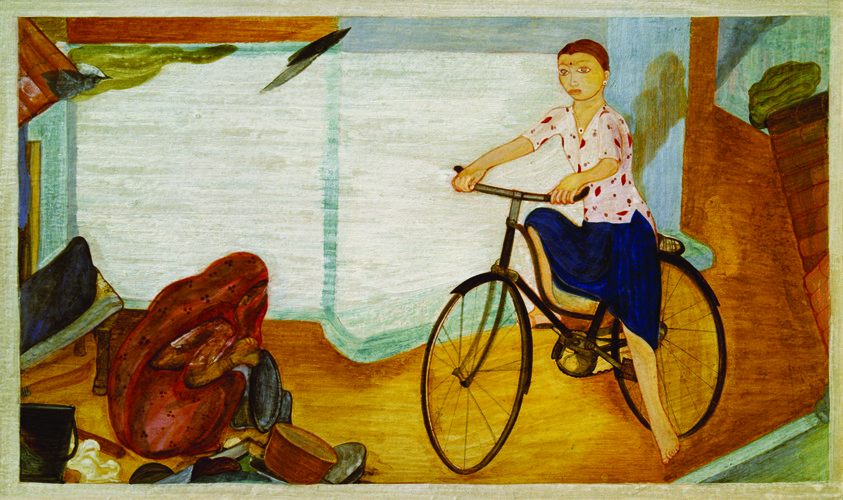
In 1997, Sheikh used Rajasthani and Pahari miniature techniques to depict the loss of identity and turmoil in the Kashmir valley in her painting series Each Night Put Kashmir In Your Dreams. She uses bright colours, sequential layering and figures to show historical violence, personal grief, exile and memory. Here, the maximalist style is not merely a spectacle but it strongly depicts the vast political trauma in intimate frames while vehemently refusing erasure.
Folk Repetition as Conceptual Rigour
Renowned artist B Prabha worked with oil to focus on the lives of rural and tribal women living in India. These paintings depict women carrying water, working in fields, selling fish and their other daily lives. Every canvas has one dominant colour in the background, with figures repeated rhythmically across the surface.
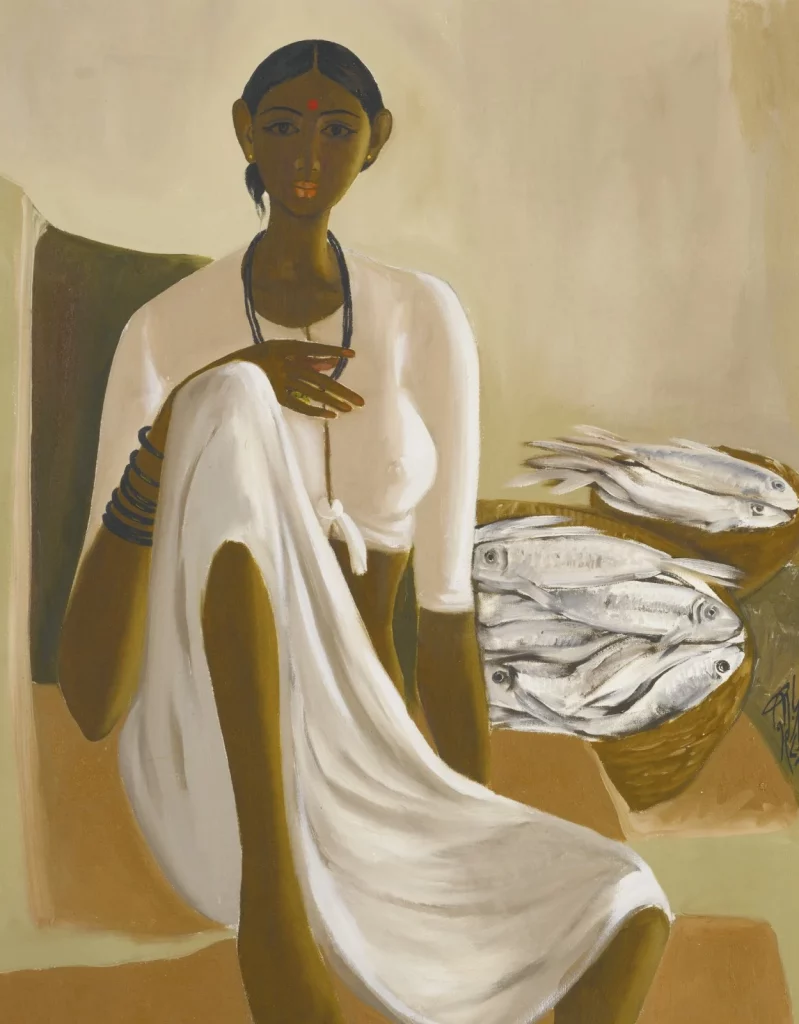
Unlike a minimalist painting, there is no negative space in any of the paintings. Meaning is built through continuity and patterns that reiterate the need to give more importance to womens’ labour than just leaving it for aesthetic consumption. At times, such work is still looked at for a decorative purpose and not so much for its critical thinking. Across paintings, installations, folk art and textiles, women’s maximalism in Indian art is not excessive spectacle, but it is a method of holding memory, political complexity and focus on their toils.
Why “Too Much” is a Feminist Question
The current socio-political environment in India continues to police women’s bodies, expressions and labour. Even taste, that now cannot be rendered apolitical. Indian maximalism practised by women cannot be categorised as an indulgence anymore. It is a direct challenge to decolonise the minimalist practices and question the patriarchal roots of the Indian art space.
The question of “too much” becomes a lazy conclusion as a viewer conveniently ignores the complexity in the art piece. Until Indian art institutions are willing to confront how gender shapes curation, taste and value, maximalism will continue to be misinterpreted, especially when a woman makes that specific stylistic choice.

Akanksha Saxena is a digital journalist based in Aligarh. She graduated from Columbia Journalism School in 2023 with a M.A in Arts and Culture reporting. She has 3+ years experience and written for publications like The Hindu, The Indian Express, The Logical Indian, Film Companion, Travel + Leisure India.