


Case Explained:This article breaks down the legal background, charges, and implications of Case Explained: Meet Charlotte’s top prosecutor – The Charlotte Ledger – Legal Perspective
Good morning! Today is Saturday, January 17, 2026. You’re reading The Charlotte Ledger’s Weekend Edition.
Need to subscribe — or upgrade your Ledger e-newsletter subscription? Details here.
Today’s Charlotte Ledger is sponsored by Carnegie Private Wealth. At Carnegie Private Wealth, we bring clarity to complexity. Through thoughtful planning and personal attention, we help you pursue opportunities and reclaim time for what matters most.

by Cristina Bolling
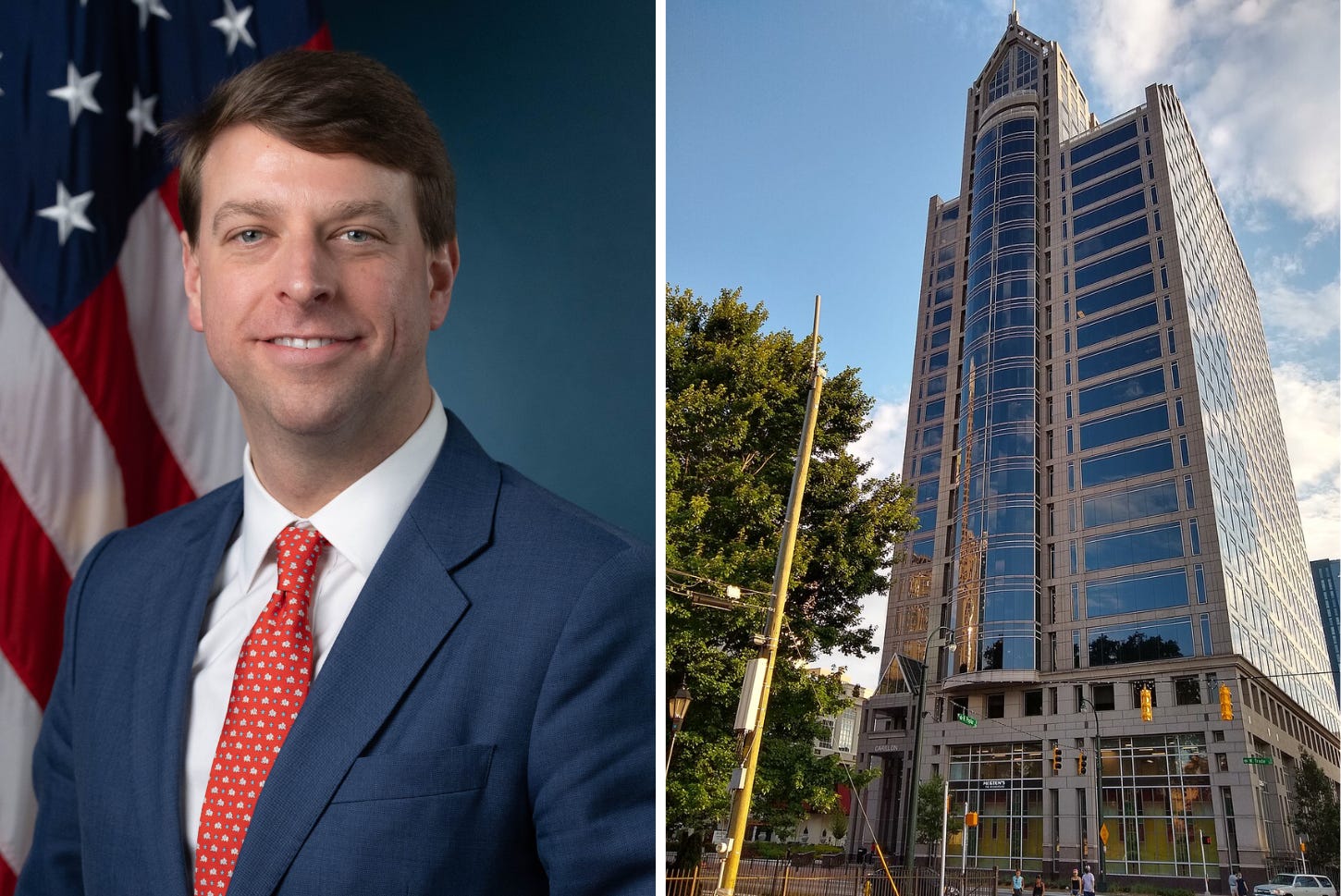
Dozens of challenge coins line the tables in Russ Ferguson’s corner office, on a high floor of the Carillon Tower uptown — shiny tokens of camaraderie exchanged among law enforcement and military peers. He now has a stack of his own to hand out, stamped with the office he leads as U.S. Attorney for the Western District of North Carolina.
From his office perch, Ferguson is about a 10-minute drive from the neighborhood where he grew up. His mother was a nurse, and his father was an entrepreneur who ran a small promotional products business.
Law wasn’t in his blood, but after graduating from Duke University, his first move was to the U.S. Department of Justice in Washington, D.C. Surrounded by lawyers, he began law school at night and soon realized the field was his calling.
After earning his degree from Georgetown University, he became a federal prosecutor in the U.S. Attorney’s Office for the District of Columbia. He later returned to Charlotte, rising to partner at the international firm of Womble Bond Dickinson.
Last March, Ferguson, 41, left the private sector for one of the nation’s top legal posts: U.S. Attorney for the Western District of North Carolina. Appointed by President Trump and confirmed by the U.S. Senate, the role is the chief federal law enforcement officer for the district, charged with prosecuting federal crimes and defending the U.S. in civil cases.
These days, Ferguson knows his work can be hard to explain. “People call me the U.S. district attorney. They call me the attorney general. No one really knows what this job is,” he says. “The most common misconception about this job is that it’s a political job. People think you’re coming in to enact some sort of political policy. And that’s not what it is at all. Ninety-nine percent of what we do has nothing to do with politics. We’re just bringing justice to the streets and taking bad guys away and working for our victims.”
Just a few months into Ferguson’s job, the intersection between the federal government and local law enforcement became a major focus of public debate, with President Donald Trump deploying the National Guard to cities including Washington, D.C., and Memphis, Tennessee. In August, the stabbing death of Ukrainian refugee Iryna Zarutska on a Charlotte light rail train amped up concerns of safety, and in an emotional news conference, a teary Ferguson said he had met with Zarutska’s family and announced that the stabbing was a federal crime.
We sat down with Ferguson to hear about his journey to U.S. Attorney, his thoughts on the state of crime-fighting in Charlotte, and his view of the role between the federal government and local law enforcement. Here’s Ferguson in his own words, edited for length and clarity:
On government careers: I was the first lawyer in my family. I grew up here in Charlotte, and I went to public school all the way through. I went to Myers Park High School, and I still keep up with everyone from there — they’re some of my lifelong friends. I came out of college and started working at the Justice Department. I was a confidential assistant in the environment division. Eventually, I went to full-time law school and went back to the Department of Justice in the U.S. Attorney’s office in D.C., prosecuting all sorts of street crimes — prostitution, assaults, drugs, whatever. I was in the courtroom every day.
What drew me to law is the power you can bring to people when you’re representing them. You take powerless people and give them power. If you think about the victims of crimes, to be able to go in front of a judge and get a resolution for them. Even in civil cases when I was in private practice, to be able to say, “OK, you’ve been wronged, we can go do something about it.” I did a lot of criminal defense work too, and to have somebody in trouble, in a system that they don’t know, don’t understand, and be able to help guide and navigate them through that — it’s just a good feeling.
I think the government’s a great place to start your career. Whenever I meet law students, I say, “Start in the government.” One, you’re not taking a pay cut, like I took to take this job, so it’s a little easier to start. And you get tremendous experience as a lawyer. In my first six months of practicing law, I tried 28 cases. There are a lot of lawyers in private practice that never get to try cases. Cases don’t go to trial a whole lot. So, early in my career, I got this incredible experience. But I always wanted to come back to Charlotte. I was in D.C. for five years and loved it, but I always wanted to come back to Charlotte.
On the Western District: I got a call in my office at the law firm one day in March (2025) from someone at DOJ. They said, “Hi, you’re being considered to be a U.S. attorney. Are you interested?” A few days later, I’m sitting in federal court, and my phone keeps buzzing. My mind’s like, “I hope my family’s OK.” There was a voicemail from the Justice Department. I called, and they said, “You’re going to be the next U.S. Attorney.”
This district is a very special district. This office has just the best trial lawyers in town. Getting to work here is an enormous honor. I love the variety. We do criminal cases, we do civil cases, we do appeals, we do stuff that has nothing to do with the law at all. I’m out in the community talking to kids about preventing crimes or talking at nursing homes about preventing scams and all sorts of things. It’s a lot of fun for that reason. I used to work so hard to make one tiny change. And now, in this job, you can change so much with one phone call.
I had a lifelong criminal defense attorney tell me the other day that he sees clients all the time who kind of shrug off the thought of their [prison] sentence. But he said when they hear their case is going federal, they go white. Because we have real judges that consider these cases that hold people and give real sentences, and those sentences mean you’re going to serve that time. You’re not going to get out for overcrowding or for any of the other reasons you maybe do in state court. And so just having people out there know their cases could go federal, it’s a deterrent.
I don’t think the federal government needs to be in local communities all the time. I think states are doing great. Local governments are doing great. Local police departments are doing great. I think out of (the “defund the police” movement) there came some cities that totally backed off protecting their citizens. And I do think, whatever those citizens felt about that movement, they need to feel safe when they go to sleep at night, and someone needs to step in and protect those people. It’s gotten a little political, but it really comes down to basic safety. People in America should go to sleep feeling like they will wake up the next morning without a bullet in their head. And whatever it takes to get there, we should do. If that means bolstering our states, bolstering our locals, great. If it means bringing in the federal government, then I think we should do it.
On criminal sentences: No one likes putting people in jail. Talk to any judge. The worst part about their job is sending people to jail. But as one of our people put it to me the other day, there are people that we have to (jail) because we can’t have them out here. I think that if Charlotte has gotten anything wrong, I think it’s being a little too compassionate for people who maybe don’t deserve our compassion.
Since January (2025), violent crime is down here, so I think things are going in the right direction. But if you take a violent crime like the light rail case [the August murder of Iryna Zarutska on a Charlotte light rail train] as an example, I do think there are shortcomings. (Decarlos Brown Jr., who has been charged with Zarutska’s murder) was a person who had committed 14 crimes, and he was sitting on the train. If he had committed one federal crime, he would not be sitting on that train. And so that doesn’t mean the federal government’s coming in to do a better job than the state government. It means we’re going to use our tools to supplement the state government processes and put the worst of the worst behind bars. That’s really what we do. We take the worst of the worst and the repeat offenders and the people that keep getting out, and make sure they are in a place where they can’t do any harm.
In Charlotte, it is particularly important because we’re trying to recruit businesses here. We’re trying to grow our city, we’re trying to get jobs, we’re trying to get high-paying jobs. Cities come to places that have good schools and that are safe. And if we lose those things, they will not come here.
I think a lot of it is gang-related, and I think if we take down the gangs and stop the recruitment of our young people by gangs, that will absolutely make a difference. And I think we’re seeing it make a difference. A lot of it is the same people over and over again. And that’s part of the problem in state court. They have this backlog because they charge someone, they get out, they commit another crime, they’ve got to charge them again. So they have two crimes for every one person. Whereas if we get some of the really bad guys put away, not influencing other people, not recruiting young people, I think we can make a huge dent in the crime problem. And I’m super-motivated to do it.
Cristina Bolling is the former managing editor of The Ledger. Reach her at cristinabolling.writes@gmail.com.
Today’s supporting sponsor is Carnegie Private Wealth. At Carnegie Private Wealth, we bring clarity to complexity. Through thoughtful planning and personal attention, we help you pursue opportunities and reclaim time for what matters most.

The Ledger’s Lindsey Banks, Ashley Fahey and Tony Mecia discussed the week’s news and some of the stories you’ve seen in The Ledger this week — including the planned redevelopment of the Manor Theatre site in Eastover, workplace trends in 2026, Elon University’s plans for a law school, the future of LendingTree in Charlotte and more!
Check it out! Or listen to it as a podcast on The Charlotte Ledger Podcast!
On Saturdays, The Ledger sifts through the local news of the week and links to the top articles — even if they appeared somewhere else. We’ll help you get caught up. That’s what Saturdays are for.
-
A new law school announced: (Ledger) Elon University plans to launch a full-time law school at Queens University of Charlotte by fall 2027, enrolling an initial class of 75 students and expanding over time.
-
CMS buildings opening in 2026: (Charlotte Observer, subscriber-only) Five Charlotte-Mecklenburg Schools construction projects are scheduled to be completed by August 2026, as part of the district’s voter-approved $2.5B school bond. The projects are among 30 renovations and new builds funded by the 2023 referendum.
-
Petition to remove McFadden dismissed: (WCNC) A Mecklenburg County judge on Thursday dismissed a petition filed by Rep. Carla Cunningham and four former Sheriff’s Office employees seeking to remove Sheriff Garry McFadden over alleged misconduct.
-
City backs new transit authority: (WFAE) Charlotte City Council voted unanimously to spend $4.3M to help launch the Metropolitan Public Transportation Authority. The money will cover consultants, legal services and basic administrative costs as Charlotte Area Transit System employees, buses and trains transition to the new authority later this year.
-
Manor Theatre site redevelopment planned: (Ledger) Developers are proposing a mixed-use project called “The Manor” at the former Regal Manor Twin movie theater on Providence Road.
-
Airport raises parking prices: (Press Release) Charlotte Douglas International Airport announced Thursday it’s increasing daily maximum parking rates across most decks and lots starting March 1.
-
Monks’ 2,300-mile peace walk reaches Charlotte: (WSOC) A group of Buddhist monks walking from Fort Worth to Washington, D.C., arrived in south Charlotte on Wednesday evening after passing through Rock Hill and Pineville. The next leg of their journey will take them to Greensboro.
-
Historic status could alter I-77 plans: (Ledger) Two historically Black west Charlotte neighborhoods are seeking national historic designation, a move that could force added federal review and potential changes to NCDOT’s $3.2B I-77 express lanes project if approved before plans are finalized.
-
Sycamore co-founder files for divorce after arrest: (Ledger) Sarah Taylor, co-founder of Sycamore Brewing, filed for divorce from husband Justin Brigham, saying she separated immediately after his December arrest on sex-crime charges and accusing him in court filings of illicit sexual behavior and hiding or squandering assets.
-
Luxury retail shakeup at SouthPark: (Ledger) British fashion house Alexander McQueen has quietly closed its SouthPark Mall store, and the Chanel boutique inside Neiman Marcus also appears to have shuttered, according to mall listings. The changes come as Neiman Marcus parent Saks Global files for bankruptcy, raising questions about the future of luxury retail at the mall.
-
Tepper execs depart unexpectedly: (Charlotte Business Journal, subscriber-only) Tepper Sports & Entertainment’s chief venues officer and general counsel recently left the organization. A company spokesperson did not provide details on exact departure dates or the reason for the departures, but said Tepper Sports plans to fill both vacancies.
-
New NFL power couple with Charlotte roots: (Ledger) Patriots quarterback Drake Maye is heading into the playoffs as his wife, Ann Michael Maye, gains national attention for her popular baking TikToks and media appearances.
-
Sports betting tops $7B across NC in 2025: (WRAL) North Carolina bettors wagered more than $7B through legal online sportsbooks in 2025, the first full calendar year since sports betting launched in the state. The state collected more than $132M in taxes from licensed operators in 2025.
Monday
Wednesday ()
-
The 2026 workforce: Less labor, more automation. Plus: Elon announces Charlotte law school; What to know about measles; Review of ‘Renaissance’ Mint exhibit; New England royalty’s local roots; City backs transit authority; Buddhist Monks on the way
Friday ()
Ways of Life ()
Toppman on the Arts
-
A quiet, patient kind of rebellion: “Renaissance, Romanticism and Rebellion” runs through Feb. 22 at the Mint Museum Uptown, 500 S. Tryon St.
Real Estate Whispers
Fútbol Friday
Need to sign up for this e-newsletter? We offer a free version, as well as paid memberships for full access to all 6 of our local newsletters:
The Charlotte Ledger is a locally owned media company that delivers smart and essential news. We strive for fairness and accuracy and will correct all known errors. The content reflects the independent editorial judgment of The Charlotte Ledger. Any advertising, paid marketing or sponsored content will be clearly labeled.
About The Ledger • Our Team • Website
Newsletters • Podcast • Newcomer Guide • A Better You email series
Subscribe • Sponsor • Events Board • Merch Store • Manage Your Account
Follow us on Facebook, Instagram, X/Twitter, LinkedIn