

Breaking Update: Here’s a clear explanation of the latest developments related to Breaking News:A new study reveals the star formation activities triggered around an expanding molecular bubble– What Just Happened and why it matters right now.
Large-scale infrared (IR) surveys have revealed some of the most eye-catching structures in giant clouds of gas and dust called IR ‘bubbles’. These bubbles which look like shells or arcs, are formed when expanding H II regions powered by the strong radiation and winds from massive stars (8 times the Sun’s mass or more), interact with the surrounding molecular material, leading to the formation of photo-dissociation regions (PDRs).
As the bubble grows, it can induce massive star formation along their peripheries, as the neutral gas is compressed, potentially becoming gravitationally unstable and fragmenting into dense cores, which leads to generation of new massive stars. Therefore, Studying IR bubbles helps scientists understand how massive stars shape their environments and how their feedback can lead to the formation of even more stars.
Astronomers at Aryabhatta Research Institute of Observational Sciences (ARIES) Nainital, an autonomous institute under the Department of Science & Technology (DST), Government of India, along with their collaborators from Physical Research Laboratory, Ahmedabad; S. N. Bose National Centre for Basic Sciences, Kolkata; Tata Institute of Fundamental Research, Mumbai; and National Astronomical Research Institute of Thailand, Thailand studied a mid-infrared bubble called [HKS2019] E71 (or simply E71), located about 1.81 kiloparsecs away. To investigate it, they used observations from the 3.6 m Devasthal Optical Telescope (DOT) and the 1.3 m Devasthal Fast Optical Telescope (DFOT) in Nainital, India, as well as data from the upgraded Giant Metrewave Radio Telescope (uGMRT) near Pune, India. They also included additional data from several archival multi-wavelength surveys.
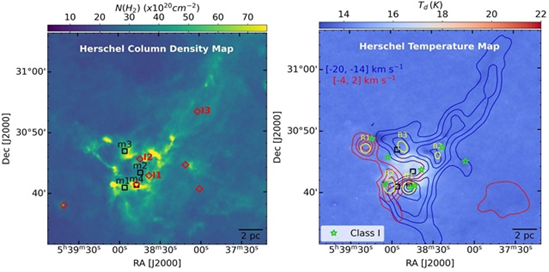
Fig: Left panel: Herschel column density map showing the large-scale view (35′ × 35′ ) of the E71 bubble, overlaid with the locations of IRAS sources (red diamonds). Right panel: Herschel dust temperature map overlaid with the locations of Class I YSOs, and blue and red contours representing 12CO integrated intensity in the velocity ranges [−20, −14] km s−1 and [−4, 2] km s−1, respectively. The lowest contour levels correspond to emission above the 5σ threshold, where σ is the rms noise. This map is also overlaid with the molecular condensations, marked with yellow circles/ellipses. The locations of candidate massive stars ‘m1, m2, m3, and m4’ are marked with black squares in both panels.
The study shows that the E71 bubble lies along the edge of a long, thread-like cloud structure. This is seen clearly in Herschel far-infrared images, a column density map (left panel of Figure 1), and molecular gas maps in the velocity range −20 to −14 km/s. The bubble also hosts a stellar cluster (about 1.26 pc in radius and located at a distance of 1.81 ± 0.15 kpc). This cluster is linked to radio continuum emission and includes a centrally positioned B1.5-type massive star, along with an enhanced population of evolved low-mass stars and young stellar objects.
The study also reveals a PDR surrounding the central B1.5-type star. This PDR forms an arc-shaped structure along the edges of the E71 bubble and shows higher dust temperatures. Along this arc, the researchers identified regularly spaced clumps of gas and dust (shown with yellow circles/ellipses in Figure 1). The molecular gas gathered around the outer edge of the E71 bubble also appears to be expanding.
Near-infrared spectroscopic observations with the TANSPEC instrument of 3.6 m DOT confirm the presence of the ongoing accretion in a massive young stellar object (MYSO, hereafter ‘m4’) located near the edge of the bubble. High-resolution uGMRT radio continuum maps also reveal detailed substructures in the ionized gas, both around the MYSO ‘m4’ and at the center of the E71 bubble.
These results suggest that the B1.5-type massive star has created the bubble’s arc-shaped structure through its radiation and stellar winds. The pressure from this massive star, along with the velocity patterns seen in the 12CO and 13CO(1–0) molecular gas, indicates that its feedback has likely pushed away the surrounding material and helped form the expanding E71 bubble. Overall, the study concludes that the “collect and collapse” process might be a possible mechanism that can describe the ongoing star formation activities around the E71 bubble.
This study will help clarify the role of the “collect and collapse” process around Galactic MIR bubbles and reveal how massive stars reshape their surrounding medium and trigger the formation of new stellar generations. Combining the morphology, kinematics, and physical conditions of the swept-up shells, it will allow to test whether feedback-driven triggering is active and efficient in these regions. Ultimately, this work will contribute to a deeper understanding of how massive-star feedback regulates star formation and influences the large-scale evolution of the Galactic interstellar medium.
For more details contact: Aayushi Verma (aayushiverma[at]aries[dot]res[dot]in).