


Lifestyle Trend:Discover lifestyle trends, travel ideas, and practical tips related to Lifestyle Trend: It’s a new era for lifestyle pioneer W Hotels: Travel Weekly You Should Know – You Should Know
NEW YORK — Walking into the newly renovated W New York — Union Square, it’s hard to know where to look first. Just past the entrance, the walls showcase murals by Shantell Martin, featuring her signature black marker drawings of abstract faces and scattered letters against a white backdrop.
Straight ahead, a curved staircase sweeps upward, wrapped in carpeting that appears to ripple down the steps in swirls of orange, cream and rust. Florals cascade from above, while glass-block walls glow with backlighting behind the welcome desks.
It’s a maximalist and multilayered aesthetic, and a far cry from what the hotel looked like when it opened in 2000. The 256-room hotel’s transformation is the result of a $100 million, four-year renovation following Marriott International’s purchase of the property in 2019.
It’s also reflective of the lifestyle brand’s efforts to re-establish its relevance as part of an ongoing, multiyear brand refresh.
“A lot of W hotels are changing their look, and they’re being redesigned to match the new ethos of the brand, said Sohrab Parakh, director of marketing at the Union Square W, during a tour of the property.
Originally developed by Starwood Hotels & Resorts, the W brand emerged as a lifestyle hospitality pioneer with its first hotel, the W New York in Manhattan’s Midtown East neighborhood, in 1998. The concept became known for its modern design elements and lively bar scene as well as playful touches like room categories labeled Cozy, Wonderful or Fabulous and culminating in an Extreme WOW Suite.
A new rooftop venue at the W New York — Union Square is expected to open later this fall. Photo Credit: W New York — Union Square
The brand joined Marriott’s portfolio in 2016 via Marriott’s Starwood acquisition, and today, W has more than 70 properties globally. With the original W New York reflagged in 2018, the Union Square hotel is now the oldest W in its system.
According to George Fleck, senior vice president and global brand leader for W Hotels, the Union Square hotel has been deemed a global flagship, serving as a “blueprint that inspires and informs what W Hotels looks like moving forward.” Fleck said the brand expects more than 80% of its portfolio to meet W Hotels’ refreshed standards by 2028.
Rockwell Group, which designed the original W New York — Union Square, led the renovation, drawing inspiration from Union Square Park and its surroundings.
During our tour, Parakh pointed out design details like light fixtures modeled after subway entrance lamps and side tables with chessboard patterns, which are a nod to the park’s chess players. In the bathroom, faucet handles are a bright taxicab yellow.
Among the hotel’s other upgrades are an indoor-outdoor rooftop bar, which is set to debut later this fall, and a reimagined Living Room lobby venue.
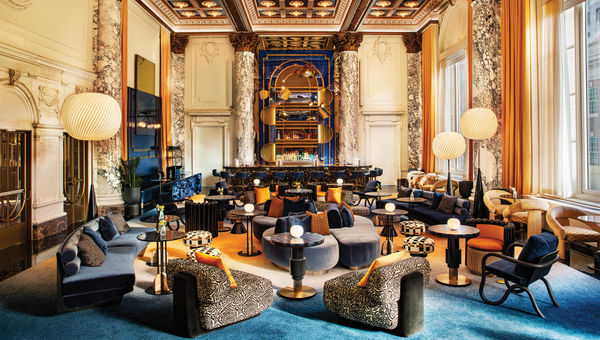
The reimagined Living Room at the W New York — Union Square. Photo Credit: W Hotels
Up the curved staircase from the entrance, the Living Room occupies what was once a private event space. Now, the airy, ballroom-like area is open to guests and locals as a lounge and bar, with Parakh aiming to position it as a “cultural club” featuring everything from slam poetry events and album listening parties to game nights. (An adjacent Living Room Cafe serves coffee by day and transitions into another bar space at night.)
On the ground floor, Seahorse, a seafood-focused brasserie, has opened with its own entrance on Park Avenue South.
“These venues are designed for locals; our goal is to attract the neighborhood,” said Parakh, adding that the hotel hopes to move away from New York’s increasingly exclusive hospitality and nightlife scene. “New York has kind of [shifted] away from being more about community, and I think we need to get that back.”
This ethos of approachability extends to the hotel’s room categories. Gone are monikers like Fabulous and Wonderful, which have been replaced by straightforward descriptors — Standard Guest Room, 1 King — that guests can more easily understand.
“We’re not trying so hard to be cool anymore,” Parakh said.
Recapturing the cool factor
But as the lifestyle category nears middle age, early players like W may indeed need to try to maintain, or in some cases regain, their cool factor.
“These lifestyle brands started becoming popular when people were tired of more standardized and cookie-cutter experiences,” said Makarand Mody, associate professor of hospitality marketing at Boston University’s School of Hospitality Administration, Mody added that W “really established its reputation as the party brand” of the lifestyle space.
The category, however, has become far more crowded over the past few decades. Early entrants like W, IHG’s Kimpton and Ace Hotel now compete with a flood of lifestyle offerings launched after 2000, like Hyatt’s Andaz, Hilton’s Tempo and Canopy, and Ennismore’s Hoxton.
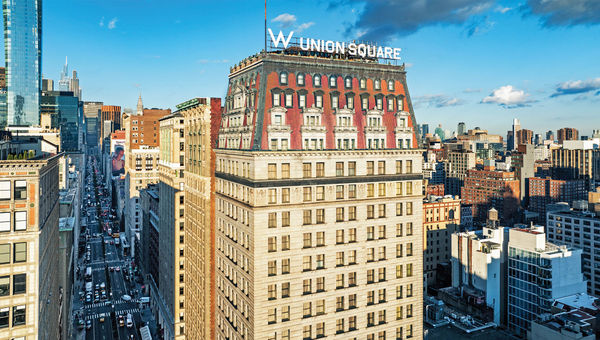
W Hotels considers the redesigned W New York — Union Square a flagship hotel for the refreshed lifestyle brand. Photo Credit: W New York — Union Square
“W and other brands, like Edition, have become almost legacy brands now,” said Bjorn Hanson, an industry consultant and adjunct professor at New York University’s Tisch Center of Hospitality. “Their degree of uniqueness isn’t what it once was.”
Part of the problem, according to both Mody and Hanson, is replicability. As other brands have jumped into the lifestyle category, “lifestyle became a bit of a buzzword for anything that’s non-standardized,” Mody said. “The model is not that hard to copy.”
The solution, said Mody, is specificity, particularly as it relates to experiences.
“You can’t sort of be in this generic lifestyle boat anymore,” he said, adding that travelers across generations seek “experience over excess.”
W appears to be betting on this approach. According to Fleck, the brand has focused on offering more “evolved” programming, like expanding its W Presents live music series that brings DJs and musicians to properties worldwide, and reimagining its W Insider role “to be more like a cultural guide than a concierge.”
“Today’s traveler expects more than just a stylish room and a buzzing lobby bar,” Fleck said. “Next-generation travelers value experiences over possessions, community over exclusivity and purpose over formality.”